
You can have a lawn that looks thick, green and “done” - the kind that makes an established garden feel like it finally has its centrepiece - and still be sitting on a quiet problem. Professionals don’t start by admiring the colour. They start by asking what the grass is anchored into, and whether it’s actually connected to the soil below.
Because an “established” lawn isn’t a look. It’s a relationship: roots, moisture, air, and the bit of ground you rarely think about until it fails.
The first check isn’t the blades. It’s the roots.
Most people judge a lawn like they judge hair: density, shine, absence of gaps. But turf can stay presentable while the root system is shallow, stressed, or trapped in a thin layer of good compost sitting on top of something far less friendly.
That’s why the first thing many pros do is a simple lift test. Not because they like pulling at your hard work, but because the fastest way to tell whether a lawn is established is to see how easily it lets go.
The tug-and-lift test (yes, really)
Pick a spot that’s “representative” - not the obvious bare patch and not the lush bit by the border that gets all the run-off. Grab a small handful of grass and tug upwards firmly.
- If it resists and you feel the soil move with it, that’s a good sign.
- If the grass lifts like a poorly stuck carpet, you’ve got shallow rooting or poor soil contact.
- If it comes up in a thin mat with very little soil attached, think: roots living in the thatch layer rather than in the ground.
It can be mildly unsettling the first time you do it. You’ll suddenly realise how much of your confidence was based on appearances.
The “established lawn” myth: green can be fragile
A lawn can look established for a whole season off the back of regular watering and feeding. That doesn’t mean it can cope when you stop.
The tell-tale sign is how quickly it sulks under pressure: a hot week, a couple of missed waterings, a kids’ football match, the dog doing the same lap every morning. If the grass collapses fast, it often means the roots never went deep enough to buffer it.
Professionals are essentially asking: if I remove the comforts, will this lawn still behave like it belongs here?
What they look for under the surface (the bit you don’t Instagram)
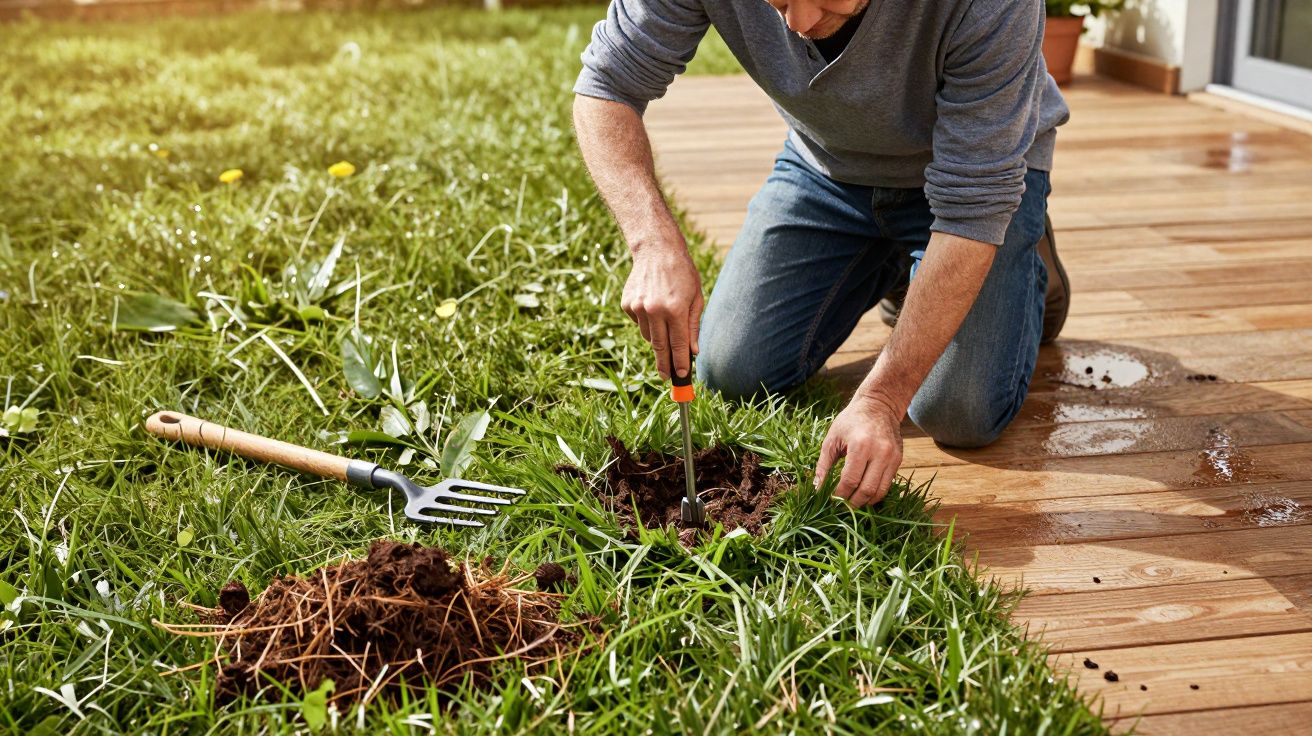
Once the lift test raises suspicion, the next check is what’s going on in the top few centimetres. You don’t need a lab. You need a trowel, a bit of honesty, and decent light.
1) Soil contact: did the turf or seed actually knit in?
For newly laid turf, poor contact is common. A few high spots, a bit of air trapped underneath, or soil that dried before it could bond, and the roots stay lazy.
Clues include: - turf edges that never fully disappear, - a “drummy” feel when you walk across it, - grass that looks fine until the first dry spell, then browns in sheets.
2) Compaction: is the ground too hard for roots to enter?
In a busy established garden, lawns get compacted quietly: foot traffic, wheelbarrows, kids’ play, even repeated mowing when the soil is damp. The surface can still grow grass, but roots struggle to push down, so they stay near the top - where drought and heat hit first.
A simple sign: you struggle to push a screwdriver into the ground. If it takes real force, roots are having the same argument.
3) Thatch: the cosy layer that becomes a trap
A little thatch is normal. Too much becomes a spongey barrier where roots linger because it’s warmer and easier than the soil underneath. The lawn then becomes dependent on frequent watering because thatch dries quickly.
If you peel back the grass and see a brown, fibrous layer more than about 1cm thick, take note. It doesn’t mean panic. It means your “established” lawn may be established in the wrong layer.
The professional tell: how your lawn behaves after stress
There’s a reason the best lawn advice often sounds boring. It’s because real establishment shows up in recovery, not in the perfect week.
Pros watch for: - Footprints that linger after you walk over it (slow rebound can mean stress or shallow roots). - Colour that fades unevenly in dry weather (often linked to compaction or patchy soil contact). - Moss returning fast after you “sorted it” last year (usually shade, compaction, or damp conditions winning again).
None of these mean you’ve failed. They mean the lawn is telling the truth.
If your lawn fails the first check, do this (in the calmest order)
You don’t fix shallow roots with more feed. That’s the trap. You fix it by making it easier for roots to go down, and slightly harder for the grass to coast at the surface.
- Water less often, but more deeply (when conditions allow). Frequent light watering trains roots to stay shallow.
- Aerate compacted areas with a fork or hollow-tine aerator, especially on paths people naturally take.
- Top-dress lightly with a suitable mix (often sand/loam-based) to improve surface structure and help knit minor unevenness.
- Scarify only if thatch is genuinely an issue, and do it at the right time of year so the lawn can recover.
- Mow a touch higher during stress. Scalping is a root-growth killer disguised as neatness.
A good lawn routine isn’t about doing more. It’s about doing the few things that change what happens underground.
The quiet goal: a lawn that doesn’t need you every week
In an established garden, the lawn often becomes the thing you want to think about least. Not because you don’t care, but because you want it to just… hold.
That’s why professionals check establishment first. A lawn that’s truly rooted into the soil - not perched on top of it - is the one that survives your holidays, your hosepipe ban, your busy month, your distracted summer. The look follows the biology, not the other way round.
The quick “pro checklist” you can steal
- Can I tug it without it lifting?
- Can I push a screwdriver into the soil without wrestling?
- Is there a thick thatch layer under the green?
- Does it recover quickly after foot traffic and dry weather?
If you can answer those honestly, you’ll know more about your lawn than most people who fertilise twice a year and hope for the best.
FAQ:
- How long does it take for a lawn to become established? It varies by season and soil, but think in terms of months, not weeks. Turf can look “done” quickly while roots are still shallow.
- Should I feed a lawn that’s lifting easily? Feeding can green it up, but it won’t solve poor soil contact or compaction. Fix the root environment first, then feed if needed.
- Is aeration worth doing if my lawn looks fine? Often yes, especially in high-traffic areas. A lawn can look great and still be compacted underneath.
- Will scarifying always help an established lawn? Only if thatch is actually excessive. Scarifying a thin lawn at the wrong time can set it back.





Comments (0)
No comments yet. Be the first to comment!
Leave a Comment