You mow the lawn because it’s part of living with a garden: a quick reset that makes the place look cared for. Yet lawn maintenance is one of those routines where doing it “regularly” can still produce a tired, thin patch of green that never quite improves. The surprise is that gardeners aren’t judging your effort - they’re looking at your timing, your height, and what you do straight after.
Most people mow by calendar or mood: Friday afternoon, before visitors, whenever it looks a bit long. Grass doesn’t grow by your diary. It responds to stress, temperature, and how much leaf you leave behind to feed the roots.
The neatest lawns aren’t cut short - they’re cut smart
A lawn is essentially a solar panel. The blades capture light, convert it into energy, and send it down to build roots and store reserves. When you scalp it, you remove the plant’s ability to feed itself right when it needs it most.
Cut too low often, and you don’t just “tidy” the top - you train the lawn to live on a smaller battery.
The classic mistake isn’t forgetting to mow. It’s mowing like the lawn is a carpet, not a living plant.
The height rule most people break
Many gardeners follow a simple guideline: never remove more than a third of the leaf in one go. That rule stops the lawn from going into shock, which is when it turns pale, slows down, and opens gaps for moss and weeds.
If your lawn regularly looks amazing for 48 hours then dull for a week, you’re probably cutting too much at once.
The weekend pattern that quietly stresses your grass
There’s a common routine: leave it all week, then take it down hard on Saturday. It feels efficient, but grass experiences it as a repeated injury.
Long grass shades the lower stems, so when you suddenly cut it short, you expose soft, pale growth to sun and wind. The plant has to rebuild leaf area quickly, pulling energy from its roots. Do that enough times and you’ll see the signs: weak density, more clover, edges that scorch first in heat.
What “regularly” should mean instead
Regular mowing is less about a fixed day and more about matching growth. In spring that might mean twice a week; in midsummer during dry spells it might mean every 10–14 days, and higher.
A practical approach:
- In fast growth (mild, wet weeks), mow little and often.
- In slow growth (heat, drought, cold snaps), mow less and raise the height.
- If you’ve missed a cut, step down over two or three mows rather than one big chop.
A sharper cut changes the lawn more than you think
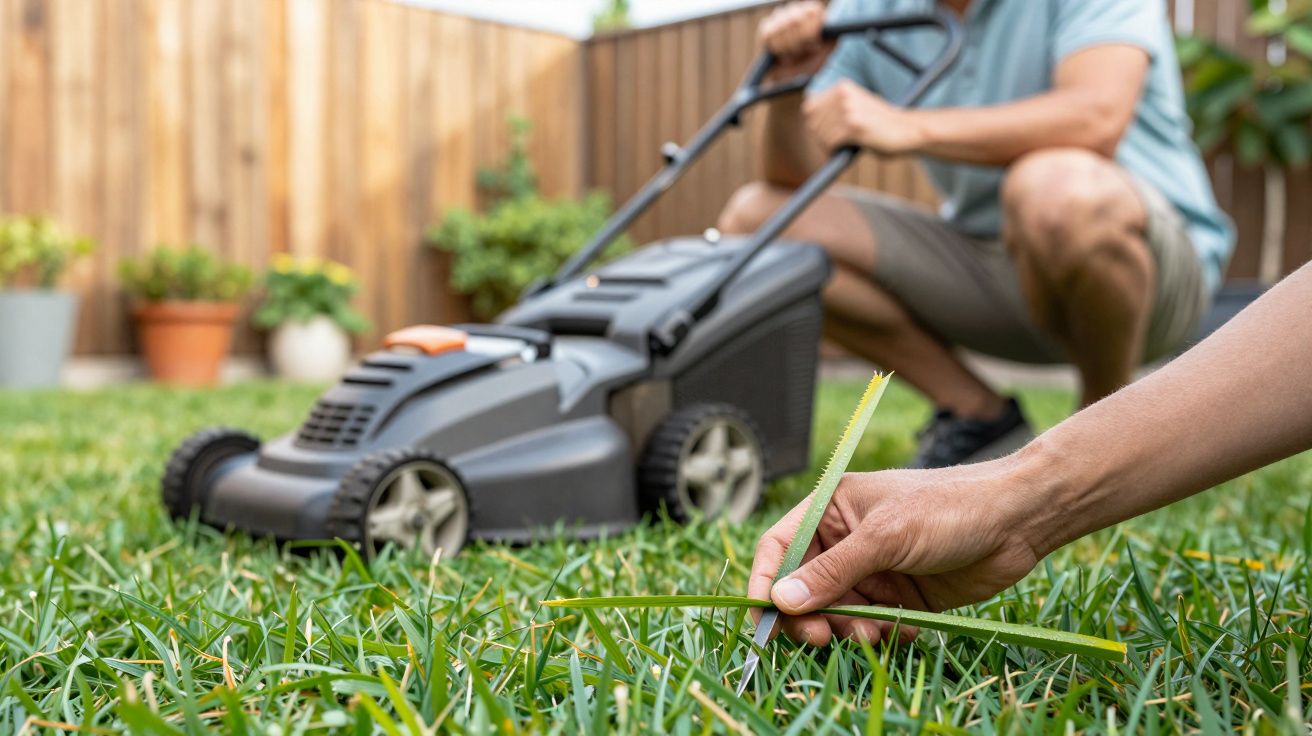
Blunt mower blades tear grass rather than slicing it. The tips dry out, go straw-coloured, and the lawn takes on a grey-green haze even when it’s well-watered. Those torn tips also create more entry points for disease.
You can spot it easily: after mowing, look closely at the ends of the blades. Clean cuts look straight; torn cuts look frayed.
The maintenance nobody schedules (but should)
You don’t need to be obsessive, but you do need a rhythm:
- Sharpen blades a couple of times per season (more if you mow large areas).
- Clear the deck so wet clippings don’t clog airflow and shred grass.
- Avoid mowing when the lawn is soggy; wheels compact soil and leave ruts that linger.
Clippings: the “mess” that can feed your lawn
A lot of people collect clippings to keep the surface pristine. That can be useful if the grass is long, wet, or full of seed heads. But in normal mowing, clippings are free nitrogen and organic matter.
Leaving fine clippings on the lawn (mulching) can reduce how much feeding you need, and it helps the soil hold moisture.
The catch is technique: mulching works when you mow frequently enough that clippings are short. If you cut long grass and leave thick rows behind, you’ll smother patches and invite fungus.
The hidden problems mowing can’t fix (but mowing reveals)
If you mow correctly and the lawn still looks thin, the issue often sits underneath: compaction, poor drainage, shade, or hungry soil. Mowing then becomes the moment you notice the symptom, not the cause.
A few quick tells:
- Moss returns fast: often shade, compaction, or consistently wet soil.
- Weeds dominate: often low mowing height and bare gaps.
- Dry patches appear first on ridges: often shallow soil or thatch blocking water.
A simple seasonal reset that fits real life
You don’t need a full renovation. One small intervention each season usually beats one big heroic weekend.
- Spring: raise mowing height slightly until growth is steady; feed if needed.
- Summer: mow higher, and don’t chase a “bowling green” look during drought.
- Autumn: scarify lightly or rake out debris, then overseed thin areas.
- Winter: avoid mowing unless growth demands it, and keep foot traffic light when wet.
A better mowing routine in three settings
Different lawns need different “normal”.
Sunny, hard-used family lawn
Keep it a touch higher for resilience, and mow often enough that you’re trimming, not correcting.
Shady lawn under trees
Mow higher, accept slower growth, and prioritise aeration and leaf removal. Cutting low in shade usually just hands the ground to moss.
New or recently overseeded lawn
Start mowing when it reaches roughly 7–8 cm, and take the top off gently. Early scalping is one of the quickest ways to undo establishment.
The quieter mindset shift: stop mowing for the day after
A lot of lawn maintenance is driven by how it looks right after mowing. Gardeners think about how it looks ten days later. The goal isn’t the shortest possible grass; it’s the densest, healthiest turf that can outcompete weeds and handle stress.
Mow like you’re building a lawn, not just trimming one. The difference is a few millimetres of height, a sharper blade, and a routine that follows growth instead of the weekend.





Comments (0)
No comments yet. Be the first to comment!
Leave a Comment