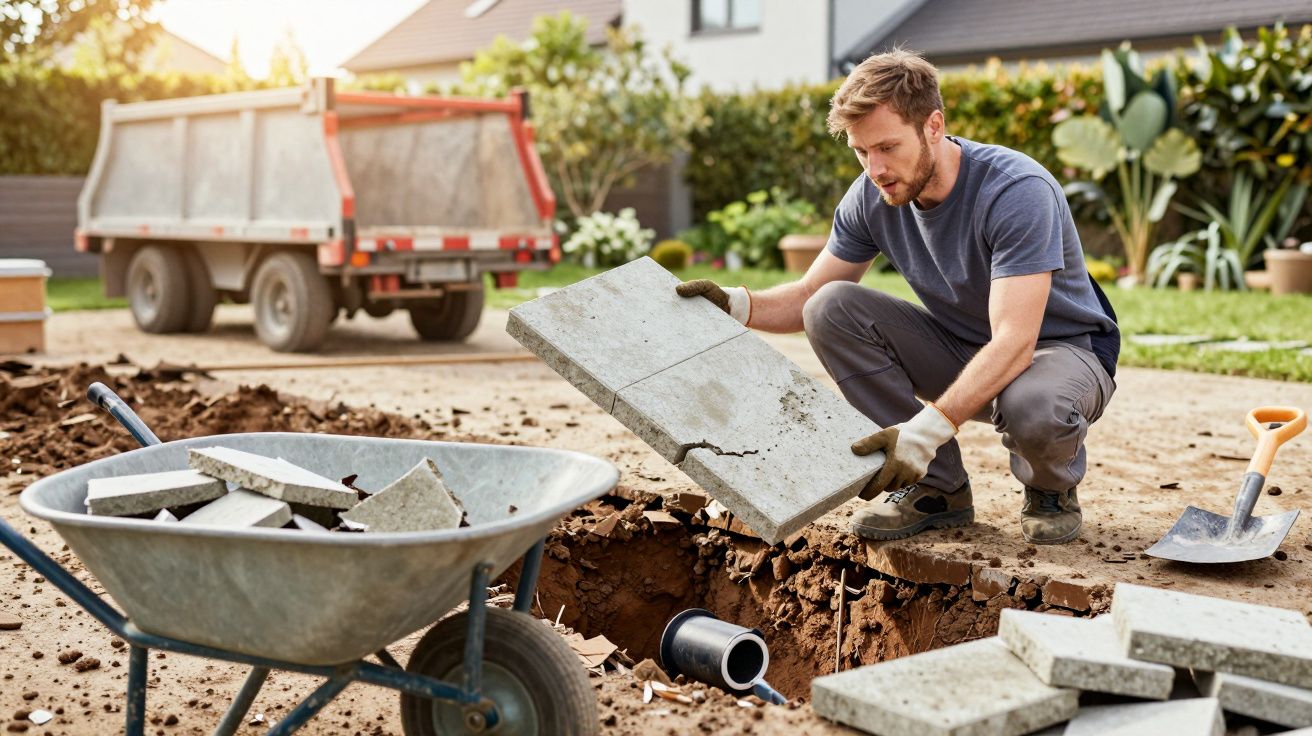
The first surprise usually arrives before the digger does. Site clearance on a garden refurbishment can look like “just getting rid of the mess”, but it’s the moment you find out what the ground has been hiding - and why your tidy sketch might not survive first contact. It matters because clearance is where cost, programme, and even what’s possible get recalculated in real time.
You can feel it on site: a skip that fills faster than expected, a patch of soil that turns to rubble, a fence line that isn’t where anyone remembered it. Plans are made in clean lines; gardens tend to answer in layers.
The day the garden stops being a picture and becomes a site
It’s still early when the first slabs come up. Damp clings to the underside, and the soil underneath has that sour, compacted smell of years of footfall. Someone finds an old soakaway that was never on the drawings, then a cable, then a pocket of broken brick that keeps going and going.
This is the real job of site clearance: not “making it neat”, but revealing what you’re actually building on. Once the ground talks back, the original plan often has to listen.
Why site clearance rewrites the plan (even when everyone tried to be sensible)
Most changes don’t come from indecision. They come from information you couldn’t verify until you removed the top layer and looked properly.
Common clearance discoveries that force a rethink include:
- Hidden hardstanding and foundations – old patios, path bases, greenhouse footings, even bits of garage slab that refuse to shift.
- Buried services – water, electrics, drainage runs that have migrated over time, or were installed without a clear record.
- Problem soil – made ground full of rubble, heavy clay that holds water, or spots where soil has been stripped and replaced.
- Roots and stumps – especially from removed trees; what’s gone above ground can remain like a buried anchor.
- Drainage surprises – standing water after excavation, collapsed gullies, or a lawn that was masking a low point.
- Boundaries and access realities – that “shared” strip, the neighbour’s overhang, or a narrow side passage that changes how materials can arrive.
None of these are dramatic in isolation. Together, they shift levels, structural needs, and the order of work - the quiet domino effect that turns a plan into a revised plan.
How small clearance finds turn into big design changes
A garden design can be perfect and still rely on assumptions: that the patio base is thin, that the soil is diggable, that drainage exists where it should. Clearance tests those assumptions with a blunt instrument.
Here’s how the cascade usually goes. You remove an old patio and realise the sub-base is 250mm of compacted hardcore instead of 75mm. That means more labour and more waste. More waste means more skips, more haulage, more time, and suddenly the programme you liked on paper starts stretching at the corners.
Or you discover the proposed pergola footings land exactly where an existing drain run crosses. You can relocate the structure, bridge the service, or reroute the pipe - but you can’t pretend it isn’t there. The plan changes because physics won’t negotiate.
The “unseen” costs that sit inside clearance
Site clearance is often priced like a single line item. In reality, it contains variables that only become visible when you start pulling things apart.
What tends to inflate the work:
- Waste classification – soil with rubble, old treated timber, or unknown fill can increase disposal costs.
- Manual handling – limited access can turn a machine job into barrow-and-board labour.
- Protection and making good – keeping a neighbour’s fence standing, protecting utilities, or retaining a path for access.
- Extra enabling works – temporary drainage, stabilising edges, or removing invasive roots properly.
Soyons honnêtes : nobody wants to pay for “discoveries”. But clearance is where those discoveries live.
Keeping your garden refurbishment flexible without losing control
The goal isn’t to expect the worst. It’s to design and schedule with enough breathing space that a surprise doesn’t become a crisis.
A practical approach that helps:
- Build in a contingency – not just money, but time. Clearance delays everything downstream.
- Agree decision points – what requires your approval, and what the contractor can resolve on the day.
- Prioritise what’s non-negotiable – the seating area size, the path gradient, the planting feel. Let other details flex.
- Ask for evidence – photos of finds, quick sketches of revised routes, simple options with costs attached.
- Clear early, commit later – if possible, do clearance and investigation before ordering bespoke items or finalising levels.
It’s not overthinking. It’s respecting the fact that gardens are rarely “blank” - they’re edited over decades, and clearance reads the edits.
What to ask once the ground changes the brief
When something unexpected appears, the calmest next step is usually a set of plain questions. Not “how bad is it?”, but “what does it affect?”
Use these prompts:
- Does this change levels, drainage, or structural support?
- Is the fix best solved by moving the design or engineering around it?
- What are the three options, and what do they cost in time and money?
- Does any change create a new maintenance issue later (waterlogging, roots, access)?
- Can we turn the find into an advantage (reusing hardcore, adjusting layout for better fall)?
Sometimes the revised plan is genuinely better - not because the first was wrong, but because it was drawn without the one thing clearance provides: certainty.
| What site clearance reveals | Typical impact | Best response |
|---|---|---|
| Buried concrete/hardcore | More waste, slower excavation | Reprice skips/haulage; consider reuse as sub-base where suitable |
| Unexpected services/drains | Footings and layout conflicts | Survey and mark; reroute or redesign around protection zones |
| Waterlogged or unstable ground | Changes to levels and drainage | Add falls, land drains/soakaway, or revise surface choice |
FAQ:
- Why can’t we know everything before site clearance? Because many issues sit below surfaces and only show up when you lift paving, dig out soil, and trace services properly.
- Does site clearance always mean the design will change? Not always, but it often changes the method, cost, timing, or exact positioning of features even if the overall look stays the same.
- What’s the most common surprise in a garden refurbishment? Buried hardcore and old foundations are frequent, followed closely by undocumented drainage and cables.
- How much contingency should I allow? It varies by site and access, but a realistic buffer in both budget and programme is usually the difference between a controlled adjustment and a stressful scramble.
- Can we reuse what we dig out? Sometimes. Clean hardcore can be reused as sub-base material, but only if it’s suitable and won’t compromise drainage, levels, or finished quality.






Comments (0)
No comments yet. Be the first to comment!
Leave a Comment