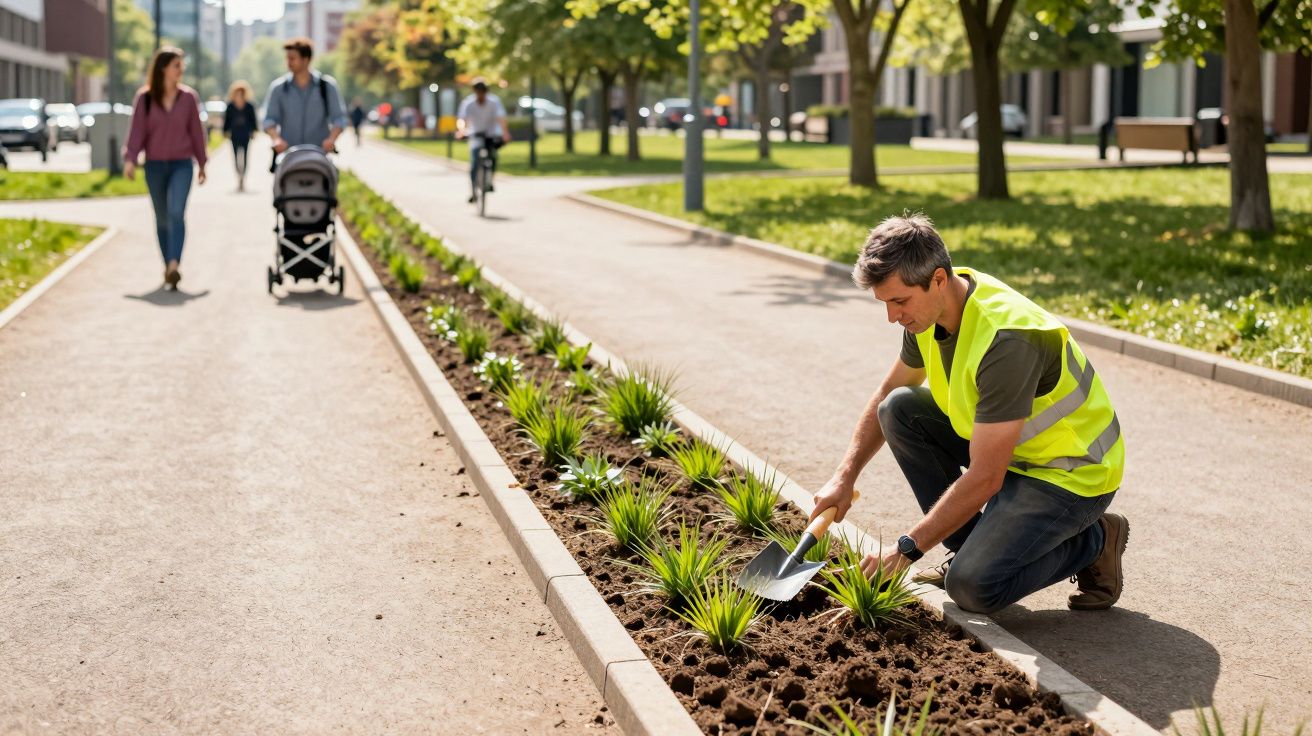
Landscaping in public spaces isn’t the same game as planting up a back garden. It has to work for thousands of feet, wheels, dogs, deliveries and weather swings, while still looking intentional on a random Tuesday in February. If you’ve ever wondered why a park feels “plainer” than a private courtyard, it’s usually because it’s built to survive people, not impress a single owner.
What looks like a lack of creativity is often a different kind of discipline. Public landscapes are designed to be legible, safe, maintainable and fair to a wide mix of users, most of whom never asked for a “design concept” in the first place.
Why “pretty” isn’t the main job
In a private garden, you can optimise for taste. In a civic square, you have to optimise for outcomes: clear routes, visibility, resilience, and predictable maintenance.
A bed full of delicate perennials might be stunning for eight weeks. Then it needs staking, deadheading, irrigation tweaks, and someone who knows what they’re looking at. Public planting is judged on what it looks like after heavy rain, vandalism, drought restrictions and a weekend event where a generator got dragged across the lawn.
That’s why so many schemes lean on robust shrubs, tough grasses, and trees that cope with compaction. It’s not aesthetic laziness. It’s risk management.
The hidden constraints that shape every planting plan
Most people read a public landscape from the path: colour, shade, texture. Managers read it as a system with failure points.
1) Footfall rewrites the ground
Soil in parks and verges gets compacted fast. That changes drainage, oxygen levels, and root growth. A plant that thrives in a loose garden border can slowly suffocate in a busy green.
Designers often compensate by:
- choosing species that tolerate poor aeration and occasional waterlogging
- building in structural soils, root cells, or reinforced turf where budgets allow
- limiting “tempting shortcuts” by aligning paths with desire lines instead of fighting them
2) Sightlines matter more than you think
In public spaces, planting can’t just be lush. It has to be readable. Tall, dense shrubs near crossings can block drivers’ and cyclists’ views. Thick planting around benches can create spaces that feel hidden in the wrong way.
A simple rule shows up again and again: keep low planting near movement routes, push height further back, and make sure lighting can actually reach the ground. This is landscaping as public safety, not decoration.
3) Maintenance is a design material
A private garden can be “high touch” because one person cares. Public work is “scheduled touch”: a crew, a route, a time slot, a limited budget, and kit that has to work quickly.
That reality drives choices like:
- fewer plant types, repeated more often (easier to replace and manage)
- larger planting drifts rather than intricate mixes (faster to weed and mulch)
- hard edges and mow strips to stop grass creeping into beds
- irrigation that’s simple, reliable, and easy to isolate when it fails
A public planting scheme isn’t just planted. It’s operated.
Why public landscapes look simpler (and sometimes feel calmer)
There’s also a psychological layer. Public spaces need to be intuitive. People should know where to walk, where to sit, where to cycle, where children can run, and where a wheelchair can pass without a drama.
Complex, highly “garden-like” landscapes can be beautiful, but they can also read as private, fragile, or confusing-especially when boundaries aren’t obvious. Simpler layouts with clearer edges tend to feel more permissive: you can enter, cross, pause, and leave without worrying you’re doing it wrong.
This is why you’ll see repeated moves: long sightlines, open lawns, clusters of trees, planting that frames rather than fills.
The logic of durability: design for failure, not perfection
The most underrated difference is that public landscaping assumes things will go wrong. Plants die. Drainage fails. A vehicle clips a kerb. A heatwave turns new turf into straw. The point is to recover fast without the whole place looking broken.
A well-designed public landscape includes redundancy:
- trees that can be replaced without redoing the whole layout
- planting that still reads as intentional when gaps appear
- materials that patina rather than “age badly”
- routes that function even when a corner is fenced off for repairs
You can feel this in successful parks. They don’t rely on one heroic feature. They work as a whole.
A quick way to “read” a public landscape like a designer
Next time you’re in a square, a park, or outside a station, try this short scan. It explains the logic in under a minute.
- Where are the fastest routes, and do the paths match them?
- Can you see through the space, and do you feel watched in a good way?
- What looks like it gets abused-and what has been designed to tolerate it?
- Which areas invite lingering, and which areas gently keep people moving?
- What could a maintenance crew fix quickly, and what would be a nightmare?
Once you do this, the choices start to look less like compromise and more like strategy.
The three audiences every public space serves
A private garden usually answers to one household. Public spaces answer to several groups at once, and they often want opposite things.
| Audience | What they need | What landscaping does |
|---|---|---|
| Everyday users | Comfort, shade, clarity | Trees, seating, legible routes |
| Operators | Predictable upkeep | Robust planting, repeatable details |
| Wildlife + climate | Habitat, cooling, drainage | Canopy, rain gardens, diverse structure |
Good public landscaping tries to hit all three without making any one group pay the price.
So what should we ask for, as citizens?
Not every sparse planting plan is defensible, and not every “easy-maintenance” scheme is honest. But the best public landscapes are rarely the most ornate. They’re the ones that keep working when budgets tighten, weather turns, and the space gets used hard.
A useful question isn’t “Why doesn’t this look like a show garden?” It’s: does it provide shade, comfort, biodiversity, and safe movement-without becoming a maintenance problem that collapses in two years?
That’s the different logic. It’s less about a perfect picture, and more about a place that holds up to real life.


Comments (0)
No comments yet. Be the first to comment!
Leave a Comment