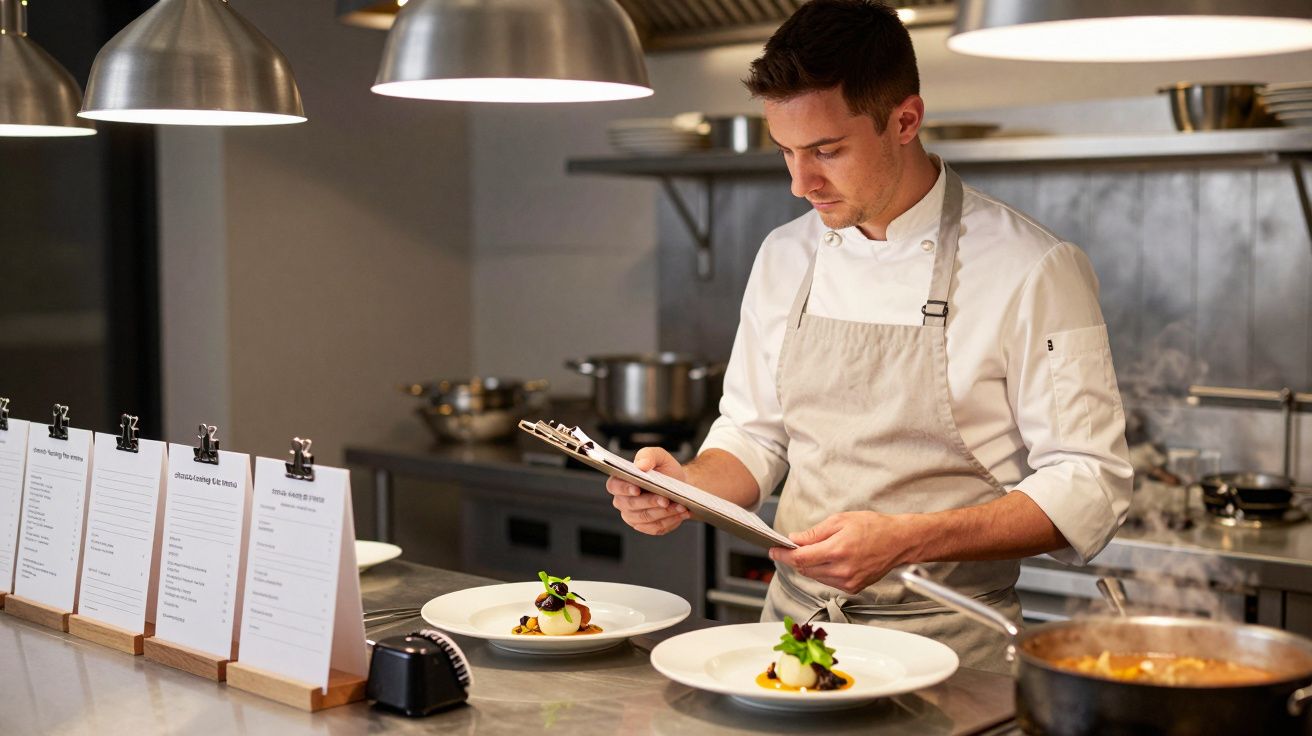
The phrase of course! please provide the text you would like me to translate. shows up more often in hospitality than you’d think, usually as a polite reflex when a manager asks for “a quick menu rewrite” and a chef realises the brief is missing the actual dishes. I’ve heard of course! please provide the text you would like me to translate. in the same meeting, too-because the real problem isn’t language, it’s translation from spreadsheet to service. For anyone running or renovating a restaurant menu, that gap matters: what reads well in theory can collapse under heat lamps, ticket times, and Friday-night panic.
It usually starts quietly. A new seasonal menu lands, tasting notes are sharp, margins look healthy, and everyone nods like the hard part is done. Then service begins, and the menu starts telling the truth.
Why menus fail in the wild (and why it isn’t the chef’s fault)
Most menu planning happens in clean conditions: daylight, calm kitchens, full prep, and a team that isn’t short two people. Real service is the opposite. It’s interruptions, substitutions, a delivery that didn’t arrive, and a grill section that suddenly owns every table.
The first failure mode is traffic. A dish might be beautiful, but if it relies on one station that also handles three other bestsellers, you’ve built a bottleneck into the night. The second is fragility: sauces that split when held, garnishes that wilt, components that can’t be reheated without turning tragic.
And then there’s the human factor. You can train a team, but you can’t train away the fact that people get tired, new staff join, and muscle memory only forms around repeatable systems. A menu is less like a poem and more like a workflow diagram people eat.
The professional rethink: design for service, not for the photos
The best menu engineers I’ve met don’t start with “What’s exciting?” They start with “What survives?”-not just in flavour, but in timing, prep and handover between stations.
One head chef in Manchester described it as writing two menus at once: the one the guest reads, and the one the kitchen actually executes. If those two are not aligned, you’ll feel it in delays, refunds, and the weird tension that creeps into the pass at 8.15pm.
Here’s the shift: professionals treat dishes like products under load. They stress-test them. They build in tolerance. They accept that a 5% drop in wow-factor can buy a 30% improvement in consistency, and that consistency is what gets five-star reviews from normal diners on normal nights.
The “service simulation” that changes everything
A simple real-world habit: run a menu like it’s Saturday, even when it’s Tuesday. Not a tasting. A simulation.
That means cooking multiple covers of the same dish back-to-back, holding components the way they’ll be held, plating at speed, and forcing the stations to work in parallel. The point is to surface the failures you never see in a calm run-through.
Common things that show up immediately:
- A garnish that looks fine at minute one and dead at minute eight
- A protein that needs a rest time that doesn’t exist when tickets stack
- A “quick” sauce that isn’t quick when you’re also doing veg and wiping plates
- A prep list that assumes perfect deliveries and perfect mise en place
A menu that works under simulation usually works in real life. A menu that only works at 4pm with the chef hovering over every plate is a liability wearing nice typography.
“If you can’t plate it cleanly ten times in a row with the music on and someone asking where the allergen chart is, it’s not ready.” - a restaurant consultant, during a pre-opening run
What gets changed first (and what gets protected)
Professionals tend to edit menus in a predictable order, because some problems compound faster than others.
1) Station load and ticket time.
They’ll move items off the busiest section, remove steps, or re-route components so two stations can share the work. The goal isn’t just speed; it’s keeping the pass predictable.
2) Holding behaviour.
They adjust dishes so key elements hold without degrading: swapping a foam for a stable emulsion, changing cut size for better reheating, or separating “hot” and “cold” components so plating stays crisp.
3) Ingredient volatility and supply risk.
If a dish depends on one special delivery, it gets redesigned. Not because the ingredient isn’t great, but because 86’ing it twice a week trains your guests to stop ordering it.
4) Identity.
Only after the system works do they protect the signature-the flavours and stories that make the restaurant feel like itself. You can simplify without becoming generic, but you must know what you’re defending.
A tight checklist you can use this week
If you’re rewriting a menu (or about to print one), run these questions like a pre-flight check:
- Which two dishes will be ordered together most often, and do they collide on the same station?
- Can every dish be plated correctly by the newest team member, not just the strongest?
- What happens if you’re down one person-what breaks first?
- Which components need a “fresh window”, and how will you enforce it mid-service?
- Are you selling any dish that requires perfect conditions to be merely acceptable?
If the answer is “we’ll just be careful”, the menu is doing wishful thinking. In the real world, you need design.
| Point clé | Ce que les pros testent | Pourquoi ça compte |
|---|---|---|
| Charge des postes | Goulets d’étranglement, collisions | Temps d’attente et stress au pass |
| Tenue des composants | Maintien au chaud/froid, texture | Qualité constante à chaque table |
| Résilience | Pannes, absentéisme, ruptures | Moins de 86, moins de remboursements |
FAQ:
- How many dishes should a small kitchen run? Fewer than you think. A tight menu that executes cleanly will outsell a long menu that breaks under pressure.
- Is simplifying the menu always better? Only if it improves consistency. Cutting variety without fixing bottlenecks just makes the same problems louder.
- What’s the quickest way to spot a bottleneck? Track ticket times by station for one busy service and note where plates queue up. The pass rarely lies.
- Should you design around trends (e.g., “viral” dishes)? Only if they fit your workflow and supply chain. Trendy items that slow service can cost more in reputation than they earn in sales.
The strange thing about menu work is how physical it becomes once you stop treating it like a document. Under real-world conditions, a menu is a system: heat, hands, timing, and attention. When professionals rethink it properly, the food doesn’t just get better-it gets repeatable, which is what guests actually come back for.



Comments (0)
No comments yet. Be the first to comment!
Leave a Comment