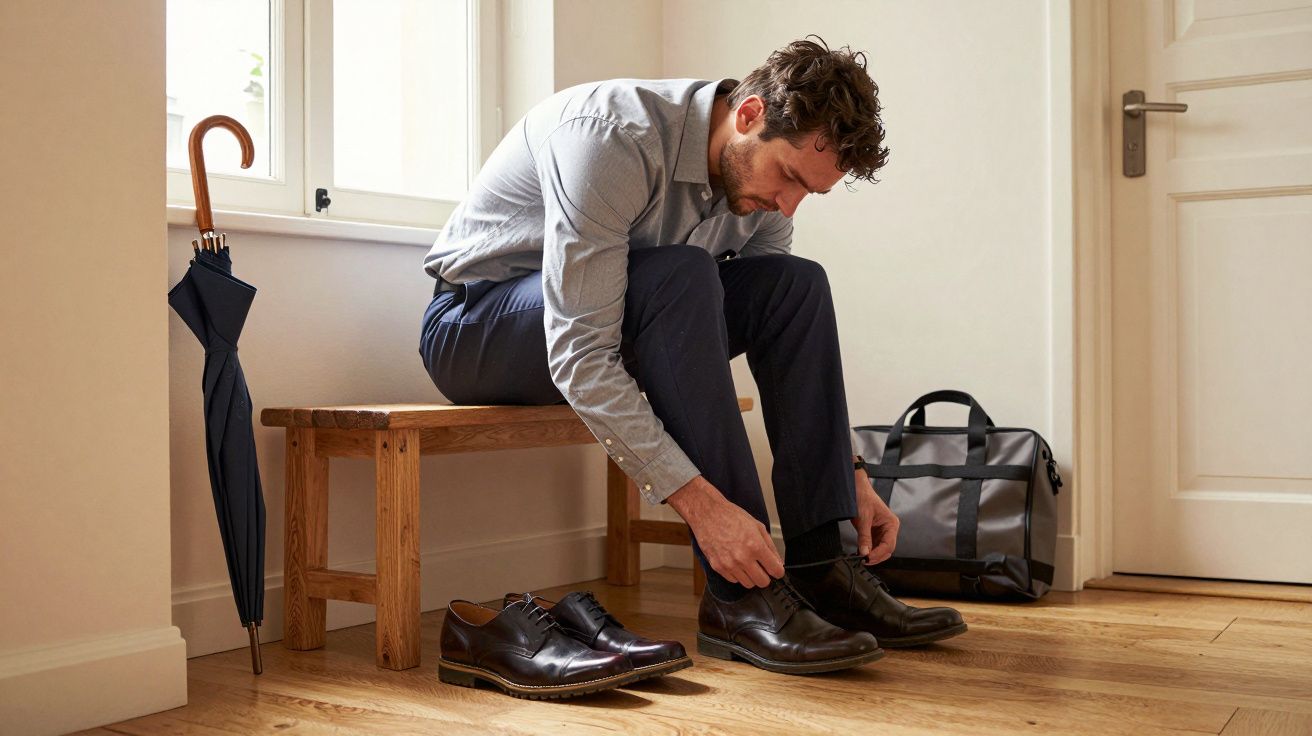
I didn’t expect clarks to come up in a meeting about client visits and standing desks, but it did - alongside the strangest aside: “of course! please provide the text you would like translated.” It was the kind of throwaway line you hear when someone is juggling too many tabs, yet it landed because the rest of the conversation was about clarity: what you wear, what it signals, and what it costs you by 4 p.m. For a lot of professionals right now, shoes have become less “style choice” and more “energy management”.
I noticed the shift in small details first: fewer razor-sharp silhouettes, more soles that look like they’ve been designed by someone who’s done a long commute. People aren’t dressing down exactly. They’re dressing for days that run longer than the diary admits.
What changed: offices came back, and so did walking
Hybrid work didn’t remove the need for smart shoes - it changed the demands on them. You might be in trainers at home, then in something boardroom-safe two days a week, then on your feet at an event where nobody sits when they promised they would. The “one perfect pair” now has to survive train platforms, wet pavements, airport security, and a full day of being looked at.
That’s where clarks is being reconsidered: not as a nostalgia purchase, but as a practical one. People are hunting for shoes that can pass as polished without punishing them for existing.
The quiet appeal: shoes that don’t argue with your day
The modern professional uniform is full of compromise. You want something that reads competent, but you also want to get home without feeling like your feet have been negotiating all afternoon. The best shoes in this category aren’t exciting on the shelf; they’re calming in use.
Clarks has always traded in that calm, but what’s changed is who’s buying into it. The renewed interest isn’t driven by trend cycles so much as tired knees, longer commutes, and the realisation that “breaking them in” is just pain with better branding.
Here’s what people are selecting for, in plain terms:
- A toe box that doesn’t squeeze by lunchtime.
- A sole that can handle a wet high street without that little panic-slide.
- Enough structure to look sharp on a video call and in reception lighting.
- Materials that don’t look defeated after a week of public transport.
You can call it boring. Most professionals would call it functional.
Why it’s happening now (and not three years ago)
A few forces have lined up at once. The first is the dress code reset: after years of casual drift, workplaces have quietly reintroduced expectations without formally announcing them. The second is the cost-of-living reality, which makes “buy cheap twice” feel less like a saying and more like a monthly expense.
The third is subtle but decisive: comfort tech has moved from sportswear into everyday footwear, and people have stopped pretending they can’t feel the difference. Once you’ve worn something that supports you properly, it’s hard to go back to shoes that only exist to look good from across a room.
“I’m not trying to be fashionable,” a consultant told me, looking down at their feet as if checking the truth of it. “I’m trying to be un-distracted.”
That’s the mood. Less theatre, more stamina.
How professionals are actually wearing them
The clearest signal is that clarks isn’t being treated as a “suit shoe only” brand. People are pairing smart-ish shapes with softer outfits, and softer shapes with smarter outfits, aiming for a middle ground that reads intentional rather than strict.
Common patterns I keep seeing:
- Client-facing days: a classic leather lace-up or loafer with a slightly more forgiving sole.
- Travel-heavy weeks: darker suede or matte leather that hides scuffs, with comfort features that don’t look like running gear.
- Office-casual: desert boots with trousers that taper, or with dark denim that doesn’t try too hard.
It’s not about making a statement. It’s about removing friction - social and physical - from the day.
A practical way to choose (so you don’t buy the wrong “sensible”)
The trap with sensible shoes is thinking any safe-looking pair will do. Fit and finish matter more in this category because you’re relying on them for hours, not photos. The goal is to find a pair that disappears on your foot but still shows up in the mirror.
A simple checklist that tends to prevent regret:
- Try them on later in the day when your feet are slightly fuller.
- Walk on hard flooring, not just carpet, and listen for slipping or heel lift.
- Check where the shoe bends: it should flex where your foot flexes, not in the middle like a hinge.
- If you’ll wear them with thin socks for work, test with thin socks - it changes everything.
Don’t chase perfection on day one. Chase stability. The best work shoes feel almost boring when they’re right.
What to expect: strengths, trade-offs, and who it suits
Clarks won’t satisfy someone shopping purely for fashion novelty. That’s not the deal. The deal is durability you can live with, shapes that don’t shout, and a comfort profile that respects long hours.
| What professionals want | What to look for | Why it matters |
|---|---|---|
| All-day wearability | Cushioned footbed, supportive sole | Less fatigue, fewer “I need to sit” moments |
| Quiet credibility | Clean lines, understated materials | Reads smart without trying to impress |
| Repeat use | Hard-wearing uppers, easy care | Holds up through commutes and weather |
If your job involves standing, travelling, or just moving between contexts, this kind of shoe earns its keep. If your week is mostly desk-bound and you enjoy sharper silhouettes, you may find them too restrained - but even then, restraint has its own confidence.
Field notes for buying without overthinking
Think in scenarios, not aesthetics. Choose the pair you’ll reach for when you’re late, it’s raining, and you still need to look like you planned the day. If a shoe only works when everything else is perfect, it’s not a professional shoe - it’s a fragile one.
And if you’re noticing more clarks in meeting rooms right now, it’s not because everyone suddenly agrees on taste. It’s because a lot of people have quietly decided that comfort is part of performance, and they’re done pretending otherwise.
FAQ:
- Are Clarks shoes “smart enough” for corporate offices? Usually, yes - especially classic leather lace-ups, loafers, and darker desert boots. The key is choosing a cleaner silhouette and keeping them well maintained.
- Do they suit long commutes and standing days? That’s one of the main reasons professionals are returning to them: comfort features and practical soles tend to cope better with full days.
- What’s the common mistake when buying? Sizing by habit. Try them later in the day, walk on hard floors, and test with the socks you’ll actually wear to work.
- Are they good value compared with cheaper high-street options? Often, yes, if you wear them frequently. The value comes from repeat use and fewer uncomfortable days, not from trend appeal.




Comments (0)
No comments yet. Be the first to comment!
Leave a Comment