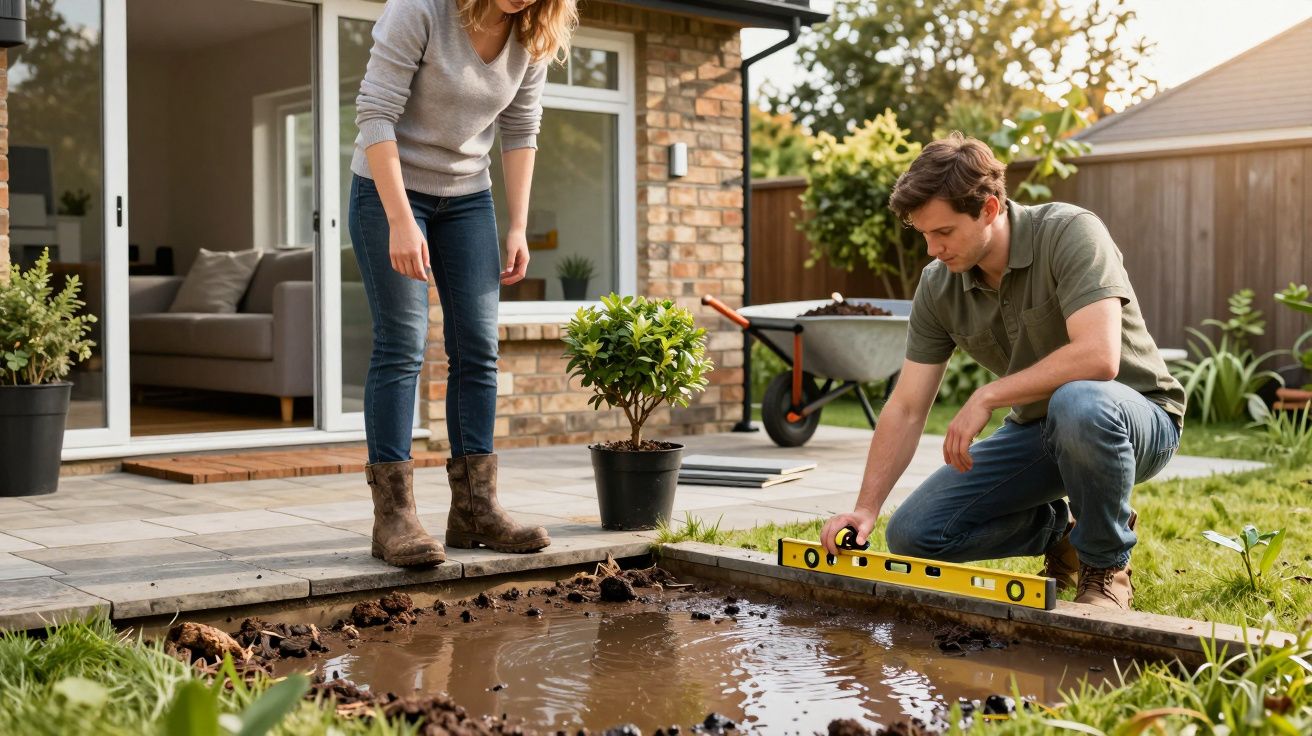
There’s a familiar moment that happens a day or two after you’ve moved into a house: you stand by the back door, look at the patchy lawn, the tired shrubs and the wonky path, and think, “We just need to plant a few things.” Landscaping and landscape design feel like the fun bit should start with a trolley full of plants, because that’s what you can see and touch. The problem is that what you can see is often the last layer, not the first-and that’s why a professional rarely leads with planting.
I’ve watched it play out on new-build plots, Victorian terraces and big family gardens where the kids have turned the lawn into a mud map. The client arrives with a Pinterest board and a favourite olive tree. The landscaper arrives with questions that sound almost annoying: where does the water go, what’s the soil like, what will you actually do out here at 7pm in November?
The quiet truth is simple. Plants don’t fix a garden that doesn’t work.
What “starts with planting” gets wrong
Let’s strip the romance out of it. Planting is decoration with roots. If the garden underneath is poorly drained, badly graded, too shaded, too windy, or just awkwardly laid out, you’re asking plants to solve a structural problem.
That’s why professionals start with the unglamorous stuff:
- levels and falls (so rainwater goes away from the house, not into it)
- soil condition (clay, sand, compaction, contamination, pH)
- light and exposure (sun paths, frost pockets, wind tunnels)
- access and use (bins, bikes, dogs, kids, barbecues, steps)
- existing services (drains, cables, stopcocks, septic, soakaways)
If you plant first, you often end up moving it later. And moving plants is the gardening version of paying twice.
The “new patio, dead border” story that keeps repeating
A couple in Leeds wanted a quick refresh: new patio, a line of grasses, and some evergreen screening. They bought plants early “so the garden would feel finished” and dotted them in while waiting for the hard landscaping slot.
When the patio went in, the contractors had to dig out deeper than expected, adjust the finished levels, and reroute a downpipe to stop water pooling by the kitchen. Half the new border was trampled, the other half sat in water for weeks. The plants weren’t “bad quality”. They were just put into a garden that hadn’t been built yet.
The order matters: build the garden’s function first, then dress it.
What professionals actually begin with
Most decent landscaping starts with a walkabout and a bit of gentle interrogation. Not in a dramatic way-more like someone trying to prevent you wasting money.
1) A site read: where problems hide in plain sight
You can learn a lot in ten minutes if you know what to look for. Professionals will clock things homeowners often miss because they’ve got used to them:
- a slight dip that becomes a pond every heavy rain
- a path that forces you through the wettest bit of lawn
- a fence line that steals light and makes a “dead strip”
- a neighbour’s windows overlooking where you wanted to sit
This is also where measurements happen. Not “roughly twelve steps”, but actual levels and distances, because design that doesn’t fit becomes expensive fast.
2) Groundwork: the boring bit that decides everything
It’s not glamorous, but it’s the difference between a garden that settles nicely and one that cracks, sinks or turns into a swamp.
Typical early-stage work might include:
- improving drainage (French drains, soakaways, regrading)
- soil improvement (adding organic matter, relieving compaction)
- retaining and edging (to hold levels and keep beds crisp)
- foundations for paving and walls (so they don’t wobble in year two)
- irrigation and electrics (before you bury everything)
There’s a reason pros get twitchy about “just chucking some topsoil on”. Topsoil on top of a drainage problem is still a drainage problem-just more expensive.
3) Layout: the part that makes it feel easy to live with
Good landscape design is often invisible when it’s done well. You don’t notice the path is in the right place; you just stop walking through the flower bed. You don’t think about sightlines; you just feel more private.
A professional will usually lock in:
- where you sit (sun, shelter, distance from the kitchen)
- where you walk (dry routes, sensible widths, lighting)
- where you store things (bins, logs, bikes, toys)
- what you want to see from indoors (the “view out” matters)
Only after that do plants become meaningful-because now they’re supporting a plan, not trying to invent one.
Why planting comes last (and why that’s good news)
Planting is where you spend money on living material. It’s also the easiest part to ruin with the wrong sequence.
When you plant at the end, you get to plant with confidence:
- you know the soil has been improved, not compacted by builders’ boots
- you know water won’t sit around roots after every storm
- you know the bed sizes are real, not guessed
- you know where shade will fall once pergolas, fences and trees are in
It also keeps the design honest. Once you can stand on the finished patio and see the boundaries, it’s much easier to choose plants that actually suit the space, rather than plants you liked in someone else’s garden.
The best planting looks effortless. It rarely happens by accident.
A simple way to think about it: structure, then softness
If you’re trying to work out whether your project is being handled properly, ask what’s being decided first.
| Stage | What gets decided | Why it matters |
|---|---|---|
| Structure | levels, drainage, hard surfaces, access | Stops costly failures and rework |
| Layout | zones, routes, privacy, sightlines | Makes the garden usable day-to-day |
| Softness | planting, lawn, mulches, finishing touches | Delivers the look without fighting the site |
How to spot “plant-first” problems before you pay for them
Not every job needs a full design package, but the sequence should still make sense. A few warning signs tend to show up early:
- you’re being sold lots of plants before anyone has checked drainage or soil
- no one has talked about levels, especially near the house
- the plan is “we’ll see where things go” despite big spend on paving
- you’re promised instant screening with unsuitable species for the light/wind
- there’s no mention of how beds will be edged or maintained
If the goal is a garden that looks good in photos, planting first can limp you over the line. If the goal is a garden that still works after three winters, it’s the wrong starting point.
What to do if you’re itching to buy plants right now
It’s normal. Plants are the exciting part and garden centres are basically retail therapy with compost. You don’t have to do nothing-you just want to buy smart.
A safer approach:
- choose a palette and hold it in a list (rather than buying randomly)
- buy pots for moveable colour near the door (you can reposition later)
- wait on hedging/screening until you know final levels and fence lines
- invest early in soil testing and compost rather than shrubs you may relocate
You’ll still get momentum, but you won’t end up digging up a £300 tree because the patio had to move 40cm.
FAQ:
- Do I always need a landscape design before landscaping work? Not always, but you do need a plan for levels, drainage and layout. Even a simple scaled drawing and a clear sequence can prevent expensive mistakes.
- What’s the first thing a professional will check on a typical UK garden? Drainage and levels, especially near the house. In many gardens the biggest issues come from water sitting where it shouldn’t.
- Can I plant while hard landscaping is happening? It’s possible at the edges, but it’s risky. Heavy footfall, storage of materials and soil compaction can undo your planting quickly.
- Is planting really “the easy bit”? It’s the most visible bit, not the easiest. Good planting depends on soil, light, spacing, and the finished layout-so it works best at the end.




Comments (0)
No comments yet. Be the first to comment!
Leave a Comment