The funny thing about patios is that they’re the bit you actually live on, yet in a garden renovation they’re often treated like the final flourish. You can have fresh planting, smart lighting, even a new lawn, and still feel vaguely annoyed every time you step outside-because the surface under your feet is the thing you touch most.
I’ve watched it happen on tidy suburban jobs and big “rip it all out” landscapes alike. Everyone starts with the exciting bits: borders, trees, a pergola, a water feature. Then someone looks at the budget and says, quietly, “We’ll do the patio later.” Later becomes next year, and the garden never quite settles.
The quiet reason patios get pushed to the end
Patios sit in an awkward category: they’re not as glamorous as planting, and they’re not as urgent as drainage-until they are. They’re also expensive in a way that’s hard to romanticise. A slab is a slab, right? Then you start adding up sub-base, edging, falls, disposal, and suddenly the “simple seating area” has the price tag of a small holiday.
There’s also a psychological thing going on. Planting feels reversible. If you hate a shrub, you move it. If you pick the wrong paving, you live with it every day, and lifting it later is noisy, messy, and rarely cheap. So people delay the decision, thinking they’re buying time, when they’re really postponing the one element that dictates how the whole garden works.
The domino effect: the patio is the plan, not the accessory
A good patio isn’t just a place for a table; it sets the geometry for everything else. Its height affects your door threshold, its footprint decides where paths land, and its edges dictate where beds begin. Get it wrong and you spend the next five years “making do” with awkward triangles of gravel and borders that never look intentional.
This is why designers often want to lock the hardscape early. The patio is the anchor point that makes the rest feel inevitable. Without it, a garden renovation can become a series of nice ideas that don’t quite speak to each other.
The patio answers questions like: - Where do you naturally step out of the house? - Where does the sun actually hit at 6pm in June? - Where will water run when it rains for three days straight? - How will you move a wheelie bin, a mower, a pram?
Once those are settled, planting becomes easier, not harder. You stop planting defensively-hiding problem spots-and start planting with purpose.
“We’ll just choose a nice slab” (and the trap inside that sentence)
The surface choice feels like the whole decision, but it’s often the least important part. What sinks projects is everything underneath and around it: levels, falls, drainage, edging, and how it meets the house. People leave patios until last because they think it’s a finishing touch, then discover it’s actually structural.
A patio that’s even slightly wrong has a special talent for being annoying in small daily ways. A puddle where the chair legs sit. A step that’s too tall when you’re carrying a tray. A threshold detail that lets rain creep towards the kitchen. None of it is dramatic. All of it is constant.
“Hard landscaping is where your garden either starts behaving-or starts apologising,” a builder once told me, after digging up a “quick patio” that had no proper base.
Why patios feel like the most disruptive part of a garden renovation
They’re the bit that turns your garden into a building site. There’s spoil to remove, materials to deliver, and compaction that rattles your fillings. If you’ve already spent months nurturing borders, the idea of a mini-excavation at the end feels like sabotage.
So people protect the new plants, protect the lawn, protect the mood-and postpone the patio. It’s understandable, but it often means doing things twice. You end up dragging slabs through finished beds, scuffing new fencing, and trying to match levels to a lawn that’s already settled in the wrong place.
If you’re planning properly, the patio goes in when mess is already part of the deal. The garden forgives chaos once. Twice, it sulks.
The budget reality no one wants to say out loud
Patios are a big lump-sum item, and lump sums make people nervous. You can buy plants in stages. You can add a light here, a bench there. A decent patio asks for commitment up front-materials, labour, waste removal, and sometimes unexpected extras like sorting a manhole cover or a soakaway.
That’s why patios often come last: not because they don’t matter, but because they’re the hardest line to fudge. And once you’ve spent on the “fun” parts, there’s a quieter, more stubborn truth: the patio is the bit you can’t half-do without it looking half-done.
How to stop “patio later” becoming “patio never”
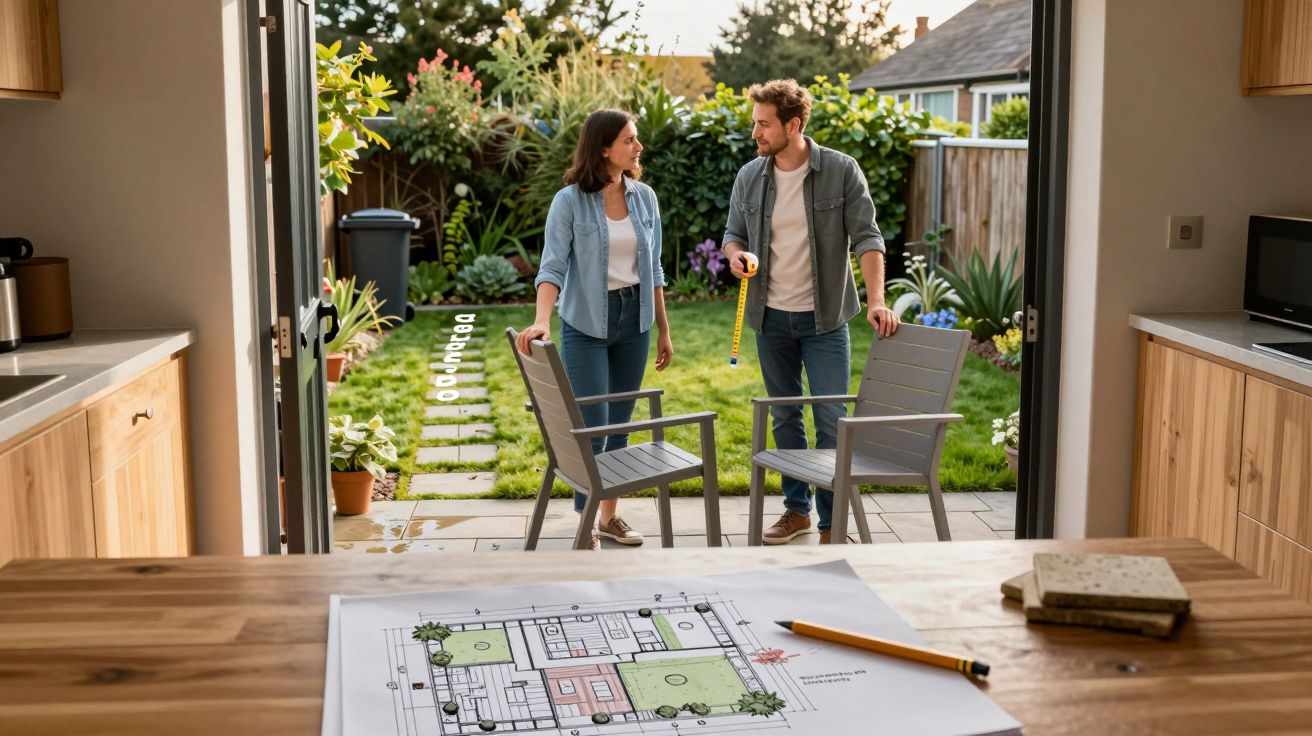
Start by treating the patio as part of the layout, not a decorative choice. Even if you delay the final surface, you can still plan levels, drainage routes, and the footprint so the rest of the garden renovation isn’t built on guesswork.
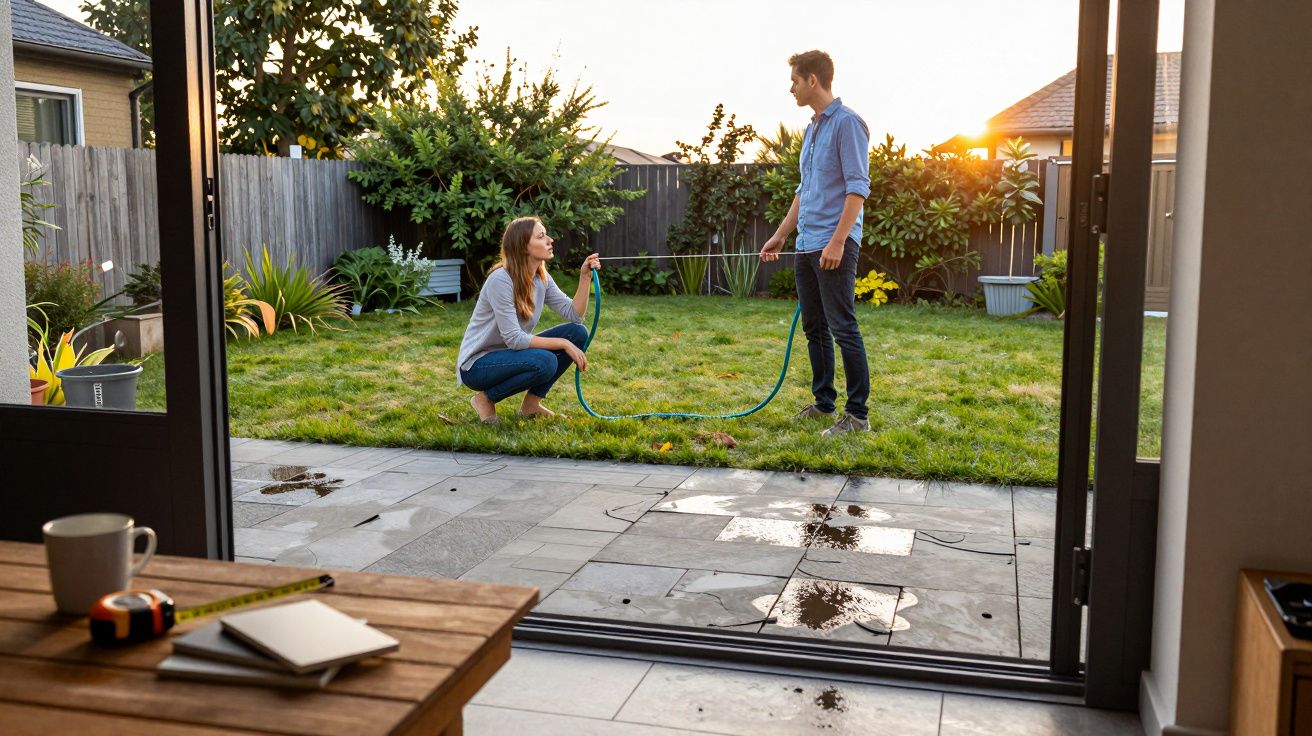
A practical, human way to do it: 1. Mark out the patio size with a hosepipe or string and live with it for a week. 2. Check sun and shade at breakfast, mid-afternoon, and early evening. 3. Decide the key edge: where it meets the house and where it meets the lawn or beds. 4. Budget for what you can’t see: sub-base, falls, waste, and proper edging. 5. If money is tight, phase the finish-not the foundations.
The best feeling is when the patio makes everything else easier. You walk out, the level is right, the chairs don’t wobble, the water goes away, and suddenly the planting looks more considered without you touching a spade.
A small checklist that saves big regret
Patios cause regret for boring reasons, so the checks are boring too. They’re also the difference between a garden that feels calm and one that feels like a series of compromises.
- Keep the patio big enough for chairs to pull out without falling onto gravel.
- Plan a slight fall away from the house (and know where that water will go).
- Make edges deliberate: a clear line into lawn or beds stops “messy fringe syndrome”.
- Think about routes: bin day, BBQ, kids, muddy boots, winter darkness.
- Choose a surface you can live with when it’s wet, greened-up, and leaf-strewn-not just when it’s clean.
If patios often come last, it’s because they carry the weight of everything: function, budget, disruption, and permanence. But when you put them first-at least in the planning-the rest of the garden stops being a collection of features and starts becoming a place you actually use.



Comments (0)
No comments yet. Be the first to comment!
Leave a Comment