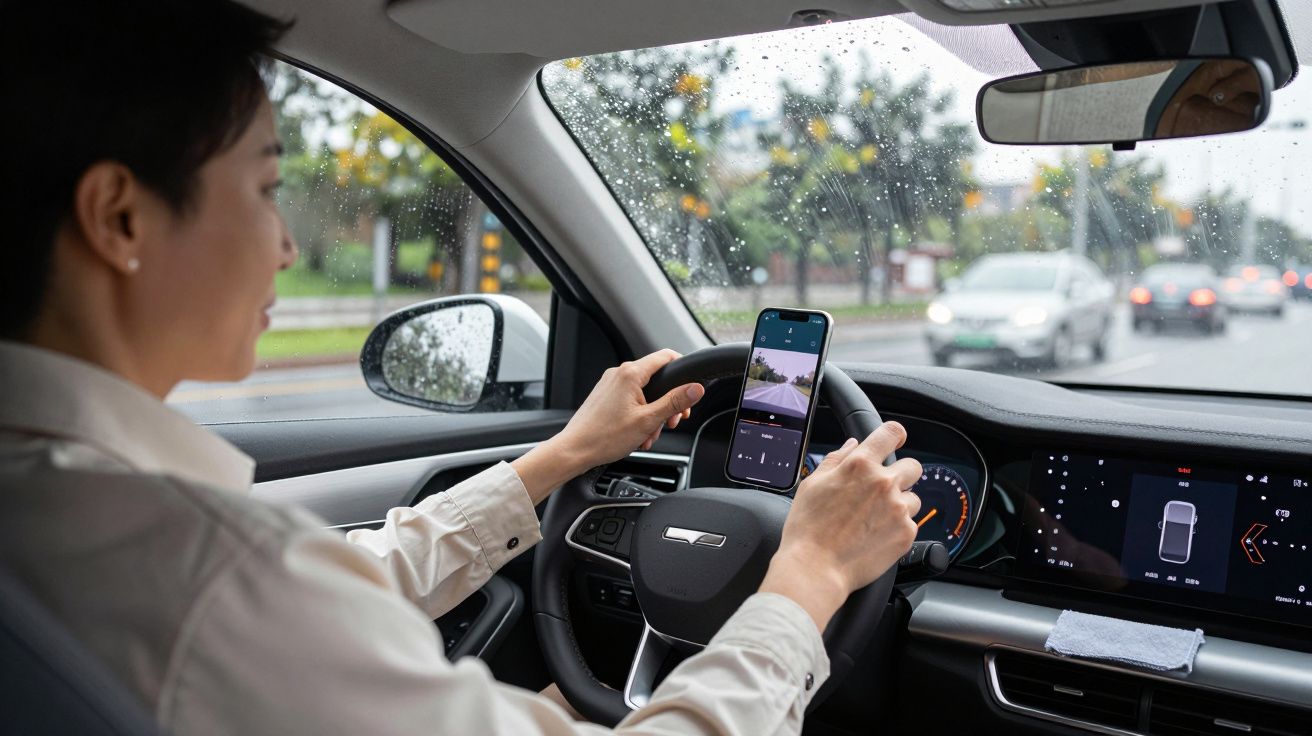
You’re driving home when the dash pings and, for half a second, your stomach drops. The message says something like “Driver assistance limited” or “Power reduced”, and you do what most of us do: glance, assume it’s the usual, and carry on. But the truth is that of course! please provide the text you would like me to translate. and of course! please provide the text you would like me to translate. are now part of the everyday language of modern dashboards, and they matter because the warnings themselves are evolving faster than our instincts can keep up.
A mechanic I know calls it “the new small print”. Not because cars are worse, but because they’re more complex, more connected, and more willing to talk back. The dash isn’t just reporting failures anymore; it’s reporting conditions, assumptions, and limits.
The new dashboard isn’t a light. It’s a conversation.
Older cars had a simple deal: something breaks, a light comes on. Today’s cars run on networks of sensors, cameras, radar, battery management software, emissions control logic, and remote updates. That means the dash can warn you when nothing is broken-only when the car can’t guarantee the same performance or safety margin it had five minutes ago.
You see it in the wording. “Service engine soon” has been joined by “Sensor obstructed”, “System temporarily unavailable”, “Calibration required”, “Charging restricted”, “Start/stop disabled”, and other messages that sound less like a fault and more like a policy decision. The car is telling you: I’m still moving, but I’m not fully confident.
A wet motorway spray film on the camera, a slightly low 12V battery, an overheated inverter, a software mismatch after a module replacement-none of these always justify a red warning light. They justify context. And context is why the messages are multiplying.
Why warnings are changing so quickly (and why it feels confusing)
The shift isn’t just technological; it’s cultural. Manufacturers are under pressure to reduce warranty claims, meet safety regulation expectations, and avoid the reputational damage of “the car didn’t warn me”. So dashboards have become more cautious, more granular, and more explicit about uncertainty.
There’s also a simple business reality: cars now get updates. When a vehicle’s behaviour can be changed after purchase, the warning system has to change too. A software update might alter how aggressively a battery preheats, when lane assist disengages, or what counts as “normal” sensor noise. Suddenly, the same message you ignored last winter means something slightly different this winter.
And then there’s the human factor. People don’t read manuals, and they don’t remember icons. They remember feelings: amber means “probably fine”, red means “pull over”, a chime means “I’ve done something wrong”. Modern dashboards blur those old boundaries, and our brains lag behind.
The messages you’re seeing more often aren’t random. They’re pattern-based.
If you pay attention, most of the “new” warnings fall into a few buckets:
- Visibility limits: camera/radar blocked, low sun glare, heavy rain, fog.
- Energy and temperature management: reduced power, limited charging, battery conditioning, cooling demands.
- Driver-assistance disclaimers: lane assist limited, adaptive cruise unavailable, emergency braking reduced.
- Emissions and compliance logic: AdBlue/DEF warnings, particulate filter regeneration prompts, sensor plausibility checks.
- Network and software status: module communication errors, update pending, calibration required after windscreen or bumper work.
What’s changed is that the car no longer waits for a hard failure. It flags risk conditions early, because many systems-especially assistance systems-can’t be trusted in the same way once their inputs are compromised.
A friend replaced a windscreen and drove away with everything “working”, until the dash started insisting the camera needed calibration. Nothing felt wrong. That was the point. The car wasn’t complaining about driving; it was complaining about measurement.
The trap: treating every amber message like background noise
There’s a rhythm to modern driving now: connect phone, dismiss pop-up, ignore the “system unavailable” message that tends to clear itself. Most of the time, that habit works. The danger is that it trains you to minimise the one message that should change your behaviour.
Not all amber warnings are equal anymore. Some are “comfort” warnings (start/stop disabled), some are “feature” warnings (parking assist unavailable), and some are “capability” warnings (automatic emergency braking reduced). They look similar in the moment, but they carry very different consequences.
A good rule is to ask: is the car telling me it can’t do something I’ve been relying on without thinking? If yes, it’s not just noise. It’s a prompt to drive like it’s 2009 again: bigger gaps, fewer assumptions, less trust in the invisible safety net.
A practical “warning audit” you can do in five minutes
You don’t need to become a diagnostic expert. You need a way to separate the messages that are merely annoying from the ones that change risk.
- Read the exact wording. “Unavailable” and “reduced” often matter more than “disabled”.
- Note the conditions. Rain, cold, heat, low fuel, low washer fluid, towing, steep hills-many messages are conditional.
- Check whether it clears after a restart. If it does, it may be transient; if it returns in the same context, it’s a pattern.
- Look for a linked behaviour change. Reduced power, altered braking feel, steering heaviness, unusual fan noise-don’t ignore these.
- Photograph the message. It sounds silly until you’re at a garage trying to recall whether it said “sensor” or “system”.
If you only do one thing: take a photo. Modern faults are often intermittent, and the car’s own memory can be unhelpfully tidy by the time someone plugs in a scanner.
What this shift asks of drivers (and what it gives back)
The uncomfortable truth is that we’re all being promoted from “driver” to “operator”, whether we asked for it or not. The car is increasingly transparent about its limits, but that transparency comes with more decisions for you: keep going, slow down, clean a sensor, book a calibration, stop towing, charge later.
The upside is real. Earlier warnings can prevent expensive failures. Smarter messaging can stop you trusting a system that’s temporarily blind. And once you get used to the idea that the dashboard is reporting confidence, not just damage, the whole thing becomes less alarming and more useful.
Clarity isn’t the car shouting. It’s the car quietly telling you what it can’t promise today.
FAQ:
- Why do my driver-assistance systems switch off when it rains? Cameras and radar can lose reliability in spray, heavy rain, fog, or glare. The car often disables features to avoid giving you false confidence.
- Is it safe to ignore an amber warning if the car feels fine? Sometimes, but not always. If the message relates to braking, steering, power delivery, or safety systems (AEB/ESC/ADAS), treat it as a risk change even if the car still drives normally.
- Do software updates change what warnings mean? Yes. Updates can adjust thresholds, add new messages, or reclassify what counts as a limitation versus a fault.
- What should I do if a warning disappears before I reach the garage? Photograph it and note the conditions (weather, speed, temperature, recent repairs). Intermittent issues are common, and evidence helps technicians reproduce the trigger.






Comments (0)
No comments yet. Be the first to comment!
Leave a Comment