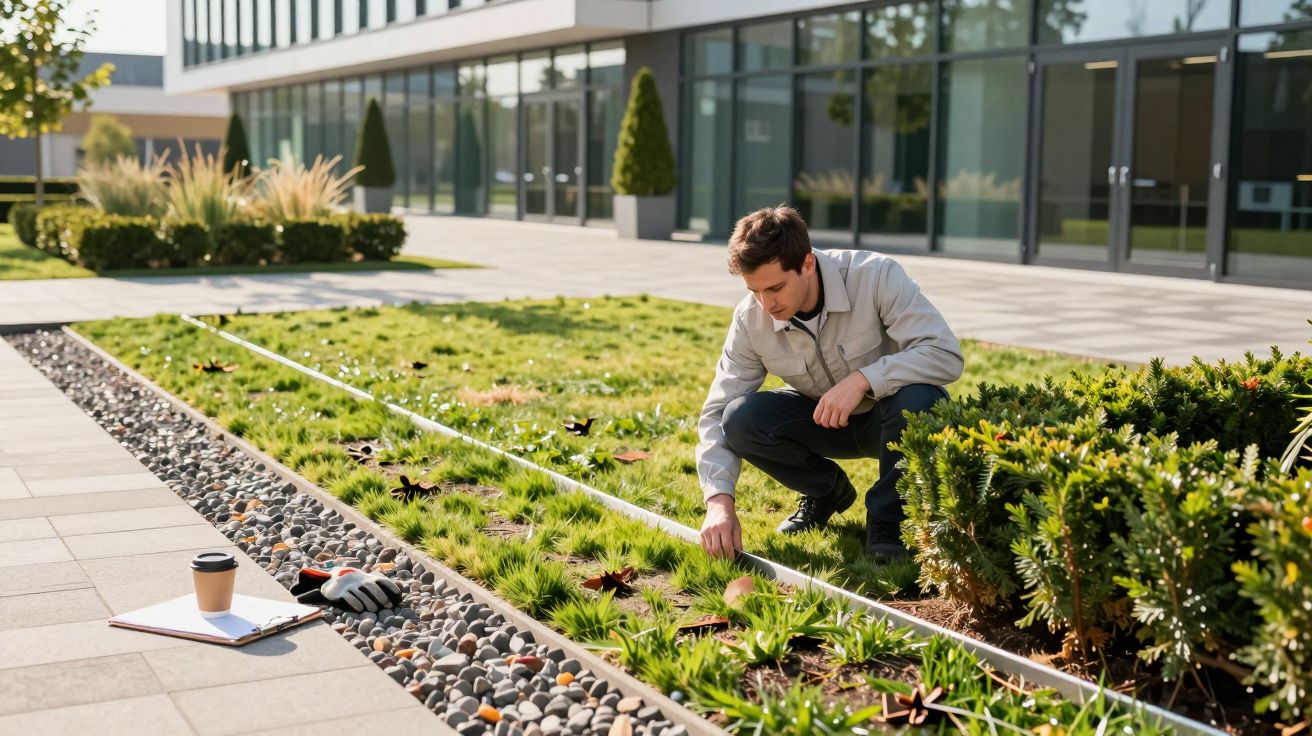
You stand outside an office block at 8.10am with a coffee cooling in your hand and notice the planting first: crisp, contained, oddly unbothered by seasons. That’s commercial landscaping in miniature - designed for commercial property where the garden has a job to do: look competent, stay safe, and never become a problem. If you’ve ever wondered why it doesn’t feel like anyone’s back garden, it’s because it isn’t trying to.
Private gardens get to be personal. Commercial ones get to be predictable. The gap between those two words explains almost everything you see - from the clipped hedges to the lack of roses that would make you stop and sniff.
The real brief: “don’t cause trouble”
A home garden can afford to be a bit of a hobby. If a border flops, you prop it up, forgive it, and try again next year. At a workplace or retail site, “flopping” becomes a complaint, a trip hazard, or a maintenance call-out that nobody budgeted for.
Most commercial schemes are written around risk, access and reputation. They’re meant to look intentional in January and still acceptable in August, even if no one has time to water them properly. When you design for that level of certainty, you naturally choose plants and layouts that behave.
What reads as boring is often just controlled. The garden is doing its quiet shift.
Footfall changes everything
In a private garden, paths are where you decided they should be. In public-facing spaces, people invent their own routes in a week. The desire line across a lawn in front of a block of flats isn’t a design failure; it’s human nature doing its thing.
That’s why commercial planting is often pulled back from corners, kept low near entrances, and protected by edging, rails or bands of gravel. It’s also why lawns are smaller than you’d expect, or swapped for groundcover and hardscape. Grass looks friendly, but it doesn’t enjoy being a shortcut.
Common “footfall fixes” you’ll spot once you know to look:
- Wider paths and turning circles for buggies, trolleys and wheelchairs
- Clear sightlines at junctions and car park exits
- Planting set back from doors to avoid litter traps and slip risks
- Durable surfaces where everyone steps off the kerb
It’s not about delight first. It’s about the site still working at 5.30pm.
Budgets aren’t just smaller - they’re stricter
A homeowner can splurge on a statement tree because they love it, then quietly forget how much it cost. A facilities manager has to explain every line. Upfront spend, ongoing maintenance, replacements, irrigation repairs, leaf clearance - it all sits somewhere in a contract.
That’s why you see repetition: the same shrub, the same grass, the same paving module. Repetition reduces failure risk and makes maintenance faster. If you can prune one thing well, you can prune twenty of it well. Variety is beautiful; variety is also expensive.
And there’s a second budget most people miss: disruption. A private gardener can spend a Saturday digging up a bed. A commercial site often can’t have contractors blocking bays, closing entrances, or making noise during trading hours. The easiest work to approve is the work that’s barely noticed.
Plant choice is a survival test, not a mood board
At home you can plant for scent, nostalgia, wildlife, or the colour you saw in a magazine. On a commercial site, plants get judged on a harsher scale: tolerance of wind tunnels, reflected heat from glazing, compacted soil, salt spray from winter gritting, and occasional neglect.
That’s why certain plants dominate. They’re not chosen because nobody has imagination; they’re chosen because they live through Thursday. Ornamental grasses that don’t mind poor soil. Evergreen structure that doesn’t collapse in February. Perennials that die back neatly and don’t look like a complaint.
Private gardens also tolerate “interesting” phases - the messy middle where seedlings come through and things look half-finished. Commercial gardens rarely get that grace. They need to look resolved all the time, which quietly rules out a lot of the charming, chaotic plants people love at home.
“In domestic gardens you design for weekends. On commercial sites you design for Mondays - when nobody has time for surprises.”
Safety, security, and liability sit in the flowerbeds
A beautiful planting scheme can become a security issue if it creates hiding spots near doors or blocks views of car parks. It can become a liability issue if berries drop and stain paving, or if fallen petals turn into a skating rink outside reception.
Even the most innocent choices get filtered through “what could go wrong?” Thorny plants near paths, trees that shed branches, anything that attracts wasps near outdoor seating - all of it is weighed against the reality of claims and complaints.
This is also why lighting and drainage often lead the design. A domestic garden can be dim and moody. A commercial one must be legible, especially in winter when everyone arrives and leaves in the dark.
The maintenance model shapes the design
Private gardens are tended by owners who notice. Commercial gardens are maintained by schedules: fortnightly visits, seasonal tasks, reactive calls. That difference changes the whole approach.
If your plan relies on deadheading, staking, feeding, and regular watering, it will fail the moment the contractor’s timetable slips or a hot spell hits between visits. So commercial landscapes lean towards plants that look fine when left alone, and layouts that can be maintained quickly with predictable tools.
You’ll see it in the details:
- Beds with wide access edges (so crews aren’t trampling planting)
- Fewer delicate climbers that need tying in
- Mulched surfaces to suppress weeds between visits
- Irrigation only where it’s truly necessary - and often designed to be robust, not subtle
There’s a kind of humility in it. The garden accepts how it will be cared for, rather than demanding more.
“But I’ve seen stunning commercial gardens”
You have - and they’re usually the ones where the brief allows it. Higher budgets, visible locations, and clients who treat landscape as part of the brand, not just an obligation. Think hotels, flagship offices, and developments selling a lifestyle rather than just square footage.
Those schemes still obey the same rules; they just have more room to play. They might add seasonal planting, more complex biodiversity features, or richer materials - but the backbone remains: safe, maintainable, resilient. The magic is often in hiding the practical decisions so it feels effortless.
| Private garden priority | Commercial garden priority | What you notice on site |
|---|---|---|
| Personality and experimentation | Reliability and risk control | Repetition, evergreen structure |
| Hands-on care | Scheduled maintenance | Plants that cope with neglect |
| “Beautiful up close” | “Looks fine at speed” | Clean lines, simple palettes |
How to read a commercial garden like a pro
Once you stop judging it by domestic standards, it becomes easier to see the logic - and, honestly, the craft. Look for where the designer has solved a problem quietly: a low hedge that guides people without signage, a tree that shades glazing to reduce overheating, a rain garden that deals with surface water without looking like a ditch.
If you manage a site, this is also your leverage. The best results come from aligning the landscape with the way the building is actually used. Tell your landscaper what gets abused, what gets ignored, and what must look good for visitors. The garden will respond to truth far better than to wishful thinking.
FAQ:
- Why do commercial gardens use so many evergreens? Evergreens keep structure year-round and look “finished” in winter, which matters on commercial property where scruffy seasonal dieback reads as neglect.
- Are commercial gardens bad for wildlife? Not inherently. Many are improving with native hedging, pollinator planting and rain gardens, but designs still have to meet safety and maintenance constraints.
- Why don’t they plant more flowers like in a private border? High-colour seasonal planting often needs frequent watering, deadheading and replacements. If the maintenance model can’t support that, it declines fast and looks worse than a simpler scheme.
- Can a commercial site look more like a private garden? Yes, if the client accepts higher upkeep and designs around footfall and sightlines. The key is choosing “domestic-feel” plants that still tolerate real-world pressure.
- What’s the quickest upgrade that makes a difference? Improve soil and watering before adding complexity. Healthier soil makes even simple planting look richer, and it reduces replacements - which is where costs creep in.





Comments (0)
No comments yet. Be the first to comment!
Leave a Comment