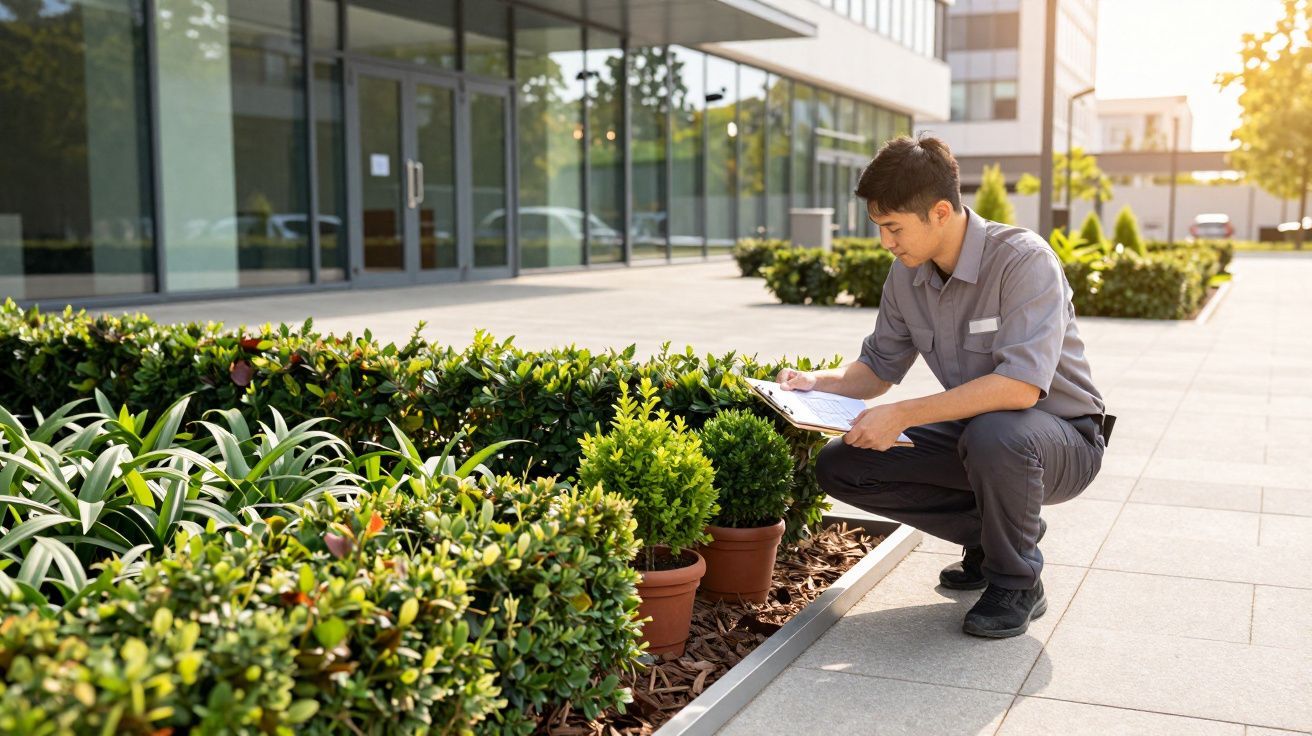
Commercial gardens rarely get to “see what grows”. In commercial landscaping, planting plans for a commercial property are built to perform on schedule, under scrutiny, and with limited tolerance for failure. The stakes are simple: dead beds look like neglect, and neglected sites lose tenants, customers, and trust.
Home gardens can indulge experiments and seasonal whims. Commercial sites are judged daily by footfall, brand standards, and safety checks, so they follow stricter planting logic by necessity-not snobbery.
The job is performance, not personal taste
A commercial planting scheme is usually measured against outcomes: tidy borders in February, colour when the café terrace is busiest, and entrances that still look intentional after a weekend of wind and litter. That pushes designers towards predictable plant behaviour and away from anything that needs constant coaxing.
It also changes the “design brief”. In domestic spaces, planting can be intimate and idiosyncratic. On a managed site, it has to read clearly at speed, from a car park, and from the far end of a reception lobby.
The key difference: commercial planting is an operating system, not a hobby.
Footfall, sightlines, and liability rewrite the plant list
People interact with commercial gardens harder and faster than they do at home. Shortcuts appear. Cigarette ends land in beds. Deliveries crush edges. That wear dictates tougher choices.
Common constraints that force stricter logic:
- Visibility and security: low planting near entrances and corners to reduce hiding places and improve sightlines for CCTV.
- Trip and slip risk: avoiding species that drop messy fruit, shed slippery leaves, or create uneven ground cover near paths.
- Allergens and irritants: limiting high-pollen plants in high-traffic areas, and avoiding spiky or toxic species where children pass.
- Root and drainage behaviour: steering clear of aggressive roots near paving, soakaways, and underground services.
A yew hedge might be elegant, but it’s also toxic. A crab apple might be charming, but its fallen fruit can become a skating rink by the main doors. In commercial work, those trade-offs are decided early and documented.
Maintenance budgets create “low drama” planting
Commercial gardens aren’t maintained by hope; they’re maintained by a contract. That contract has hours, visit frequencies, and seasonal tasks priced in. Plants that demand fine pruning, constant deadheading, or winter wrapping quickly blow up those assumptions.
That’s why you see more of the following:
- plants with long “presentable” windows rather than short peaks
- fewer delicate cultivars and more robust, repeatable varieties
- mass planting that can be maintained quickly with clear edges and access
It’s not that commercial landscapes avoid beauty. They avoid beauty that needs a daily rescue mission.
The hidden driver: speed of upkeep
If a team has 45 minutes on site, planting must allow efficient routines: litter pick, quick weed pass, trim, and move on. Dense groundcover that suppresses weeds, shrubs that hold their shape, and perennials that don’t collapse after rain are all time-savers.
Microclimates are harsher around buildings
Commercial property creates its own climate problems. Wind tunnels between blocks, reflected heat from glazing, shade from overhangs, and dry soil under canopies all punish the wrong plant choices.
A domestic garden might have one awkward corner. A business park can have five different microclimates within a single frontage. That forces a more engineered approach:
- Right plant, right place becomes non-negotiable.
- Beds are selected to tolerate drought, wind, and compacted soil.
- Irrigation (if present) is designed around zoning, not wishful thinking.
A plant that thrives in a sheltered back garden can fail repeatedly outside a main entrance where heat bounces off paving and the wind never stops.
Seasonality is planned around business, not the calendar
Retail parks, offices, hotels, and residential blocks have predictable high-visibility periods: leasing season, event season, summer terrace use, end-of-year visits. Planting is tuned to those moments.
That usually means planning for:
- strong evergreen structure so winter doesn’t look empty
- reliable spring impact when budgets reset and inspections happen
- summer resilience when watering is most stretched
You’ll often see fewer “one-week wonders” and more plants that look good for months, even if they’re slightly less exciting at peak.
Replacement risk and supply chains matter more than you’d think
Commercial planting has to be repeatable. If a run of shrubs fails, you need replacements that match-size, form, and finish-without waiting half a year for a specialist nursery.
That leads to stricter specifications:
- common nursery stock that can be sourced quickly
- consistent cultivars for uniformity across multiple sites
- plant sizes that establish fast without excessive aftercare
A rare plant might be perfect on paper, but if it can’t be replaced in two weeks, it’s a liability in a prominent bed.
A simple logic model used on many sites
Here’s how commercial planting decisions often stack up in practice.
| Priority | What it protects | Typical outcome |
|---|---|---|
| Safety and access | People, compliance, operations | Clear sightlines, non-slip choices, controlled height |
| Reliability | Brand, tenant confidence | Robust species, repeatable layouts, fewer failures |
| Maintainability | Budget, consistency | Low-drama plants, fast routines, tidy structure |
This isn’t about lowering standards. It’s about delivering standards every day, with real-world constraints.
What this means if you manage a site
If you’re responsible for a commercial property, stricter planting logic is a tool, not a limitation. The best schemes are the ones that still look intentional after a missed visit, a hot week, and a windy weekend.
A useful way to brief your contractor is to ask for three things up front: a planting palette that matches site microclimates, a maintenance method that fits the contract hours, and a seasonal plan that aligns with your busiest periods. When those three align, commercial gardens stop being fragile showpieces and start behaving like assets.





Comments (0)
No comments yet. Be the first to comment!
Leave a Comment