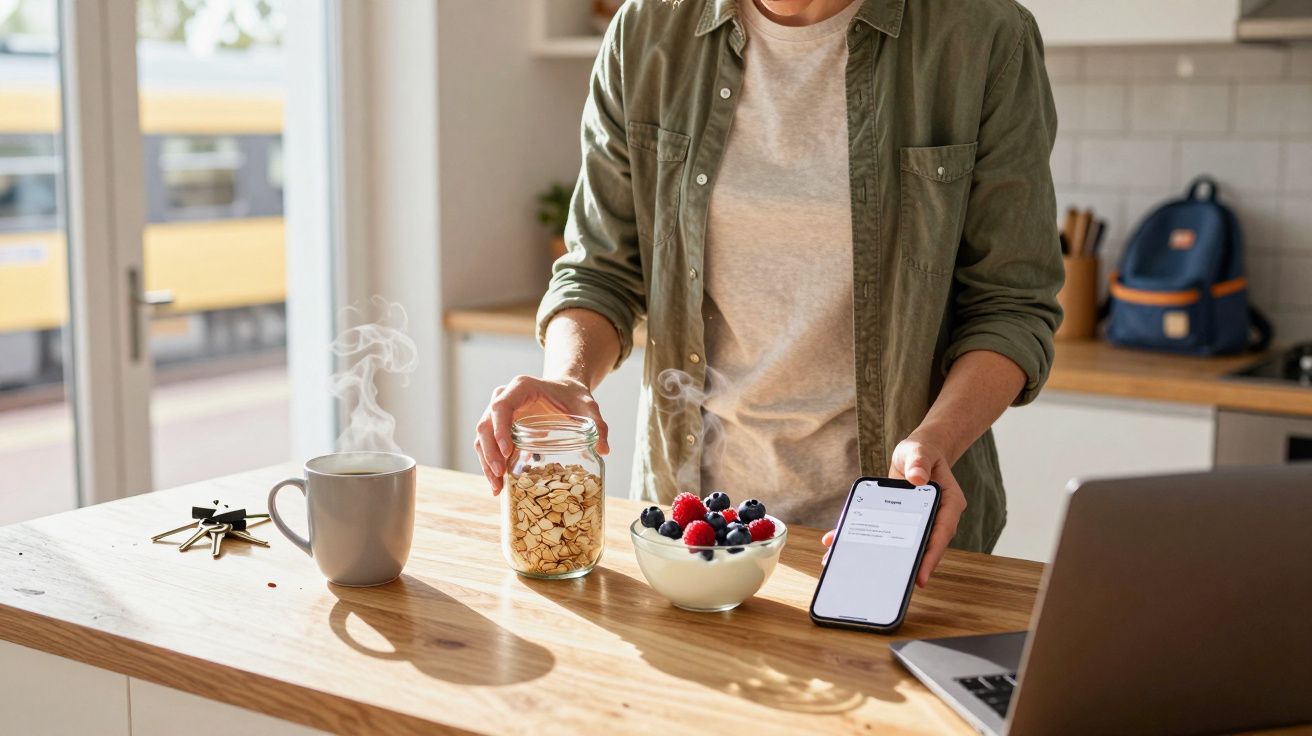
I didn’t expect my breakfast epiphany to arrive via a pop-up chat box. There it was on my screen - “it seems you haven't provided any text to translate. could you please provide the text you'd like translated into united kingdom english?” - followed immediately by “of course! please provide the text you would like translated.” It’s the kind of polite, slightly robotic exchange that lives in the background of modern life, and it matters because breakfast is starting to look exactly like that: improvised, prompted, and shaped by whatever system you’re interacting with at 7.43am.
Because breakfast isn’t just “what you eat in the morning” anymore. It’s what fits between a delayed train notification, a child’s missing PE kit, a meeting that could’ve been an email, and the quiet realisation that you can’t remember the last time you sat down with a bowl and nowhere to be.
The old breakfast story is falling apart
For a long time, breakfast had a script. Cereal at the table. Toast on a plate. A hot drink you drank while looking out of the window like you were in an advert for stability. Even when life was hectic, the idea of breakfast was domestic: something you “had” before you “went”.
Now the morning is less like a doorway and more like a moving walkway. People aren’t skipping breakfast purely out of laziness; they’re skipping the format of breakfast because the day has started before their body has caught up. The meal isn’t gone. The boundaries are.
You can see it in what’s selling, but you can also see it in how people talk. We don’t say “I had breakfast” so much as “I grabbed something”. That verb - grabbed - tells you everything.
The quiet drivers: time, glucose, and a phone full of nudges
There are three forces changing breakfast faster than most people realise, and none of them are about people suddenly hating toast.
First: time. Commutes are patchier, work is more hybrid, and mornings are filled with micro-decisions. When your first meeting is at 9.00 and your inbox is already performing, you don’t want another task called “make breakfast properly”. You want “edible, now”.
Second: blood sugar awareness has gone mainstream. Not in a perfect, clinical way - more in an anxious, group-chat way. People have absorbed the idea that a sweet breakfast can make them crash, that protein keeps them steady, that fibre is a kind of moral good. Even if they can’t explain the science, they can explain the feeling: “If I eat that, I’m starving by 10.30.”
Third: phones have become breakfast editors. Recipe reels, “what I eat in a day” clips, protein targets, step counts, sleep scores - it’s a constant low-level suggestion that your morning meal is either setting you up for success or quietly sabotaging you. It’s exhausting, which is why so many breakfasts are becoming simpler, repeatable, and slightly defensive.
Breakfast used to be a meal. Now it’s often a strategy.
The new breakfast: portable, higher-protein, and less romantic
The biggest shift isn’t that people have stopped eating. It’s that they’ve stopped staging breakfast.
A lot of modern breakfasts are designed to be eaten one-handed, in transit, or at a desk without drawing attention. They’re built around satiety and convenience: yoghurt pots, protein shakes, overnight oats, pre-made egg bites, microwave porridge, bananas eaten over the sink.
And even when people do sit down, the meal is often engineered. Not necessarily joyless, but purposeful. The same rotation, the same macros, the same ingredients bought on autopilot. It’s breakfast as a reliable setting, not a daily event.
Common “new breakfasts” you’ll hear people admit to, slightly sheepishly:
- A coffee first, then “something” later when hunger becomes undeniable
- Greek yoghurt with whatever fruit is about to go off
- Oats made the night before because mornings are chaos
- A supermarket pastry eaten in a hurry and regretted by 11.00
- Leftovers, because rules feel optional before 9am
None of this is decadent or quaint. It’s functional. That’s the point.
Why it’s speeding up now (and not slowly over years)
It’s tempting to think breakfast trends change like fashion: gradually, with the odd throwback. But breakfast is changing more like software. Small frictions get removed, and suddenly everyone’s behaviour shifts.
When more people work from home, you’d expect more cooked breakfasts. But what actually happens is stranger: the kitchen becomes always available, so breakfast stops needing its own slot. People graze. They delay. They drink coffee, answer messages, then realise it’s nearly lunch. The morning meal dissolves into the day.
At the same time, food companies have got extremely good at selling “breakfast-shaped” products that require no cooking and minimal thought. The packaging does the decision-making. The portion is pre-agreed. The texture is designed to be eaten quickly. It’s hard to compete with that when you’re half-awake.
And then there’s the social shift: fewer shared mornings. More people live alone, co-ordinate different schedules, or do the school run on rotation. When you’re not eating with someone, breakfast becomes easier to skip - and easier to replace with whatever feels manageable.
What people are gaining (and what they’re quietly losing)
There’s a lot to like about the new breakfast. Many people genuinely feel better on a steadier, higher-protein morning. Others are relieved to stop forcing themselves through food early, just because tradition says “you should”. If you’re not hungry at 7am, you’re not hungry. That’s not a moral failing.
But there’s a trade-off we don’t talk about much: breakfast used to be a soft landing. A pause before the day started performing. When breakfast becomes a commute snack or a desk activity, the morning gets sharper. More efficient, yes - but also more relentless.
You see it in little comments: “I didn’t even taste it.” “I ate it on a call.” “I forgot I’d had anything.” Food turns into fuel, which can be fine, until you realise you’ve removed one of the few predictable breaks you used to have.
A small reality check for your own mornings
If your breakfast feels “off” lately, it’s worth asking a boring but useful question: is the problem the food, or the format?
Try this for a week:
- Pick one breakfast you can repeat without thinking.
- Make it easy to access (same shelf, same bowl, same routine).
- Decide whether you’re eating it at a table, at your desk, or on the move - and be honest.
- Notice what changes: hunger at 11.00, mood, snacking, stress.
This isn’t about building a perfect morning. It’s about removing the daily negotiation.
The next shift: breakfast becomes personalised - and less shared
The direction we’re heading is simple: fewer universal rules, more individual patterns.
Some people will do an early protein-heavy breakfast because it stabilises their day. Others will delay their first meal because it suits their appetite, their meds, their workouts, their commute. Breakfast will keep splitting into “what works for me”, which sounds freeing - and is - but it also means the classic shared breakfast moment becomes rarer.
That’s why the change feels fast. It isn’t one trend. It’s a thousand private adaptations, happening quietly, until one day you look around and realise almost nobody is having the breakfast you grew up with.
FAQ:
- Is skipping breakfast actually bad for you? Not automatically. Some people feel fine delaying food; others get shaky, irritable, or over-snack later. The useful test is how you feel by mid-morning and what it does to your eating pattern for the rest of the day.
- Why does a sugary breakfast make me hungry again so quickly? For many people, a high-sugar, low-fibre breakfast can spike blood sugar and then drop it, which feels like a crash. Adding protein and fibre often helps you stay fuller for longer.
- What’s a “good” breakfast if I have no time? Something you’ll actually eat, consistently. A simple rotation like yoghurt and fruit, porridge, eggs on toast, or a sandwich can beat a perfect plan you never follow.
- Are protein breakfasts just a trend? Protein is having a moment, but the underlying idea - staying full and steady - is practical. You don’t need powders to do it; dairy, eggs, beans, nuts, and leftovers all count.
- How can I make breakfast feel less rushed? Change the format, not your personality. Pre-portion one option, reduce decisions, and sit down for even five minutes if you can. The pause is often the benefit, not the recipe.



Comments (0)
No comments yet. Be the first to comment!
Leave a Comment