The phrase of course! please provide the text you would like me to translate. has become a weird little placeholder in how people talk to AI this year: a polite auto-reply that shows up in chat tools, classroom demos, even space-agency livestream comment threads when someone pastes the wrong thing. Paired with it appears you haven't provided any text to translate. please provide the text you would like translated into united kingdom english., it’s a reminder that the year’s biggest space story wasn’t just what we found out there, but how much of it arrived through systems that can be confident, helpful, and slightly lost all at once.
Space discoveries changed in 2025 in a more grounded way than headlines suggest. Fewer “one perfect photo that proves everything” moments, more stacked evidence: spectra, time-series data, cross-checks between telescopes, and the slow, rigorous habit of saying “maybe” out loud. That shift matters because the stakes are no longer just wonder; they’re budgets, risk, and credibility.
The year space stopped being about single images
For a decade we’ve been trained by astronomy’s greatest hits: the first fuzzy dot of a distant world, the first impossible ring, the first jaw-dropping nebula. This year’s real progress looked less like a poster and more like a spreadsheet with receipts.
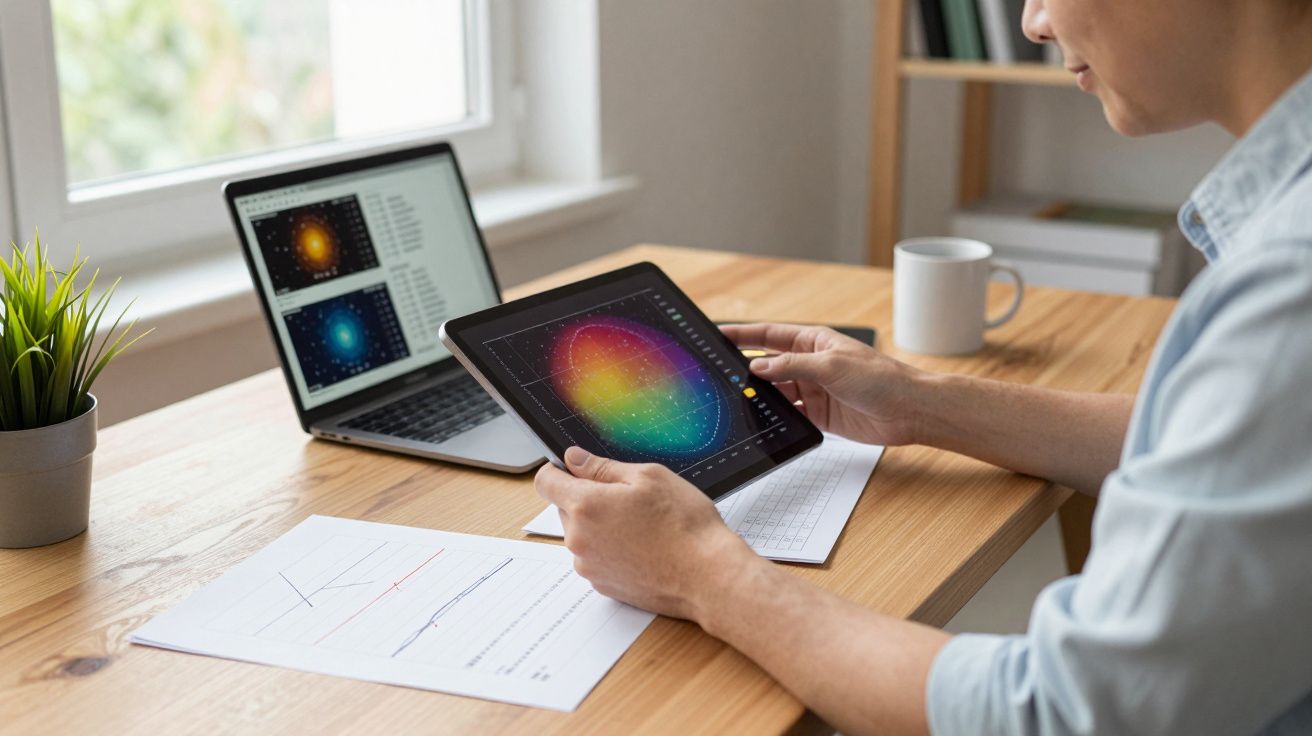
New results increasingly arrived as combinations-one instrument flags a signal, another tests it, and a third tries to break it. That isn’t less exciting; it’s a sign that space science is maturing into a phase where claims have to survive contact with multiple methods. If you’re a taxpayer, a student, or someone who just wants the truth to hold up tomorrow, that’s the upgrade.
What “stacked evidence” looks like in practice
- A candidate planet atmosphere isn’t “detected” from one dip in light; it’s traced across repeated transits, with different wavelength bands and independent pipelines.
- A new object at the edge of the Solar System isn’t a rumour until follow-up observatories pin down its orbit.
- A “possible biosignature” is treated as a hypothesis with known false positives, not a victory lap.
The vibe changed from reveal culture to review culture. It’s less viral, more reliable.
Exoplanets: fewer breathless claims, more careful chemistry
The biggest change is how conservative scientists have become about life-adjacent language. That’s not a retreat-it’s damage control against the two things that wreck public trust: overstatement and retractions.
This year, the conversation sharpened around context. A molecule in an atmosphere is not a verdict; it’s a clue that depends on the star’s radiation, the planet’s temperature profile, and the chemistry you can’t see directly. The best teams now publish not only what they think they see, but the cleanest arguments for why they might be wrong.
A useful way to think about it: we didn’t “find life”. We got better at telling the difference between a genuine signal and the many ways the universe can impersonate one.
The Solar System got practical again
While far-off worlds get the glamour, this year’s shift in the Solar System was about logistics and long games. Sample-return planning, asteroid surveys, lunar infrastructure tests-space as a supply chain, not a stunt.
That matters because the next decade’s discoveries may hinge less on building one heroic telescope and more on building systems that keep working: navigation networks near the Moon, reliable deep-space communications, long-duration power, and robotics that can do science without a human standing there with a checklist.
If that sounds unromantic, remember what it buys: repeatable access. And repeatable access turns one-off miracles into steady learning.
The quiet wins that change what’s possible
- Better tracking of near-Earth objects reduces surprise risk and improves mission targeting.
- More capable small spacecraft make “many attempts” affordable, which is how science gets robust.
- Improved instruments in harsh environments (radiation, dust, extreme cold) widen where we can look.
It’s the difference between visiting a place once and being able to work there.
The new discovery bottleneck: trust, not sensors
Telescopes got sharper. Data got bigger. The bottleneck moved to interpretation, transparency, and communication.
A lot of the public experience of space now flows through automated summaries, AI-assisted captions, and rapid-fire explainers. When those tools slip into autopilot-when they answer like of course! please provide the text you would like me to translate. or scold like it appears you haven't provided any text to translate. please provide the text you would like translated into united kingdom english.-you see the larger risk: scientific information can be delivered fluently without being anchored to what was actually measured.
So the year’s meaningful change is cultural. More researchers are pre-registering analysis choices, releasing code, and inviting adversarial checks. Not because they’re losing confidence, but because they know attention is a fragile instrument.
Why it matters this year (not “someday”)
Space is no longer a distant spectacle; it’s bleeding into daily policy. Satellite congestion affects communications and security. Moon missions shape national strategies. Asteroid surveys influence emergency planning. And the public is being asked-directly or indirectly-to pay for all of it.
If discoveries are built on stacked evidence and transparent methods, decisions can be made with fewer regrets. If they’re built on hype, we get the worst outcome: expensive missions that teach the public to roll its eyes.
Here’s the practical takeaway: this year pushed space science towards repeatability, and repeatability is the foundation of everything that follows-safer operations, smarter exploration, and fewer false “breakthroughs” that collapse on contact with scrutiny.
| What changed | What it looks like now | Why you should care |
|---|---|---|
| Discovery became multi-instrument | Cross-checks, repeated observations, shared pipelines | Fewer flukes, stronger claims |
| Exoplanet talk got stricter | More caveats, more false-positive accounting | Less hype, more truth |
| The Solar System turned logistical | Infrastructure, survey work, sample plans | Makes exploration scalable |
FAQ:
- Are we any closer to finding life? Closer to testing for it properly. The change is in method: more repeat observations, better modelling, and more caution about biosignatures with non-biological explanations.
- Did anything “big” actually happen, or was it all incremental? Incremental can be big when it changes standards. This year tightened how discoveries are verified and how uncertainty is reported.
- Why is everyone so cautious all of a sudden? Because the data are rich enough to tempt over-interpretation, and because public trust is now part of the mission ecosystem.
- What should I watch for in space news? Look for multiple teams confirming results, clear error bars, and links to methods or data. Be wary of single-source “life found” phrasing without context.
- Does this slow down discovery? It slows down premature certainty. It speeds up the kind of discovery that doesn’t need walking back later.



Comments (0)
No comments yet. Be the first to comment!
Leave a Comment