You notice it at the gate, not at home: a staff member points at your bag, asks you to step aside, and suddenly the trip is about rules, not routes. That’s where “of course! please provide the text you would like me to translate.” and “it seems you have not provided any text to translate. please provide the text you would like translated into united kingdom english.” fit in as oddly familiar prompts-little reminders that if you haven’t prepared the right information, you don’t get a smooth outcome. Carry‑on rules have shifted in subtle but important ways this year, and getting them wrong now tends to cost you time, money, or both.
The change isn’t one single ban that hit everywhere overnight. It’s a patchwork of updated screening tech, tightened enforcement on “personal items”, and airlines quietly redefining what counts as included baggage. The result is the same: what you used to get away with is less likely to slide.
What actually changed in carry‑on rules
Most travellers think of carry‑on rules as one static list: liquids, batteries, sharp items, size limits. In practice, the biggest change this year is consistency-airports and airlines are aligning enforcement around the parts that create delays and disputes at the gate.
1) The “two bags” promise is getting narrower
Many airlines still advertise a cabin bag plus a personal item. The definition of “personal item” has tightened, and gate staff are more likely to measure it.
A tote that used to pass as “under‑seat” can be treated as a second cabin bag, especially on fuller flights. That means last‑minute fees, or your larger bag being taken and placed in the hold.
2) Battery rules are being policed more actively
Lithium batteries have always been a safety focus, but the on‑the‑ground reality is changing: loose power banks and spare batteries are more likely to be questioned, especially if they’re unlabelled or look damaged.
- Power banks generally must go in the cabin, not checked luggage.
- Spares should be protected against short‑circuiting (original packaging or taped terminals).
- Anything swollen, cracked, or suspicious is likely to be confiscated.
If you travel with camera kit, medical devices, or multiple chargers, expect more scrutiny rather than less.
3) Liquids are “changing”, but not in the way people assume
There’s a lot of noise about new scanners and the end of the 100ml rule. Some airports are rolling out equipment that can screen liquids differently, but the key detail is simple: rules may differ by airport, terminal, and even lane.
That means the safest assumption is still: - 100ml containers - all liquids in one clear, resealable bag - present it when asked
If you pack as if the limit is gone and you’re wrong at security, you lose items or miss your slot. That’s the year’s real shift: the risk is on the traveller.
Why it matters more this year than last
The pain point isn’t theoretical. The system is tighter: flights are full, turnaround times are short, and staff are under pressure to keep queues moving.
When cabin space runs out, the gate becomes a sorting machine. Anything borderline-bulging backpacks, a “personal item” that’s basically a weekender, duty‑free plus a third bag-gets dealt with quickly and not always kindly.
The practical rule now is: if it looks like it won’t fit under the seat or in the sizer, assume it will be challenged.
There’s also a quieter knock‑on effect: travel insurance and compensation don’t always cover “I had to pay because my bag was too big”. Many policies treat it as a preventable cost.
The new carry‑on reality: what to do before you leave
You don’t need to become an aviation lawyer. You need a small routine that reduces your odds of being picked off at security or the gate.
- Check your airline’s exact allowance for your fare type. “Basic” tickets often mean no full cabin bag.
- Measure your bag when it’s full, not empty. Soft bags grow; that’s what gets you.
- Pack a collapsible layer, not an extra bulky jacket tied to the handle. Loose items attract attention.
- Keep liquids and electronics easy to reach. The faster you comply at the belt, the less chance of a secondary check.
- Label power banks and carry spares sensibly. If the capacity marking has rubbed off, replace it.
If you’re travelling with gifts, remember that security doesn’t care that the bottle is expensive or that it’s sealed. The rule is the rule at the lane you happen to be in.
A quick “gate test” that saves money
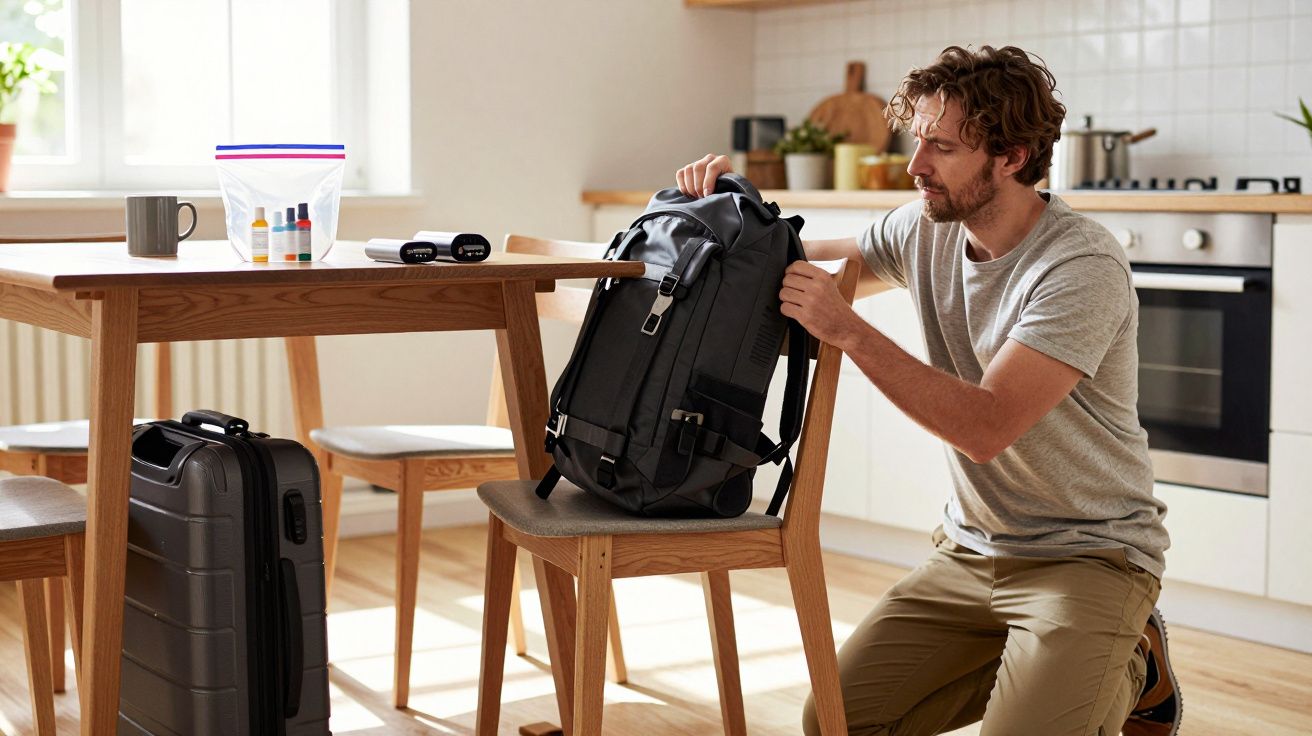
Before leaving home, do this: place your packed personal item under a chair at your kitchen table. If it doesn’t slide in easily, it probably won’t slide under an aircraft seat without a fight.
Then ask one blunt question: if the airline made you put it in a sizer while people watched, would it fit without forcing it? If the answer is “maybe”, repack now, not at the gate.
The most common catches
- Hard‑shell cabin cases that exceed depth once expanded
- Backpacks with rigid frames or stuffed front pockets
- Cross‑body bags worn in addition to a “personal item”
- Duty‑free bags treated as an extra item on stricter airlines
Where travellers get misled (and how to read the rules properly)
A lot of confusion comes from mixing three different authorities: 1. Airport security rules (what can go through screening) 2. Airline baggage rules (what you can take on the plane for your ticket) 3. Crew discretion and aircraft limits (what actually fits in overhead lockers)
You can be compliant with security and still pay a fee at the gate. And you can be compliant with airline rules and still be forced to gate‑check if the flight is full.
That’s why the “what changed” story matters: enforcement is increasingly happening at the handover points-security lanes and boarding gates-where there’s no time to argue.
FAQ:
- Do the 100ml liquid rules still apply everywhere? Assume yes unless your specific departure airport clearly states otherwise on its own website for your terminal, and be prepared for lanes that still enforce 100ml.
- Can I take a power bank in my checked suitcase? Generally no; keep power banks and spare lithium batteries in your cabin baggage, protected from damage and short‑circuiting.
- Is a handbag counted as a personal item if I also have a backpack? Often yes, meaning it can become a “third item”. If your airline allows only one under‑seat item, consolidate.
- Why are airlines stricter about bag size now? Full flights and limited locker space push enforcement to the gate, where staff need quick, standard decisions to avoid delays.





Comments (0)
No comments yet. Be the first to comment!
Leave a Comment