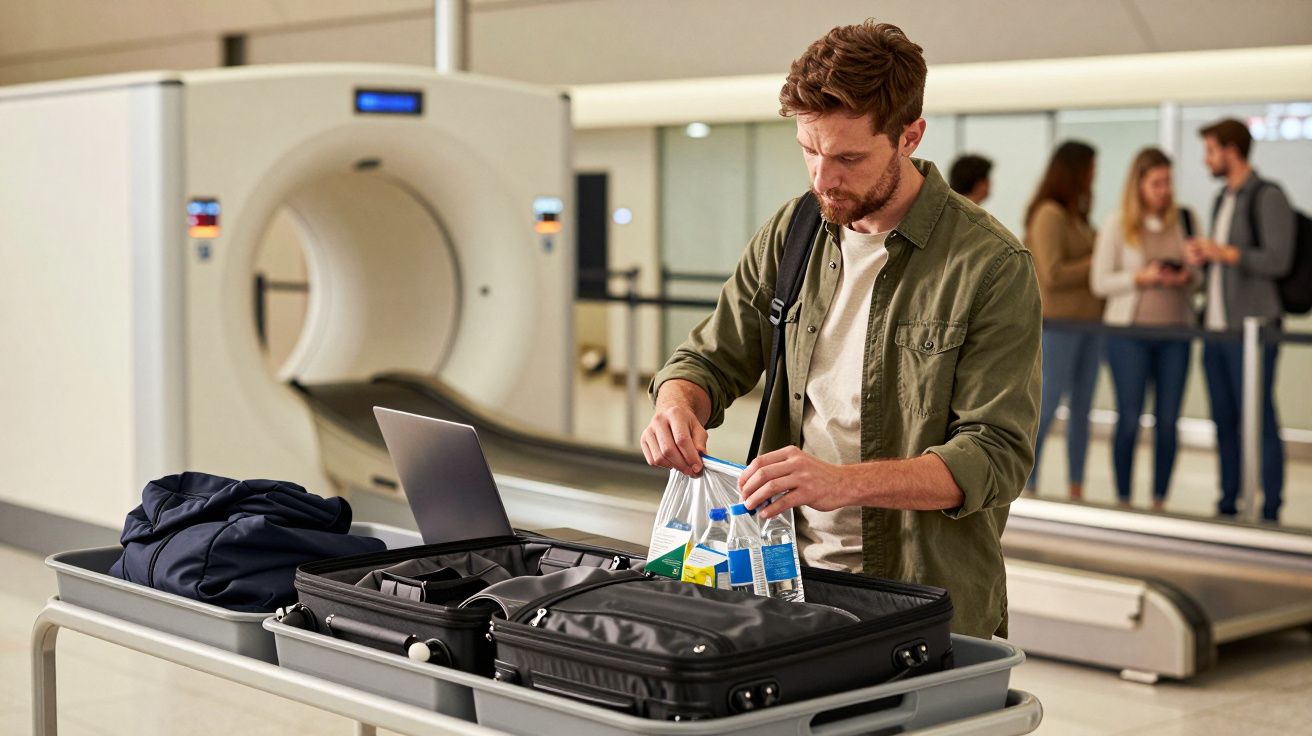
I heard “sure! please provide the text you would like me to translate.” again last week, but this time it wasn’t a language tool-it was a frazzled passenger at the security trays, trying to explain a liquid bag rule to a mate. The reply from the queue was basically “it appears you haven't provided any text to translate. please provide the text you'd like translated into united kingdom english.”: a weary, polite version of “you’ve brought the wrong stuff and now we all wait”.
Airport security changed in small, sharp ways over the last year, and the point isn’t to make travel harder. It’s to move people through faster without letting risk slip through the gaps, while airports quietly swap old X‑ray kit for the next generation.
The shift you can feel: better scanners, messier rules (for now)
The big change is technology. More UK airports have been installing CT scanners at security-3D imaging that can “look through” a bag in slices, rather than as a flat picture. In the best-case scenario, that means fewer bag searches, fewer tray rechecks, and a line that actually moves like it means it.
But 2025 has a frustrating twist: the rules are not uniform. Some airports (and sometimes specific lanes) can handle liquids and laptops differently, while others still need the old routine. That’s why two passengers on the same trip can report opposite experiences and both be telling the truth.
What actually changed at the checkpoint
Think of it as three layers: kit, rules, and staffing.
- Kit (the visible bit): CT scanners are spreading, with sharper detection and better “what is this object?” confidence. That can cut secondary checks when it’s working well.
- Rules (the confusing bit): liquids and electronics policies are in flux as airports roll out kit, calibrate it, and comply with national requirements. Some places trial relaxed procedures; others revert or tighten.
- Staffing and flow (the human bit): many airports have redesigned lanes, trays, and preparation areas to reduce the “tray panic” bottleneck. The best security isn’t just detection-it’s throughput without chaos.
The net effect: you might be asked to keep laptops in your bag at one airport, then remove them at the next. You might sail through with liquids, then be told to repack at the gate of another terminal. It’s not personal; it’s the awkward middle chapter.
Why it matters this year: time, stress, and missed flights
We’ve all watched a queue “suddenly” balloon when the trays back up. One slow family repacking becomes ten minutes for everyone behind them, and the knock-on effect is real: missed boarding, rushed connections, and a terminal full of people who don’t buy food because they’re sprinting.
There’s also a security reason this matters. Better imaging can reduce reliance on blunt rules, but only if the process is consistent and passengers understand what to do. Confusion creates friction, and friction creates distraction-on both sides of the belt.
A practical playbook for the new, inconsistent era
Treat security like a short sequence you rehearse, not a surprise exam. The goal is to be the person who doesn’t need a second try.
- Check your departure airport’s security page the night before. Don’t assume “UK airports all do it the same way”.
- Pack liquids so you can adapt in 10 seconds. Even if you think you can keep them in, keep them together so you can pull them out fast.
- Keep electronics “top accessible”. Not because you’ll definitely remove them, but because you might be asked to.
- Empty pockets before you reach the trays. It sounds basic, yet it’s the number one cause of that awkward second walk-through.
- Dress for speed: belt that doesn’t beep, shoes that slip off easily if required, minimal metal.
- If you’re stopped, stay literal. Tell staff what the item is and where it is. The fastest bag searches are the ones with no guessing.
Common mistake: people optimise for one airport’s routine, then get rattled when the next airport flips it. Pack for flexibility, not for certainty.
The quiet changes you don’t notice (but your bag does)
Some airports have altered what they care about most: not just liquids, but dense clutter. Overpacked bags create layered “shadows” that make any scanner less confident, CT included. If your cabin bag looks like a drawer stuffed shut, you’re more likely to be pulled, regardless of how modern the lane is.
Another subtle change is how staff manage “tray economics”. Many lanes now push you to use fewer trays, stack items carefully, and keep things flat. It isn’t fussiness. It’s about keeping the belt moving so images stay readable and the line doesn’t jam.
What to watch for next
If you’re flying frequently this year, pay attention to these signals:
- Signage that mentions CT or “3D scanners”: you may be allowed to keep laptops/tablets in, but don’t bet your flight on it.
- Different rules by terminal: airports often upgrade in phases. Terminal A can be “new world”, Terminal B can be “old world”.
- A sudden return to strict liquid limits: this usually reflects compliance shifts or operational readiness, not a random crackdown.
The point isn’t that airport security is becoming kinder. It’s becoming more technical-and, in the transition, more inconsistent. If you plan for the messy middle, you buy yourself time, calm, and a much better chance of starting your trip without the belt-and-tray drama.
| What changed | What it means for you | What to do |
|---|---|---|
| CT scanners expanding | Fewer bag searches in some lanes | Keep items accessible anyway |
| Rules vary by airport/terminal | Your “usual routine” may fail | Check guidance before you travel |
| Flow design and tray control | Faster lanes if you cooperate | Reduce clutter; prep early |
FAQ:
- Can I keep liquids and laptops in my bag now? Sometimes. It depends on the airport, terminal, and lane. Pack so you can remove them quickly if asked.
- Why do rules differ within the same country? Upgrades happen in phases, and procedures can change as airports validate equipment and comply with updated requirements.
- What’s the fastest way to avoid a bag search? Keep your cabin bag uncluttered, pack liquids together, and make electronics easy to access. Dense, messy layering is a common trigger for secondary checks.
- Is arriving earlier still necessary with newer scanners? Yes. New kit can speed things up, but inconsistency and peak-time surges still cause queues. Treat any time saved as a bonus, not a plan.
- What should I do if staff instructions conflict with what I read online? Follow staff directions on the day. Procedures can change quickly, and the lane team’s instruction is what determines whether you get through smoothly.



Comments (0)
No comments yet. Be the first to comment!
Leave a Comment