
Tree pruning in an established garden is rarely about “making it look tidy”. It’s a quiet form of control: keeping light moving through old branches, stopping weight from tearing limbs in a gale, and making fruiting wood behave. The habit that keeps turning up, again and again, is not a fancy cut or a new tool-it’s the same simple restraint.
I first noticed it in a back garden where everything looked slightly too calm. Old apple, mature lilac, a privet hedge that had clearly seen decades, and not a single stubby stump in sight. The owner, well into his seventies, showed me the “secret” with a shrug: he never took too much in one go, and he always cut back to something-never to nothing.
The old-garden habit: thinning, not topping
Older gardens often carry the scars of heavy-handed cutting: lopped tops, blunt stubs, and that frantic tuft of shoots that springs up afterwards like a bad haircut. The habit you’ll see in well-kept, long-lived gardens is the opposite. It’s thinning-removing selected branches right back to their point of origin, or back to a smaller side branch, so the tree keeps its natural outline.
This matters because trees respond to brutality with panic. Hard “topping” triggers a flush of fast, weak regrowth (water shoots), which then shades the interior, catches wind, and fails under its own weight. Thinning lets you reduce crowding and size without winding the tree up.
There’s a look to a properly thinned tree: you can see little windows of sky through the crown, but it still feels full. That’s the tell.
Why it works (and why it keeps getting passed down)
The logic is mostly physics and a bit of plant behaviour. When you remove a whole limb at the collar, you’re simplifying the structure-less leverage, less sail, fewer crossing points that rub and invite disease. When you cut back to a side branch, you redirect growth rather than provoking a frenzy.
It also matches the pace of an established garden. Mature trees don’t need constant interference; they need periodic, thoughtful reduction that preserves their framework. Older gardeners learn, often the hard way, that a tree you “fix” in one afternoon can spend five years punishing you for it.
A useful rule from the old hands: if you’ve made it uglier, you’ve probably done too much.
How to do it today, step by step
Choose a dry day, take a minute to stand back, and decide what you’re really trying to achieve: light, clearance, safety, fruiting, or shape. Then work in this order.
- Remove dead, damaged, diseased wood first. It’s non-negotiable and it clarifies what you’re working with.
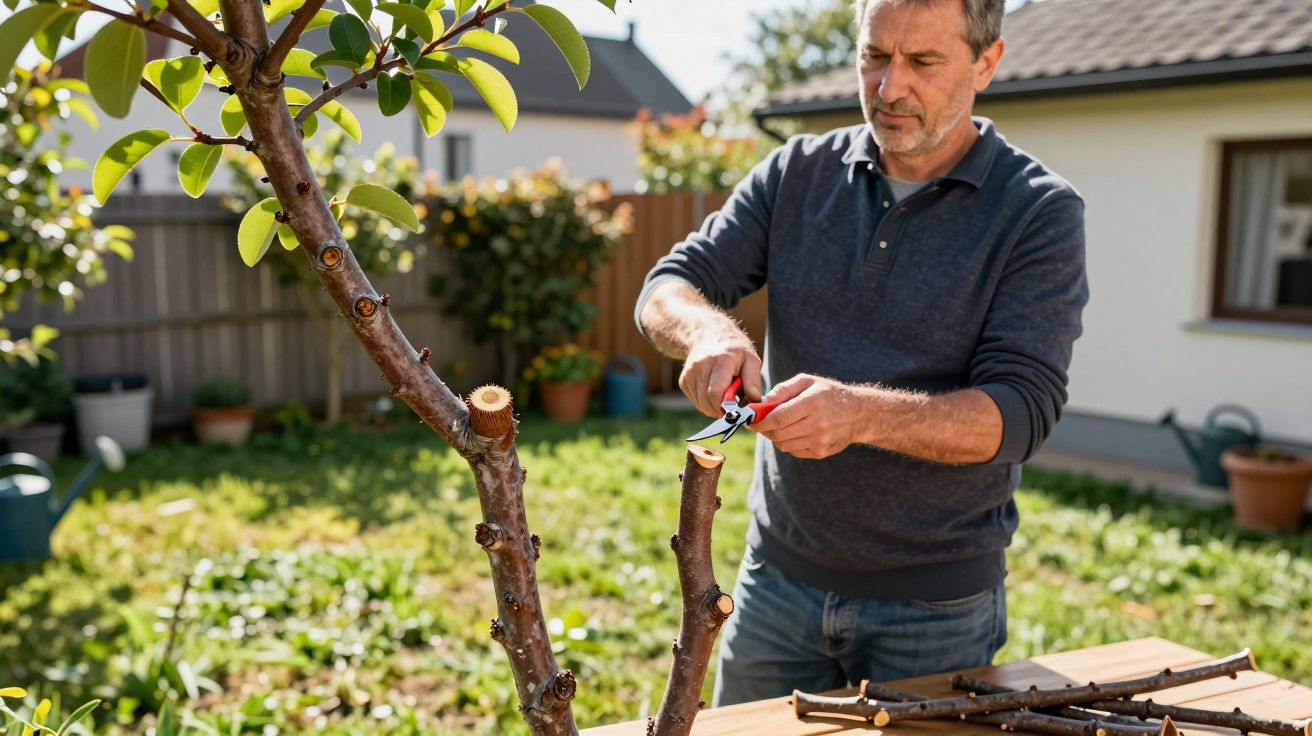
- Take out crossing and rubbing branches. Pick the better-placed one and remove the other at the branch collar.
- Thin crowded areas by removing entire branches. Aim for a few well-chosen cuts, not lots of nibbling.
- Reduce length by cutting back to a lateral branch. The side branch should be substantial enough to “take over” (as a rough guide, at least a third the diameter of the piece you’re removing).
- Stop early and reassess. Walk away, look from a different angle, then decide if you truly need another cut.
Keep the cuts clean, just outside the branch collar, and avoid leaving stubs. For anything thicker than about a wrist, it’s worth using the three-cut method (a small undercut, a top cut to drop the weight, then the final cut at the collar) to prevent bark tearing.
“Take a branch, not a haircut,” my neighbour said, and then went back to weeding as if it wasn’t philosophy.
The common slip-ups that older gardens quietly avoid
Most mistakes aren’t malicious. They come from rushing, or from trimming like you’d trim a hedge.
- Topping to control height. It creates weak regrowth and long-term problems. If a tree is too big for its spot, consider professional reduction, formative pruning (on younger trees), or replacement with a better-suited species.
- Lion-tailing (stripping inner growth, leaving tufts at the ends). It makes branches heavier at the tips and more likely to fail.
- Lots of tiny cuts everywhere. That “neatening” can stimulate more shoots and more density, which is the opposite of what you want.
- Pruning at the wrong moment for the wrong tree. Stone fruit (plum, cherry) generally prefer summer pruning to reduce disease risk; many deciduous trees and apples/pears tolerate winter pruning well. When in doubt, check the species.
The older-garden habit is conservative: fewer cuts, better placed.
A quick guide for deciding what to cut
Use this as a small checklist before each cut. If you can’t answer “yes” to at least one, leave it.
- Does it remove a hazard (deadwood, cracking, rubbing)?
- Does it improve light and airflow through the canopy?
- Does it reduce weight on a long, overextended limb?
- Does it help keep a clear leader or a balanced scaffold?
- Does it open space for underplanting or access in the garden?
| Aim | Best cut type | What it prevents |
|---|---|---|
| More light through the crown | Thinning (remove whole branch) | Dense shade, mildew-prone canopies |
| Smaller, steadier shape | Reduction to a lateral | Weak water-shoot regrowth |
| Safer structure | Remove rubbing/overextended limbs | Splits, bark wounds, storm damage |
What you’ll notice next season
A thinned tree often looks almost unchanged the day you finish, which can feel anticlimactic if you were expecting a dramatic reveal. Then spring arrives and you see the point: fewer vertical whips, more balanced leafing, blossoms where you can actually see them, and fruit that colours more evenly because light can reach it.
In an established garden, that subtle improvement is usually the goal. The best pruning job is the one that doesn’t announce itself-until the tree has to carry wind, rain, and a heavy crop without complaint.
FAQ:
- When is the best time to prune? For many apples and pears, winter is traditional; for plums and cherries, summer is often safer. Always check the species and avoid pruning in hard frost or very wet conditions.
- How much can I remove in one go? In general, avoid taking more than about 20–25% of the canopy in a season on mature trees. Older gardens stay healthy by spreading big changes over years, not afternoons.
- Do I need to seal the cuts? Usually no. Clean cuts in the right place allow the tree to compartmentalise naturally; wound paints often do more harm than good.
- What if the tree has already been topped? Don’t re-top. Start a gradual recovery: remove a few of the weakest shoots, thin for airflow, and over time select better-placed regrowth to become new structure. For large trees, get an arborist’s advice.


Comments (0)
No comments yet. Be the first to comment!
Leave a Comment