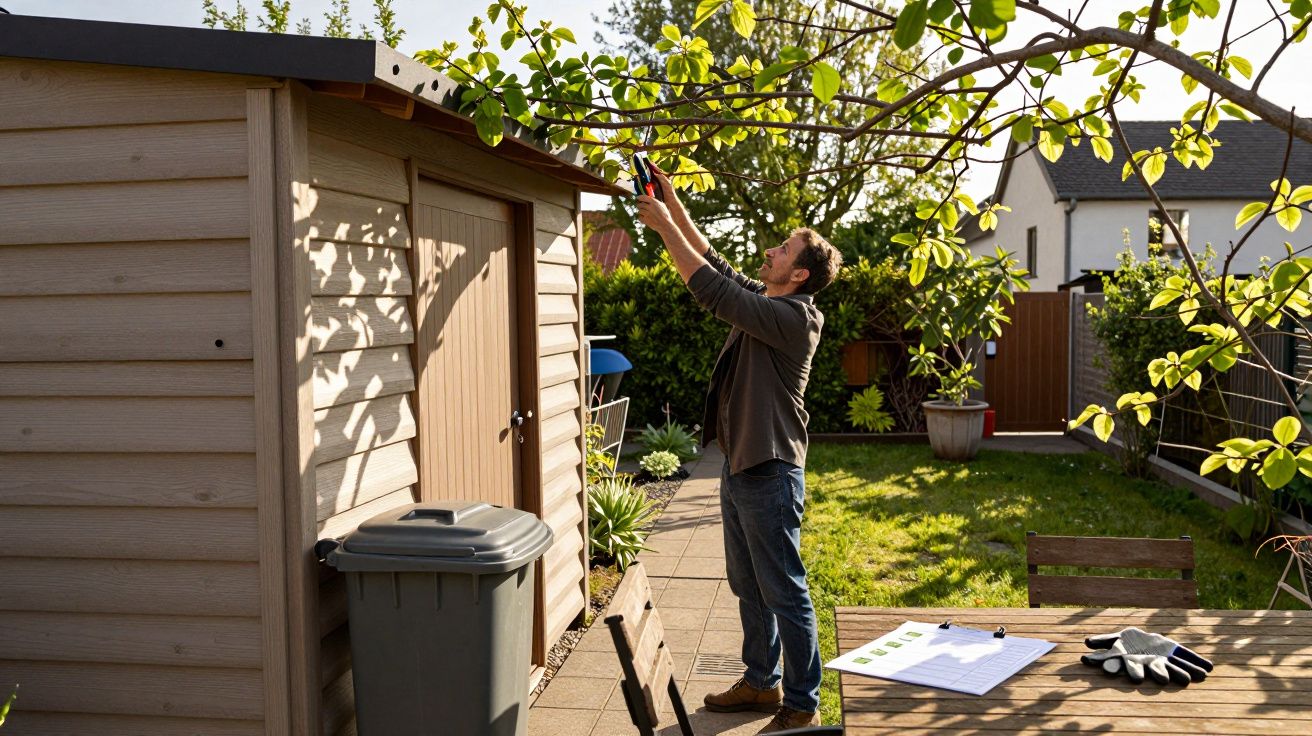
The moment you pick up the secateurs, tree pruning stops being a “plant job” and turns into a space decision. Your garden layout - paths, fences, sheds, sightlines from windows - often matters more than the textbook shape of the crown. Done well, pruning buys you light, clearance and calm; done badly, it can make a small garden feel even tighter.
I’ve watched people trim a tree because it looked “a bit big”, when what they really needed was to keep a walkway usable or stop branches scraping the conservatory roof in wind. The tree wasn’t the problem. The surrounding space was.
The choice most people think is about the tree (but isn’t)
In a roomy garden, you can let a tree carry its natural silhouette and still have shade, privacy and a lawn that doesn’t sulk. In a narrow side return or a compact new-build plot, the same species becomes a constant negotiation: head height over the path, distance from the boundary, light into the kitchen, leaves in the gutter.
That’s why the “right” cut is often less about what the tree can biologically tolerate, and more about what the space can realistically accommodate for the next five years - not just this weekend.
A useful way to think about it is this: you’re pruning to protect a function. The function might be access, light, a view, a neighbourly boundary, or simply the ability to sit outside without feeling hemmed in.
Read the space first: three questions that change the cut
Before you remove anything, stand where the conflict actually happens. Not at the trunk - at the back door, on the path, under the branch that clouts the shed roof.
Ask:
- What needs to pass underneath or beside this canopy? (People, bins, a mower, a car, a sightline for reversing.)
- Where does light need to land? (Veg beds, a patio, a living room window, a greenhouse.)
- What must not be touched in wind? (Roofs, overhead cables, fences, neighbouring trees, play equipment.)
Once you answer those, the pruning target becomes clearer: you’re not “reducing the tree”, you’re creating clearance and space where it matters. The same tree might need limb removal over a path, but hardly anything on the lawn side.
Common space-driven decisions (and what they really mean)
A lot of pruning terms get used loosely, so it helps to match the decision to the layout problem you’re solving.
1) “Lift the canopy” when the garden needs a corridor
If you’ve got a path, driveway, or seating area under the tree, the fight is usually at head height. Canopy lifting removes selected lower branches to create clear space underneath.
It can make a small garden feel instantly bigger, but it’s not a licence to strip the trunk bare. Keep enough lower structure for balance, and avoid removing a cluster of large limbs from one side - that’s how you invite lopsided weight and stress.
2) “Thin it out” when light is the issue - but space isn’t
If the footprint is fine yet the garden feels gloomy, light thinning can help by reducing density rather than size. This is the subtle one: you’re opening “windows” through the crown, not chopping the outline smaller.
The layout win is better dappled light and less sail effect in wind, without suddenly exposing you to neighbours or changing the shape into something harsh.
3) “Reduce it” when boundaries and buildings are non-negotiable
When a tree is simply too close to a shed, fence, or the neighbour’s washing line, reduction is often what people reach for. The surrounding space forces it: you need shorter laterals, more distance, fewer collisions.
The pitfall is overdoing it. Heavy reductions create lots of regrowth (often upright, fast and weakly attached), which means you’re signing up for more pruning later. In tight gardens, that can turn into a cycle: cut hard, regrow harder, cut again.
4) “Remove one limb” when the layout conflict is local
Sometimes the smartest space fix is not a general trim but a single, well-chosen branch removal - the one that blocks the gate swing, smacks the pergola, or rubs the roof tiles.
It feels almost too simple, which is why people miss it. But in a small garden, one limb can dominate how the space works.
The quiet rule: prune for the garden you actually use
People often prune as if the garden is a photograph: neat from one angle, fine for a week. Space-led pruning treats the garden as a route map.
A quick, practical check is to walk your regular loops:
- Back door to bin store
- Kitchen to washing line
- Patio to shed
- Gate to car (or bike storage)
Wherever you duck, squeeze, or detour, that’s where the tree is costing you space. And that’s where a targeted cut usually pays off.
How to avoid the two classic space mistakes
The first mistake is chasing symmetry. Gardens aren’t symmetrical: the path is on one side, the neighbour’s fence on another, the light comes from one direction. A slightly “one-sided” prune can be the most honest response to an uneven layout.
The second mistake is cutting to the boundary line as if it’s a wall. Branches don’t behave like timber. If you shear a crown back to a hard edge, you often trigger dense regrowth right where you least want it - at eye level, over the path, into the neighbour’s space.
If you need repeated control because the surrounding space is genuinely too tight, it’s worth considering the bigger decision: is this the right tree for this layout long-term?
A small checklist that keeps pruning sensible
You don’t need to be an arborist to plan well, but you do need to be deliberate.
- Choose the space outcome first (clearance, light, access, view).
- Make fewer, better cuts rather than lots of nibbling.
- Step back every few minutes and re-check from the problem spot.
- Avoid heavy pruning during active nesting season; check before you start.
- If the tree is large, near power lines, or you’re removing big limbs: bring in a qualified tree surgeon.
A garden can feel generous on surprisingly little square footage, but only if the canopy isn’t stealing the routes and light you rely on. The pruning decision so often comes down to this: what does your space need to do - and what can the tree do without being pushed into constant correction?
FAQ:
- Is it better to thin or reduce a tree in a small garden? It depends on the garden layout problem. Thin if you want more light and less density while keeping the same overall size; reduce if you need hard clearance from buildings or boundaries.
- How much canopy lifting is too much? If you remove too many lower limbs at once, you can stress the tree and make it unstable or unbalanced. Aim for gradual changes and keep enough lower structure for a natural shape.
- Can I just cut branches back to the fence line? You can, but it often leads to dense regrowth right at the edge and can look harsh. It’s usually better to make thoughtful cuts back to suitable side branches and plan for how the tree will respond.
- When should I call a professional? If the tree is large, close to structures, or any work requires ladders and a saw above shoulder height, use a qualified tree surgeon-especially near roads or overhead cables.





Comments (0)
No comments yet. Be the first to comment!
Leave a Comment