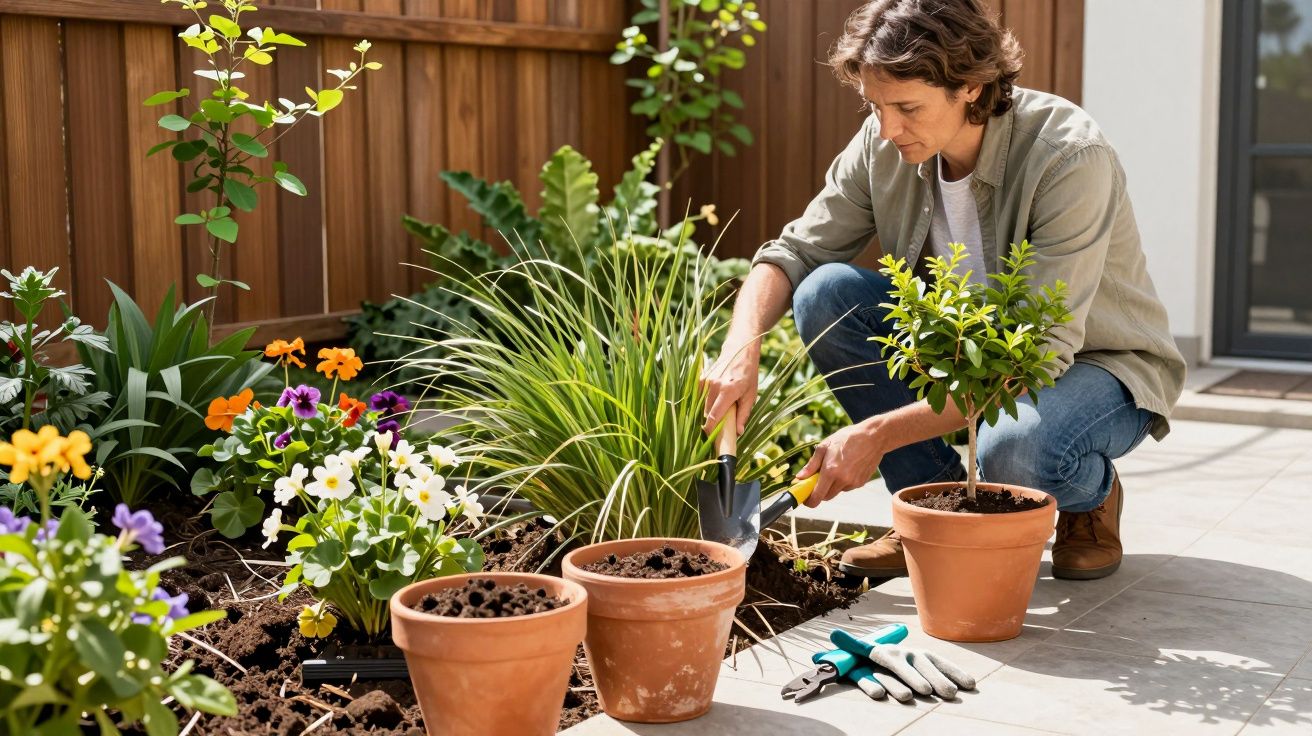
A planting plan can look calm and “finished” on day one, then feel oddly cramped two summers later. That’s where planting services earn their keep: they don’t just place plants for immediate impact, they map how space, light and root competition behave in a mature garden. For homeowners, the difference is simple - fewer costly replacements, less perpetual pruning, and borders that still make sense after everything has bulked up.
The trap is that young plants are polite. They sit neatly in their pots, hold their label height, and leave generous gaps that look like good design. Those gaps are not empty space - they’re future growth you either planned for, or you’ll be fighting.
The layout that “works” at planting time
Most balanced-looking schemes rely on repeating shapes and even spacing. Nurseries reinforce this by selling plants at a similar container size, so a line of three shrubs reads as a tidy rhythm even if their eventual sizes are wildly different.
A common example is a mixed border built on 60–90 cm centres: a few shrubs for structure, perennials for colour, and ornamental grasses for movement. In April, it photographs beautifully. By the second or third year, the shrubs have doubled, the grasses have flopped wider, and the perennials are trying to survive in the shade you accidentally created.
A border that looks “full but not crowded” at planting is often one season away from being crowded.
Why maturity breaks the symmetry
Plants don’t mature evenly. Some sprint for height, others spread sideways, and a few do both while also seeding into the gaps you meant to keep open.
The result isn’t just “more growth”. It’s a shift in microclimate: airflow reduces, humidity rises, and light levels at soil height drop. That’s when mildew appears, slugs multiply, and the tidy spacing you paid for turns into a maintenance obligation.
The growth mistakes that cause the mess
The same problems appear again and again, especially in new-build gardens and refreshed borders where instant impact is the priority.
- Assuming label sizes are realistic. Many tags quote “10-year size” or ideal conditions; your soil and aspect may push growth faster.
- Planting to current width, not eventual canopy. A shrub that arrives at 40 cm wide may want 120 cm in three years.
- Forgetting root competition. Crowded planting isn’t only above ground; roots compete early, and the weakest plant declines first.
- Stacking “part shade” plants under future shade. A small tree is not a small tree for long.
- Using grasses as soft filler. Many popular grasses balloon, collapse outward, and smother neighbours.
The tell-tale sign you’re already behind
If you’re pruning just to keep paths clear, rather than to improve shape or flowering, the layout is dictating your time. Another giveaway is a border that looks decent from a distance but messy at the front - that’s usually light loss and overcrowding, not “untidiness”.
Fix it without tearing everything out
A mature border rarely needs a full restart. It needs selective edits that restore light, space and hierarchy.
- Reduce the biggest plant first. One oversized shrub can be the cause of five struggling neighbours.
- Re-establish clear layers. Tall at the back, medium in the middle, low at the edge - and keep those layers honest.
- Create breathing lanes. Aim for small pockets of open ground or mulch breaks to improve airflow and access.
- Split or lift aggressive perennials. Divide clumps and replant only a portion; compost the rest.
- Replace “fussy” plants with resilient ones. If something needs constant pampering, it’s often in the wrong place.
Done well, these changes can make a crowded border feel intentional again within a weekend, especially if you mulch properly and edge cleanly.
How planting services plan for the garden you’ll actually have
A good installer isn’t guessing. They’re working from mature dimensions, seasonal behaviour, and maintenance tolerance - yours, not theirs. In practice, that means choosing fewer structural plants, spacing them for their final width, and using perennials that knit without strangling.
Expect questions that feel almost annoyingly specific:
- How many hours of direct sun in June, not “generally sunny”.
- Whether you’ll prune annually, occasionally, or never.
- If you want a neat look in winter, or you’re happy with seedheads and dieback.
- How you use the space: play area, entertaining, viewing from a kitchen window.
The best planting plans don’t maximise plant count. They maximise how long the border stays coherent.
A quick spacing reality check (before you plant)
Use this simple rule: if two plants will touch at maturity, you are choosing a “knit” effect. If they’ll overlap heavily, you are choosing ongoing pruning or future removal. Both can be valid - only one is effortless.
| Plant type | Typical maturity behaviour | Planning cue |
|---|---|---|
| Shrubs | Slow, then suddenly large | Space for final width, not pot size |
| Grasses | Expand, then flop outward | Give extra lateral room or stake plan |
| Perennials | Fill gaps fast, then compete | Choose spreaders selectively, divide routinely |
The goal: a border that ages well
A garden that matures gracefully isn’t sparse; it’s legible. You can still see the intended shapes, reach in to weed, and walk past without getting brushed. The planting feels balanced in year three because it was designed for year three.
If your layout only looks right on planting day, it isn’t finished - it’s just young.



Comments (0)
No comments yet. Be the first to comment!
Leave a Comment