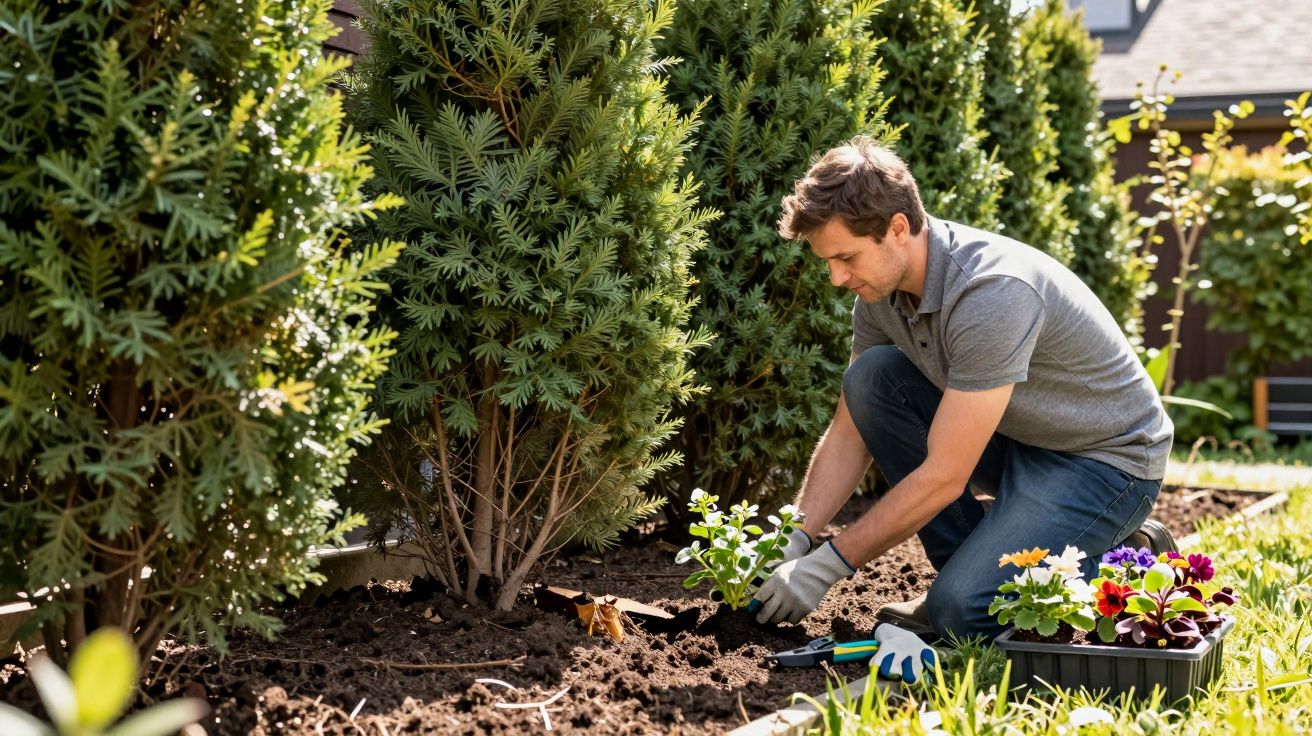
You hire planting services because you want the new borders to look “sorted” quickly, even if you’ve only just moved in. In an established garden, that instinct can feel especially sensible: match what’s already there, keep it tidy, don’t rock the boat. The trouble is the safest-looking planting choice on day one is often the one that causes the most drama by year three.
It usually starts innocently. A neat line of the same shrub, evenly spaced, guaranteed evergreen, labelled “low maintenance”. It photographs beautifully at handover, and for a while you feel like you’ve nailed adulthood.
Then the garden matures, and the bill arrives in a different currency: shade, crowding, mildew, bare ankles, and that slow realisation that “neat” has become “stuffy”. The plants didn’t misbehave - they just did exactly what they were built to do.
The ‘safe’ choice that turns on you later
The classic is mass planting one dependable evergreen (often laurel, photinia, cherry laurel, leylandii, or a wall of identical box substitutes). It reads as privacy, structure, and instant fullness. In a young garden, it’s a win: you get green quickly, weeds are hidden, and the space looks finished.
In a mature garden, the same choice can become a light thief. Evergreens hold their bulk all year, so borders never get that seasonal “breathing space” where bulbs, perennials and self-seeders can do their thing. The canopy thickens, the base gets leggy, and the interesting plants you added later start living on borrowed time.
A bigger problem is that uniform planting gives you uniform failure. One pest, one disease, one harsh winter, and an entire section declines together. It’s not dramatic like a storm - it’s worse: slow, expensive, and slightly embarrassing when guests say, “Did that always look like that?”
Why it feels sensible (and why it isn’t)
We all want predictability. When someone tells you a plant is tough, evergreen, and “will fill the gap”, your brain hears: fewer decisions, fewer trips to the garden centre, less chance of getting it wrong.
But gardens aren’t spreadsheets. Growth compounds, roots compete, and microclimates show up late - especially in an established garden where neighbouring trees, old walls, and decades of soil life create pockets of damp shade and dry heat you can’t see at planting time.
If you plant for the first six months, you end up managing for the next ten years. The irony is that the “safe” option often demands the most pruning, feeding, and firefighting once everything has knitted together.
The moment it flips: when ‘coverage’ becomes congestion
There’s a specific point - usually somewhere between year two and four - where the plants stop being separate individuals and become one continuous mass. Airflow drops. Leaves stay wet longer. Fungal issues appear and never quite leave, because the conditions are now perfect for them.
At ground level, you get the other classic: bare stems and dead zones. The top grows thick, the bottom is shaded out, and suddenly your “evergreen screen” is an evergreen lollipop forest with nothing happening where you actually see it.
What planting services should be doing instead
Good planting services don’t just install plants; they stage a future. That means choosing for mature size, layering heights, and building in change so the border looks good at year one and year five.
Here’s what that looks like in practice:
- Mix structure with softness. A few strong shrubs, then perennials and grasses that can shift and self-correct.
- Use repetition without monoculture. Repeat a palette, not a single species. Your eye still reads “designed”, but the garden stays resilient.
- Plant for light, not just looks. In an established garden, track where shade lands in summer, not just in March.
- Leave breathing space. Slightly under-planting at first feels wrong, but it prevents the inevitable crowding cycle.
And yes, it can still look finished quickly. The trick is using temporary fillers (annuals, bulbs, short-lived perennials) while the long-term framework grows into its correct proportions.
A quick sanity check before you commit
If you’re standing with a planting plan (or a trolley of “safe” evergreens), run this like a small pre-flight checklist:
- What does this plant look like at full size - not “in the pot”?
- Will the base stay leafy without constant pruning?
- If one plant fails, do I lose the whole look?
- What happens to everything underneath once it thickens?
- Am I planting for privacy, or for panic relief? (They’re not the same.)
That last question matters more than people admit. A lot of “safe” planting is really anxiety planting: we want to cover things up fast. The garden always charges interest on that decision later.
The mature-garden fix: how to undo it without ripping everything out
If you’ve already got the wall-of-green situation, you don’t have to bulldoze it. You just need to introduce gaps, layers, and light - slowly, deliberately, and with a plan.
Start small:
- Thin and lift existing shrubs to let air and light in at the base.
- Create windows by removing one in every three (or every five) and replanting those pockets with something different.
- Add an understorey of shade-tolerant perennials where you’ve reclaimed light: hellebores, epimedium, geranium nodosum, ferns, astrantia (if you have moisture).
- Edge with something low and forgiving so the border looks intentional while the new planting settles.
The goal isn’t novelty. It’s a garden that can mature without turning into a maintenance job you secretly resent.
| The “safe” move | What happens later | The better swap |
|---|---|---|
| One shrub, planted everywhere | Congestion, leggy bases, shared failure | Repeated palette, mixed species |
| Instant screens and dense hedging | Shade and damp pockets | Layered planting + selective screening |
| Planting to fill space now | Constant pruning later | Plant for mature size + temporary fillers |
FAQ:
- Is it always bad to use evergreens in bulk? No - but bulk should be strategic. Use evergreens as structure, then break them up with deciduous shrubs, perennials and grasses so the planting can breathe and recover from setbacks.
- How do I know a plant’s “mature size” is realistic? Check multiple sources, not just the label, and assume good conditions equal bigger growth. In sheltered, fertile established gardens, many shrubs outgrow their promised size.
- Can planting services make an instant garden without future problems? Yes, if they build a framework for year five and use temporary fillers for year one. “Instant” should come from clever staging, not over-planting.
- What’s the quickest improvement in an overgrown border? Thinning for airflow and light. It’s unglamorous, but it changes everything you can successfully grow underneath.




Comments (0)
No comments yet. Be the first to comment!
Leave a Comment