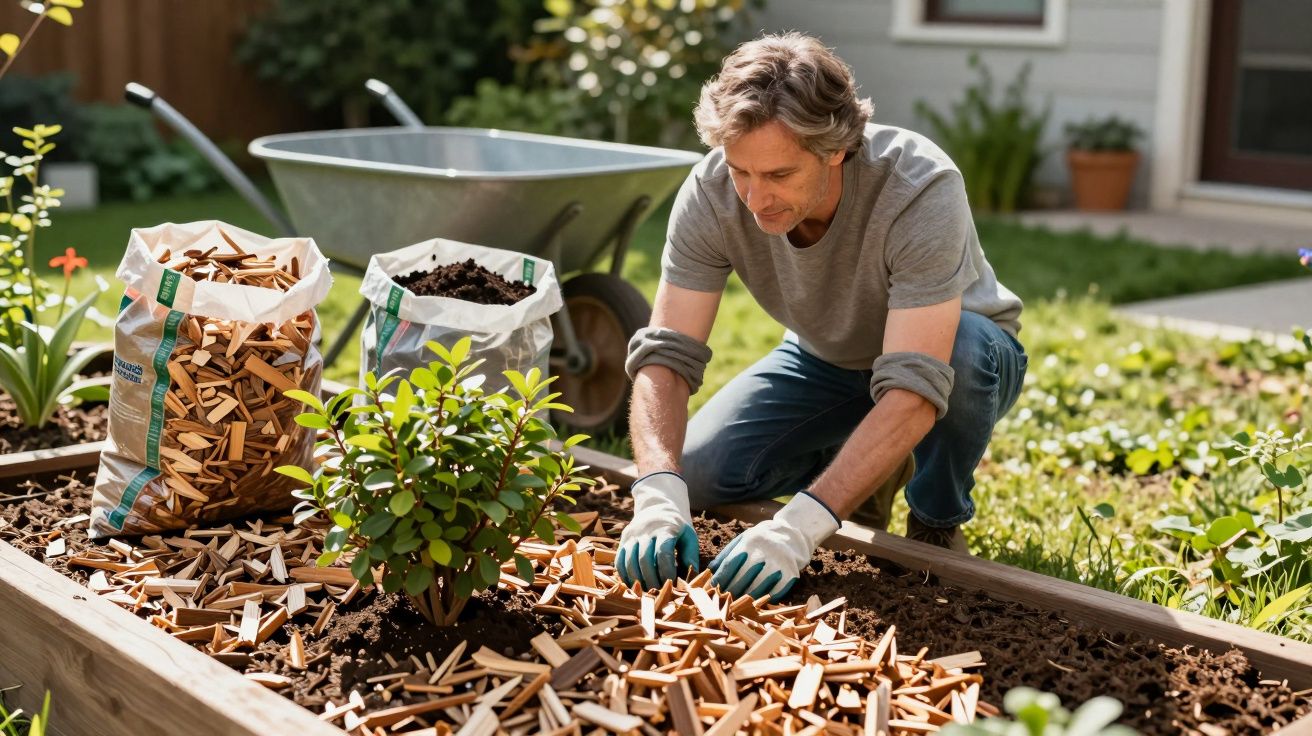
You can watch a garden change season by season, but the real drama often happens under your feet. Mulch sits on top of the soil like a quiet decision: it buffers temperature, slows evaporation, and decides what gets to thrive at the surface. Choose one type and you’re basically feeding fungi; choose another and you’re inviting bacteria, worms, and a different pace of decay.
It’s easy to think of mulch as cosmetic-something to make borders look “finished”. In practice, it’s one of the fastest ways to steer how the garden evolves, because it’s a repeated input: the same material, added again and again, nudging the soil in one direction.
The hidden lever: what your mulch is made of
Most mulch falls into two broad families, and they behave very differently once rain, microbes and time get involved.
Woody mulches (bark, wood chips) are carbon-heavy. They break down slowly, favour fungal networks, and tend to build a more stable, crumbly structure over years. Leafy/green mulches (fresh grass clippings, “green” compost, some manures) are nitrogen-rich and decompose fast, fuelling quick growth but also quick swings.
Neither is “good” or “bad”. The point is that each one sets a tempo. One is a slow-release conversation with the soil; the other is more like a strong cup of tea.
When bark and wood chips win: stability, fungi, fewer weeds
Walk past a newly mulched bed of wood chips and it looks inert. Underneath, it’s a long project.
Woody mulch is excellent for perennial borders, around shrubs and trees, and on paths between beds. It’s especially useful when you want moisture retention without smothering roots in richness. Over time it encourages fungal-dominant soil biology, which tends to suit woody plants: roses, fruit bushes, ornamental shrubs, and many perennials.
A few practical effects gardeners notice (usually after a year, not a week):
- Weed pressure drops because the light is blocked and seedlings struggle.
- Watering becomes less frantic, especially through dry spells.
- Soil structure improves as fungi and worms pull particles into aggregates.
- Beds become more forgiving: less crusting, less sudden drying, less stress.
There’s one common worry: nitrogen “robbed” from the soil. That mostly happens when wood chips are mixed into the soil, where microbes need nitrogen to break them down. Used as a surface layer, the effect is usually minor and localised to the top centimetre or so.
When compost is the better bet: faster change, faster feedback
Compost-as-mulch is the choice that changes things quickly. If a bed is tired, pale, and slow-especially a vegetable patch-compost on the surface is an immediate vote for growth.
It adds nutrients, introduces biology, and improves water-holding in sandy soils. It also tends to make the soil more bacterial, which many annuals and vegetables love. The trade-off is that it doesn’t last as long as wood chips, and it can feed weeds if it’s not well-finished.
Compost works brilliantly when:
- you’re growing hungry crops (courgettes, brassicas, sweetcorn);
- your soil is very sandy and dries out fast;
- you need a reset after a harsh season of drought or heavy harvesting.
If you’re mulching with compost, aim for a thin, even layer (often 2–5 cm is plenty). Thick, wet layers can cap the surface and create a slimy interface, especially in cool weather.
The “wrong” mulch is often a timing problem
A lot of mulch disappointment comes from putting the right material in the wrong moment.
Fresh grass clippings, for instance, can be brilliant around established veg-if applied thinly and topped up little and often. Dump them in a thick mat and they turn into a damp felt: smelly, airless, and oddly good at sheltering slugs.
Straw is another classic. It’s excellent as a seasonal shield for strawberries and veg beds, but it can blow about, carry seeds, and doesn’t feed the soil as richly as compost. Use it when you want protection and cleanliness more than nutrition.
A simple rule that saves trouble: match the mulch to the plant’s rhythm. Slow-growing, woody, perennial? Think slow mulch. Fast-growing annuals? Think fast mulch.
A simple decision framework (so you don’t overthink it)
If you’re standing in the garden with a barrow and indecision, try this:
- What are you mulching?
Shrubs/trees/perennials: wood chips or bark. Veg/annuals: compost, leaf mould, fine organic matter. - What’s your biggest pain?
Drought: chunky mulch for evaporation control. Low fertility: compost. Weeds: thicker, longer-lasting cover. - What’s your patience level?
Want results this season: compost. Building a garden that improves every year: wood chips + patience.
And if you’re not sure, you can split the difference: compost as a thin base layer, then wood chips on top as a longer-lasting lid. It’s not fancy. It’s just stacking benefits.
How thick, how often, and where people mess it up
Mulch fails quietly when it’s applied like a duvet over everything.
A good default thickness: - Wood chips/bark: 5–10 cm on bare soil (less on heavy clay, more on very sandy soil). - Compost/leaf mould: 2–5 cm, topped up as it disappears. - Straw: 5–8 cm around crops, kept away from stems.
Two key “don’ts” that prevent most problems:
- Don’t pile mulch up against trunks and crowns. Leave a small gap so bark stays dry and rot stays away.
- Don’t mulch bone-dry soil and expect miracles. Water first, then mulch; you’re sealing in moisture, not creating it.
The garden’s trajectory is set by repetition
Mulch is rarely a one-off. It’s a habit. And the garden becomes the record of that habit.
Add woody mulch every year and you tend to get darker, more resilient soil, fewer boom-and-bust cycles, and a garden that feels calmer in extremes. Lean on rich compost constantly and you can get incredible productivity-along with more weeding, more softness, and sometimes more pest pressure if growth stays lush.
The most useful way to think about it is not “What’s the best mulch?” but “What kind of garden am I building?” Because your mulch choice answers that question on your behalf, quietly, every time it rains.
| Mulch choice | What it pushes the soil towards | Best used for |
|---|---|---|
| Wood chips / bark | Fungal, stable, slow improvement | Shrubs, trees, perennial borders, paths |
| Compost / leaf mould | Bacterial, fertile, faster change | Veg beds, annuals, soil recovery |
| Straw / dry stems | Protection more than feeding | Strawberries, seasonal veg mulching |
FAQ:
- Is it OK to mulch every year? Yes. Most gardens improve with regular mulching; just avoid burying crowns and keep the layer appropriate for the material.
- Will wood chips make my soil nitrogen-poor? Not usually when used on the surface. The main issue comes from digging chips into the soil, where decomposition competes more directly with plant roots for nitrogen.
- What’s the safest “all-rounder” mulch? Well-made compost or leaf mould is broadly safe for most beds, especially in thin layers. For long-term weed control and moisture, wood chips are often better around perennials.
- Can I mulch in winter? Yes. Winter mulching protects soil structure from heavy rain and reduces erosion. Just don’t trap wet mulch against vulnerable crowns, and avoid smothering very small seedlings.



Comments (0)
No comments yet. Be the first to comment!
Leave a Comment