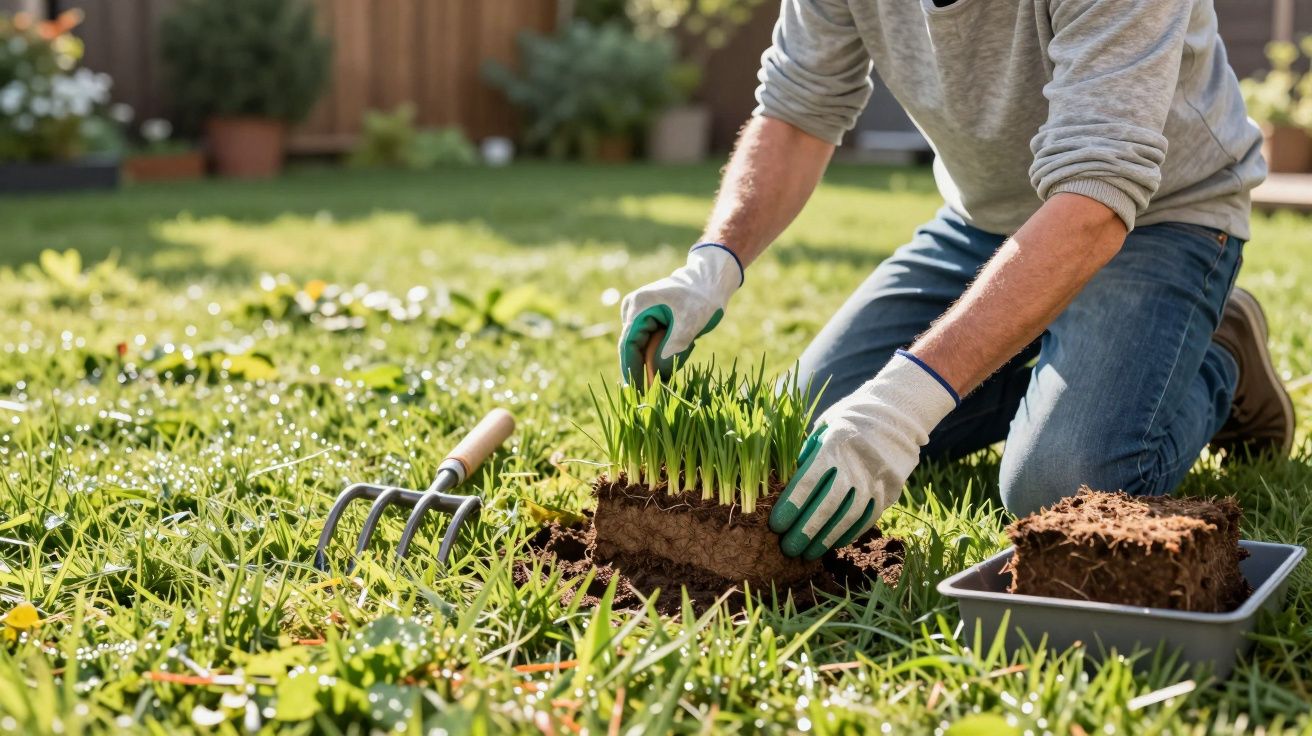
A neat lawn can look “sorted” from the kitchen window, even when it’s quietly struggling. In professional gardening, one small detail keeps coming up in client visits and site surveys because it explains so many mysteries: why grass thins, why it stays damp, and why it never quite colours up.
It’s the kind of thing you don’t notice until someone points it out, and then you can’t unsee it.
The tiny detail that makes gardeners pause
You’ll hear it described in different ways-“spongy underfoot”, “springy”, “thatch-y”, “it feels like walking on a doormat”. What they’re really talking about is the layer sitting between the green blades and the soil: a build-up of dead stems, roots and organic debris.
A little bit is normal. The questions start when it gets thick enough that the lawn feels soft, the mower sinks slightly, or the grass seems to float rather than root. At that point, it stops being a harmless layer and starts acting like a barrier.
Why it looks harmless (until it isn’t)
From above, a thatchy lawn can still look lush. That’s why people keep feeding it, watering it, mowing it tighter-because the surface looks like it’s responding. Underneath, the plant is doing something else entirely: it’s trying to survive in a shallow, unsettled zone.
Thatch holds moisture near the surface, but it can also stop water getting down to the root zone. In summer, it can dry out into a water-repellent mat; in winter, it can stay wet and cold for longer than the surrounding soil. Either way, it changes the lawn’s “normal”, and the grass reacts with stress you can’t fix with another bag of fertiliser.
The quiet symptoms people misread
Most lawn problems don’t announce themselves with one dramatic sign. They show up as a collection of small annoyances that feel unrelated until you connect them.
Common clues include:
- The lawn feels bouncy, even when dry.
- Water sits on the surface or runs off instead of soaking in.
- The grass looks pale despite feeding, or “flushes” then fades quickly.
- Moss spreads in patches that keep returning.
- You see more surface roots and fewer deep roots when you lift a small section.
- The mower scalps high spots and misses low ones because the surface is uneven.
None of these automatically means “thatch”, but together they’re usually pointing at a lawn that’s building a layer faster than it’s breaking down.
What actually causes the build-up
Thatch isn’t just “dead grass”. It’s dead material that doesn’t decompose at a normal rate, often because the conditions underneath aren’t letting soil organisms do their job.
The usual triggers are boring, which is why they’re easy to miss:
- Overfeeding with nitrogen: lots of soft growth, lots of debris, faster accumulation.
- Mowing too short: stresses plants, encourages shallow rooting, increases die-back.
- Compaction: reduced air in the soil slows decomposition and root health.
- Overwatering or poor drainage: keeps the surface wet and oxygen-poor.
- Heavy clay soils: can tip towards thatch if aeration and soil biology aren’t supported.
It’s rarely one thing. It’s a pattern built over seasons: small choices that make the lawn produce more material than the soil can process.
The fix isn’t “rip it up” - it’s a sequence
The biggest mistake people make is treating thatch like dirt you can simply remove once. If you scarify hard, don’t address compaction, and then go straight back to the same watering and mowing habits, the lawn will rebuild the layer-often faster, because it’s stressed.
A more reliable order looks like this:
- Check the depth: pull out a small wedge with a trowel. If the spongy layer is more than about 1–2cm, it’s worth addressing.
- Scarify in the right season: usually spring or early autumn, when grass can recover. Avoid extremes of heat, drought or frost.
- Aerate: hollow-tine for compaction, or solid-tine for lighter relief. Air in the soil speeds recovery and decomposition.
- Top-dress if needed: a thin layer of suitable soil/sand mix can help dilute thatch and level the surface, but only if it matches your soil type.
- Overseed: especially if scarifying leaves gaps. Thinner lawns invite moss and weeds to move in.
- Adjust the routine: mow higher, water deeper and less often, and don’t chase colour with constant high-nitrogen feeds.
This is why gardeners ask questions. They’re not being fussy-they’re trying to work out which step you can skip, and which one you can’t.
When to bring in professional help (and what to ask)
Professional gardening teams tend to spot thatch and compaction quickly because they’re used to seeing lawns that “look fine” but behave badly. If you’re paying for a one-off visit, you want clarity rather than a vague promise of “a treatment”.
Useful questions to ask include:
- “What’s the thatch depth in millimetres, roughly?”
- “Is compaction a bigger issue than thatch here?”
- “Would you hollow-tine or solid-tine, and why?”
- “What should I change in mowing height and feeding afterwards?”
- “Do you recommend top-dressing on this soil, or will it cause layering?”
A good answer sounds specific to your garden, not like a scripted package.
A lawn doesn’t usually fail because you missed one job. It fails because the surface looks healthy enough to hide what’s building underneath.
A quick self-check you can do in five minutes
Pick a spot that’s always a bit disappointing-thin, mossy, slow to dry. Push your fingers down through the grass. If you feel a springy layer before you hit soil, you’ve found the detail.
Then cut a small plug and look at the side profile. Grass on top, brown fibrous layer beneath, then soil. Once you see those layers, the lawn stops being a mystery and starts being a system you can actually manage.
| Sign you notice | What it can indicate | A sensible next step |
|---|---|---|
| Spongy feel underfoot | Thatch build-up | Measure depth with a small plug |
| Water pooling/run-off | Thatch or compaction | Aerate, then review watering |
| Moss that keeps returning | Damp surface, low vigour | Mow higher, improve drainage/air |
FAQ:
- Is thatch always bad? No. A thin layer is normal and can protect the soil. Problems start when it becomes thick enough to block water, air and rooting.
- Should I scarify every year? Not automatically. Light scarifying can be annual on some lawns, but heavy scarifying is better done only when the thatch depth and lawn condition justify it.
- Can I just top-dress over it? Top-dressing can help, but it’s not a shortcut if the lawn is very thatchy or compacted. If you bury a problem layer, it often comes back in a more awkward form.
- What mowing height helps prevent it? As a rule, mowing a bit higher (especially in summer) supports deeper roots and steadier growth, which reduces stress and slows thatch build-up.
- Will feeding fix a struggling lawn with thatch? Feeding can make it look better briefly, but it won’t solve the underlying barrier. In some cases, high nitrogen makes the build-up worse.






Comments (0)
No comments yet. Be the first to comment!
Leave a Comment