
Most of us blame the lawn for having moods in seasonal context. A flush of pale patches in spring, a sudden thinning in summer, a suspicious sheen of green in autumn - we file it under “weather” and move on. The problem is that one common bit of lawn behaviour looks seasonal, but is actually a timing trick: the grass is reacting now to something that happened weeks ago.
I noticed it the first time I tried to be “low-effort” about it. I fed, I watered, I waited, and still the same areas sulked on cue every year like they’d been scheduled. It turns out they had been - just not by the seasons.
The patch that returns on schedule (even when the weather doesn’t)
Seasonal-looking lawn problems have a very specific vibe. They appear in roughly the same month, in roughly the same places, and they make you feel faintly guilty because you can’t point to a single disaster. No hosepipe ban. No heatwave. No dog apocalypse. Just a lawn that starts acting up as if it’s following a calendar.
That pattern is your clue. If the patchiness is genuinely seasonal, it tends to track conditions: cold soil, drought stress, low light. If it’s not, it tracks habits: mowing height, foot traffic, feeding timing, and how water actually moves through your garden (which is rarely how you assume it moves).
A good rule of thumb is this: weather changes the whole lawn; routines punish the same bits.
What’s really happening: a delayed reaction, not a seasonal one
Grass is slow to complain. By the time it shows you stress, the cause is often already over and done with. That’s why lawn problems are so good at masquerading as “spring issues” or “autumn issues” - those are simply the times you notice them.
Here are the non-seasonal culprits that most often arrive wearing a seasonal costume:
- Scalping from mowing too low: one enthusiastic cut exposes stems, weakens the plant, and two to three weeks later you see the thinning.
- Compaction: repeated walking, a mower turning in the same arc, kids’ goal mouths, the path you take to the shed - the grass roots can’t breathe, and the decline shows up later.
- Uneven watering: one sprinkler pattern, one shady edge, one slope that sheds water - the lawn looks “summer-stressed” even in a mild year.
- Feeding at the wrong moment: a nitrogen hit can force soft growth that can’t cope with the next stress (heat, cold snap, mowing), and the damage looks like a seasonal fade.
- Thatch build-up: water and nutrients sit above the soil, roots stay shallow, and the lawn behaves like it’s drought-prone no matter the season.
The key point is timing. Grass doesn’t respond like a light switch; it responds like a diary. Today’s colour is often last month’s story.
The quick test: follow the pattern, not the patch
If you want to know whether you’re dealing with “season” or “system”, don’t stare at the colour. Map the behaviour.
Walk the lawn slowly and ask three boring questions that happen to be decisive:
- Where exactly does it start? Edge by the fence, under the tree dripline, along the route to the washing line, near the gate.
- What do you always do there? Turn the mower, park the wheelbarrow, stand and chat, empty the paddling pool.
- What would water do if you poured a bucket there? Run off, puddle, or soak.
If the weak spots line up with how you live in the garden, that’s not seasonal context - that’s the lawn reflecting your footprint.
The most common “seasonal” illusion: mowing height whiplash
People often cut low in early spring because the lawn looks messy and they want a reset. The grass responds by throwing energy into survival rather than thickening. Then, right when you expect spring growth to make everything lush, you get a tired, see-through look instead - and it’s easy to blame the season.
A calmer approach is annoyingly effective: raise the mower one notch and keep it there for a month. Let the plant keep leaf area so it can photosynthesise properly. Your lawn doesn’t need a haircut that feels satisfying; it needs a haircut it can recover from.
If you must “tidy” it, do it with frequency, not brutality: a little off, more often.
What people notice when they stop scalping
The change is rarely dramatic in a single weekend. It’s more like a sequence of small realisations: the grass stops looking stressed after a cut, the colour evens out, the patch that “always happens” doesn’t arrive with the same confidence.
You also notice something psychological: you stop bracing for the lawn to disappoint you on schedule. That alone makes it easier to stick to better habits, because you’re no longer fighting a mystery.
The fix that feels too small to matter: aerate the places you stand
Compaction is the quiet villain because it doesn’t announce itself. The lawn still grows - it just grows poorly, and it dries out fast, and it goes yellow in exactly the places you use most. Then you call it a “summer patch” or a “winter die-back”, depending on the month.
If you only do one thing, do this: aerate the worst areas, not the whole lawn out of principle.
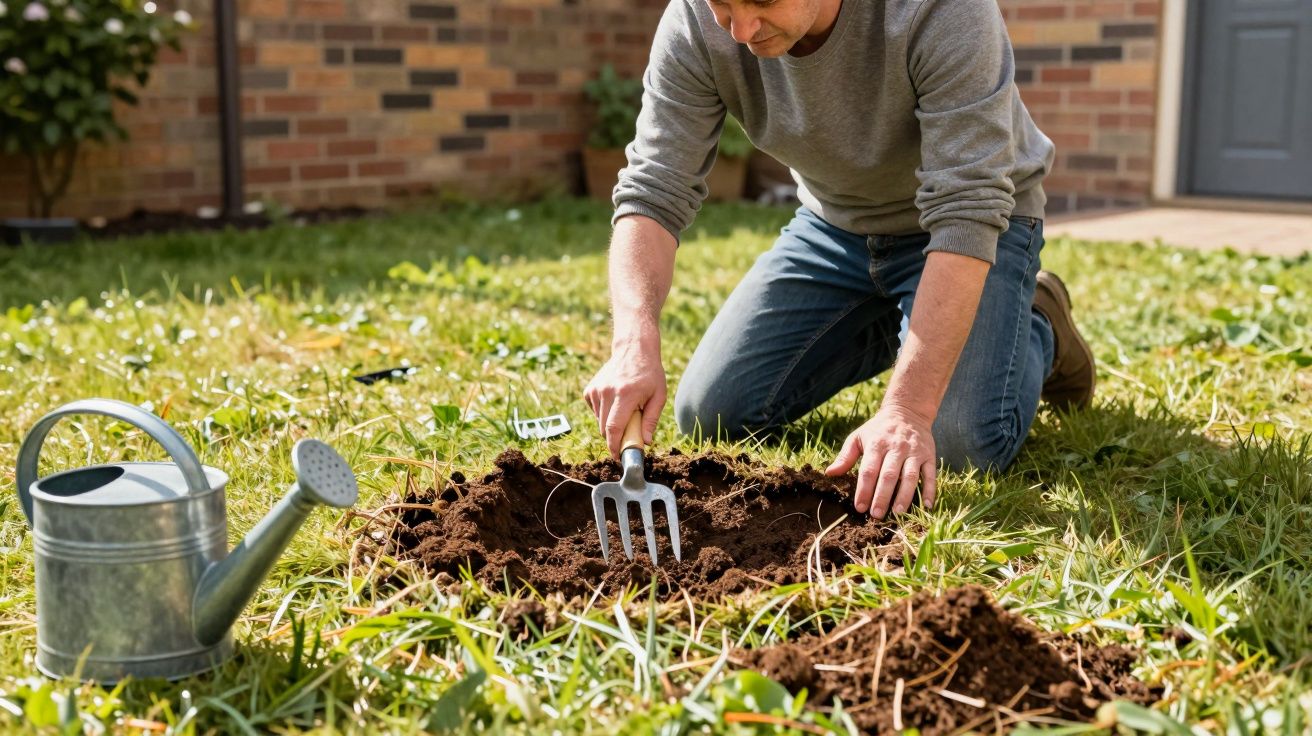
- For small lawns: a garden fork, pushed in and gently rocked back, every 10–15cm in the compacted zones.
- For bigger lawns: a hollow-tine aerator in high-traffic strips (gate to shed, patio edge, washing line corridor).
Then brush in a little sharp sand or a sandy top-dressing if your soil is heavy. You’re not “feeding” the grass; you’re giving the roots oxygen and a path for water to move.
When “seasonal” is actually water movement
Many lawns are watered like a pot plant: the same amount, the same place, the same hope. But gardens aren’t flat, soil isn’t consistent, and sprinkler patterns are often comically uneven. The lawn doesn’t dry out “because it’s summer”; it dries out because the water never reached the roots in the first place.
A simple check: put a few mugs or tuna tins around the lawn and run your sprinkler for 15 minutes. If some are nearly full and others barely damp, you’ve found your fake season. Adjust the sprinkler position, or water in two shorter runs to reduce run-off.
A small reset plan (that doesn’t turn into a new hobby)
If your lawn keeps “misbehaving” in the same seasonal context, try this for four weeks and see what shifts:
- Mow higher and avoid taking more than a third off at once.
- Change your mowing route so you’re not compacting the same turns.
- Aerate the worst zones (gate, shed path, kids’ play spot).
- Water deliberately: fewer days, longer soak, and check coverage with containers.
- Hold off on quick-fix feeds until the grass is growing steadily, not struggling.
None of this is glamorous. That’s why it works. Most lawn problems that look seasonal aren’t drama; they’re repetition.
The quiet relief of understanding the timing
Once you realise the lawn is responding on a delay, you stop treating it like a moody seasonal creature and start treating it like a system with cause and effect. The same patch doesn’t feel like fate; it feels like information.
And that’s the real shift. A lawn that looks “seasonal” but isn’t is basically asking you one question: what have you been doing the same way, in the same place, for longer than you think?




Comments (0)
No comments yet. Be the first to comment!
Leave a Comment