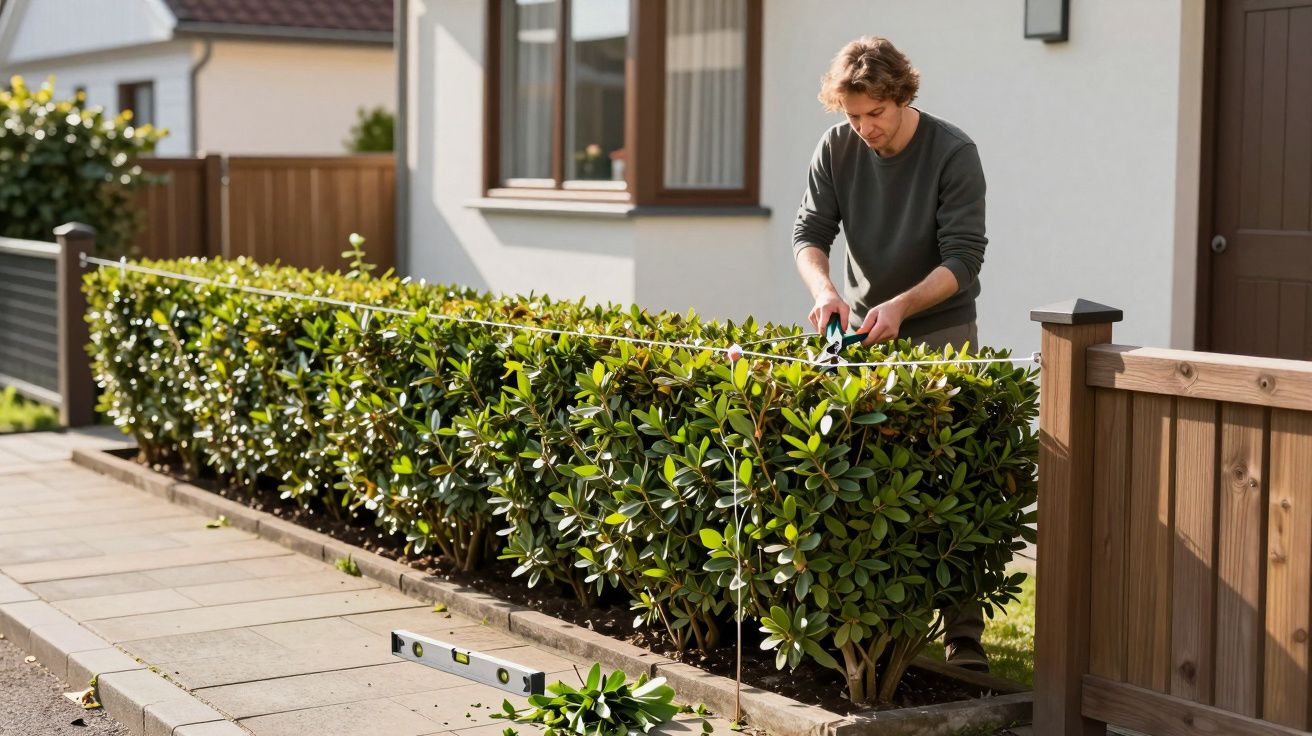
It starts innocently: you walk past a terrace and notice a hedge cut into a crisp rectangle, flat-topped like a loaf tin. A week later, it’s outside a school, then along a new-build fence line, then squared off beside a bay window. Hedge trimming in the urban garden has fallen into a repeatable look, and it matters because that look quietly controls light, space, privacy, and neighbourly peace.
The funny part is how modern it feels, even when the shrubs are old. It’s not topiary peacocks or country-estate clouds. It’s the same calm geometry, copied from garden to garden, as if the street has agreed on a single font.
The “block hedge” is back (and it’s not just about neatness)
Call it the block hedge: straight sides, sharp corners, level top, kept at a consistent height. It reads clean from the pavement and it photographs well, which is part of the point now. A clipped rectangle looks like intention, even if the rest of the border is pots and a wonky hose.
There’s also a practical reason it keeps repeating. In tight plots, a hedge is doing several jobs at once: screening bins, hiding a front-room view, muffling traffic, marking a boundary without the harshness of a fence. A crisp shape signals, politely, “this line is the line,” without a note through the door.
And yes, it’s easier to maintain than it looks-once you commit to the shape. The moment you decide “this is a cuboid,” your trimming decisions get simpler, because every stray shoot is clearly out of bounds.
Why urban streets keep choosing the same silhouette
Most people aren’t trying to start a design movement. They’re trying to make a small space feel calmer.
The block hedge works because it’s visually quiet. Curves and shaggy growth can be charming, but they also add movement, shadow, and a slightly chaotic edge. In a street already full of parked cars, wheelie bins, signage, and mixed brickwork, a straight hedge is a rare bit of order.
A few forces push it along:
- Privacy without darkness. Kept at chest to head height, it screens without turning windows into caves.
- Neighbour compatibility. A tidy edge reduces complaints about overhang, dropped leaves, and “it’s coming through the fence.”
- Time pressure. People want a trim that can be done in an hour, twice a year, not a weekly romance.
- The influence loop. Once two houses do it, the third feels scruffy by comparison, even if their hedge is healthy.
In other words, it repeats because it solves the same urban problem in the same instantly legible way.
The three moves that make a hedge look “professionally” trimmed
There’s a difference between “cut back” and “shaped”. The repeating style has a simple recipe: define the face, define the top, define the edge.
1) Set a height you can actually keep
Pick a height that matches your life, not your aspirations. If you can’t reach the top safely without wobbling, you’ll avoid the job, and the hedge will swell upward and outward until you’re hacking it back in panic.
As a rule, the best-looking block hedges are the ones trimmed little and often, not the ones scalped every couple of years.
2) Slight taper, not dead-vertical walls
The classic mistake is trimming the sides perfectly vertical. It looks sharp for a month, then the bottom thins as it gets less light.
Aim for a subtle A-shape: a little wider at the base than the top. You still get the rectangular look, but the plant stays dense where it matters-down at eye level and below.
3) A clean “top line” that isn’t a stressed haircut
The top is what the street reads first. Use a line (string, a plank, or even a long spirit level held as a visual guide) and trim to that. Then step back and check it from the pavement, because your eyes correct more accurately at distance than up close.
One quiet truth: the hedge doesn’t need to be perfectly flat; it needs to look consistent from where people view it.
What shrubs suit this repeating look (and which ones punish you)
Not every plant enjoys being forced into a box. Some shrug it off. Others sulk, brown, and leave holes you stare at all winter.
Good candidates for a dense, clipped urban hedge:
- Yew (slow, forgiving, deep green, handles hard cuts)
- Box (classic, but watch for blight and moth in the UK)
- Lonicera nitida (fast, small leaves, very “neat”)
- Privet (tough, quick to fill, can look a bit municipal if overdone)
- Hornbeam (more of a taller hedge, keeps structure, good in mixed soil)
Plants that can fight back if you insist on the block shape:
- Conifers like leylandii (brown patches if cut into old wood; also the classic neighbour dispute starter)
- Laurel (will do it, but leaf size makes it look chopped rather than clipped unless you’re careful)
- Mixed hedges (beautiful, but the block style exposes uneven growth rates)
If you’ve inherited an established hedge, identify what it is before you start “improving” it. Some species will never regrow from bare stems, and a hard trim can turn into a long-term gap.
The trimming rhythm that keeps it sharp without constant work
Most urban hedges don’t fail because people don’t care. They fail because the timing is wrong: one late summer hack, then nothing, then another emergency cut.
A simple, realistic rhythm:
- Late spring / early summer: a light trim to hold shape as growth accelerates
- Late summer / early autumn: a second trim to tidy the season’s push and keep winter outline clean
Check local guidance if nesting birds are active; in the UK it’s wise to inspect first and avoid disturbing nests.
Tools matter less than you think, but two habits matter a lot: keep blades sharp (ragged cuts brown at the tips), and don’t trim when the foliage is soaking wet (you smear and tear instead of cutting cleanly).
When the repeating style goes wrong: the “green wall” problem
A block hedge can look calm. It can also look hostile if it’s too tall, too close to the pavement, and too aggressively squared. That’s when it stops being a garden feature and starts feeling like a barrier.
If your hedge is making a narrow front garden feel smaller, try one of these tweaks instead of abandoning the style:
- Lower it by 10–20 cm and keep the top crisp; it often feels instantly friendlier.
- Introduce a deliberate “step” (two heights rather than one long wall) near a gate or path.
- Soften one end with a rounded corner or a planted gap for a climber, so it reads designed rather than defensive.
The aim is the same: keep the clarity, lose the severity.
| What you want | The block-hedge move | Why it works in an urban garden |
|---|---|---|
| Privacy without a fence | Flat top, consistent height | Screens views while staying visually “light” |
| A tidy look that lasts | Slight taper + regular trims | Keeps foliage dense, avoids bare bottoms |
| Less neighbour friction | Clear boundary line, no overhang | Reduces shade complaints and encroachment |
FAQ:
- Is this style bad for the hedge? Not if the species suits clipping and you avoid cutting into old, leafless wood. Light, regular trims are gentler than rare, heavy ones.
- What’s the quickest way to get straighter lines? Use a string line (or a visual guide like a plank) and step back to check from the pavement. Most wonky tops come from trimming too close-up.
- Can I turn an overgrown hedge into a block shape in one go? Often it’s better in stages over a season or two, especially with conifers and anything that doesn’t regrow from bare stems.
- How do I stop the bottom going thin? Don’t make the sides perfectly vertical. Give it a slight taper so light reaches the lower growth.





Comments (0)
No comments yet. Be the first to comment!
Leave a Comment