You can walk through an established garden and think it’s finished: borders full, lawn clipped, a pergola doing its job. Then someone trained in garden design arrives and pauses in a way that makes you look again. Not at what’s there, but at what the garden doesn’t do yet - and why that matters for how you live in it.
It’s rarely the plants. It’s the missing structure underneath: the quiet decisions that make a space feel calm, usable, and resilient rather than simply pretty on a good day. Once you see it, you can’t unsee it.
The moment professionals clock it: the garden has no “spine”
Most “complete” gardens read like a collection of nice choices. A handsome tree here, a mixed border there, a path that sort of wanders, a patio that happened because that’s where the back door is. Nothing is wrong - but nothing is truly holding the picture together.
Designers look for a spine: a clear organising line or sequence that tells your eye where to go and your feet where to walk. In a small plot it might be a straight axis, a repeated edging, or one strong shape carried through. In a larger one it might be a main route and two secondary loops that stop the garden becoming a dead end.
Without it, you get familiar symptoms: you drift, you hesitate, you don’t quite know where to sit, and the garden feels smaller than it is.
A garden can be full and still feel unfinished if it lacks a legible route and a few repeatable forms.
What’s “missing” most often isn’t a plant - it’s a job
A garden that photographs well can still fail on Tuesday morning. Professionals keep asking: what is each part for?
Here are the gaps that show up again and again in established gardens:
- A real arrival: a threshold from house to garden that slows you down (even if it’s just a change of surface and one tall pot).
- A primary sitting spot: not “some chairs somewhere”, but a place with proportion, shelter, and a reason to face one way.
- A secondary perch: a bench, a step, a small gravel pad - a different mood, not a duplicate.
- Storage that doesn’t shout: bins, hose, tools, compost. If you can see it, you’ll feel it.
- Night logic: a safe route with low-level light, and one focal glow so the garden exists after 5pm.
People often spend years adding features, then wonder why it still feels a bit restless. That’s because features aren’t jobs. Jobs are the brief.
The “good bones” checklist: three quiet systems
If you want a quick diagnostic, ignore the flower colour and look for these systems. When they’re missing, the garden never quite settles.
1) Structure that stays when the border collapses in February
Evergreens, hedging, clipped forms, strong stems, winter silhouettes. Not a forest of conifers - just enough framework that the garden holds its shape in the off-season.
A common tell is a garden that feels lush from May to August, then suddenly looks like it’s been switched off. That’s not bad gardening; it’s missing structure.
2) Edges that define space (and save you work)
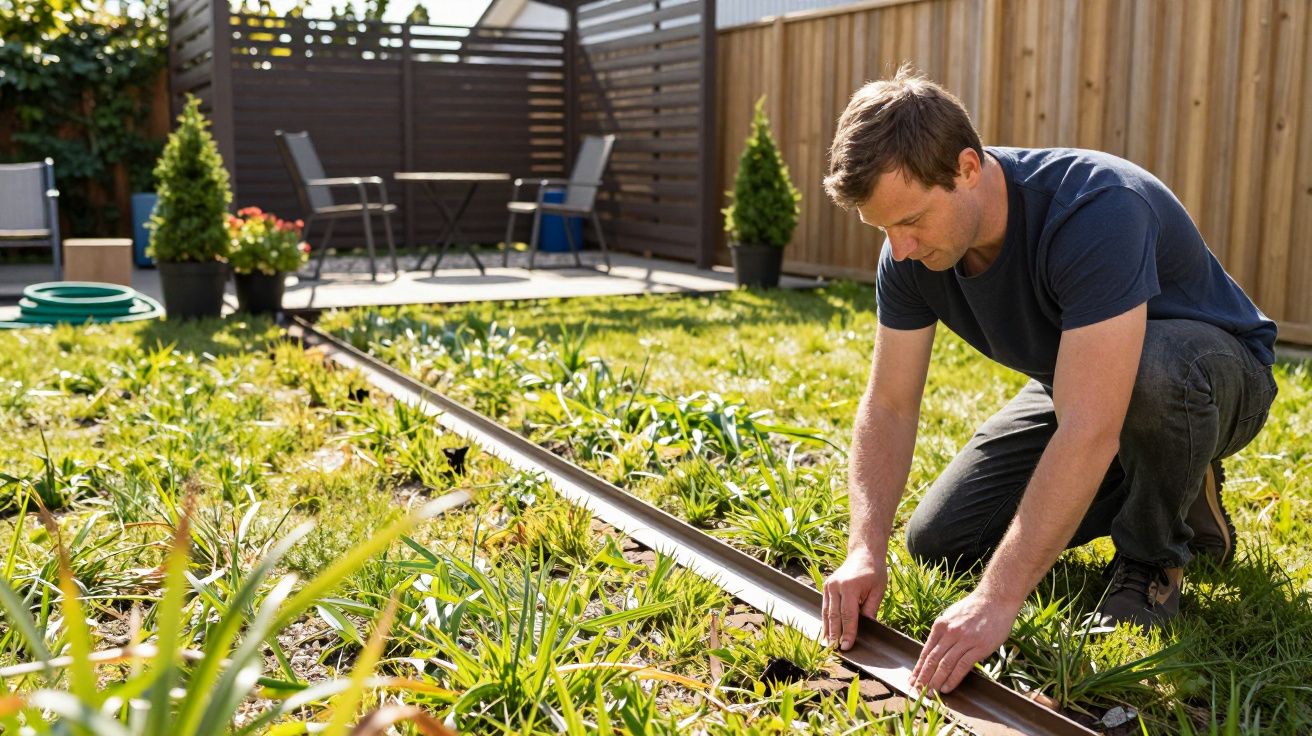
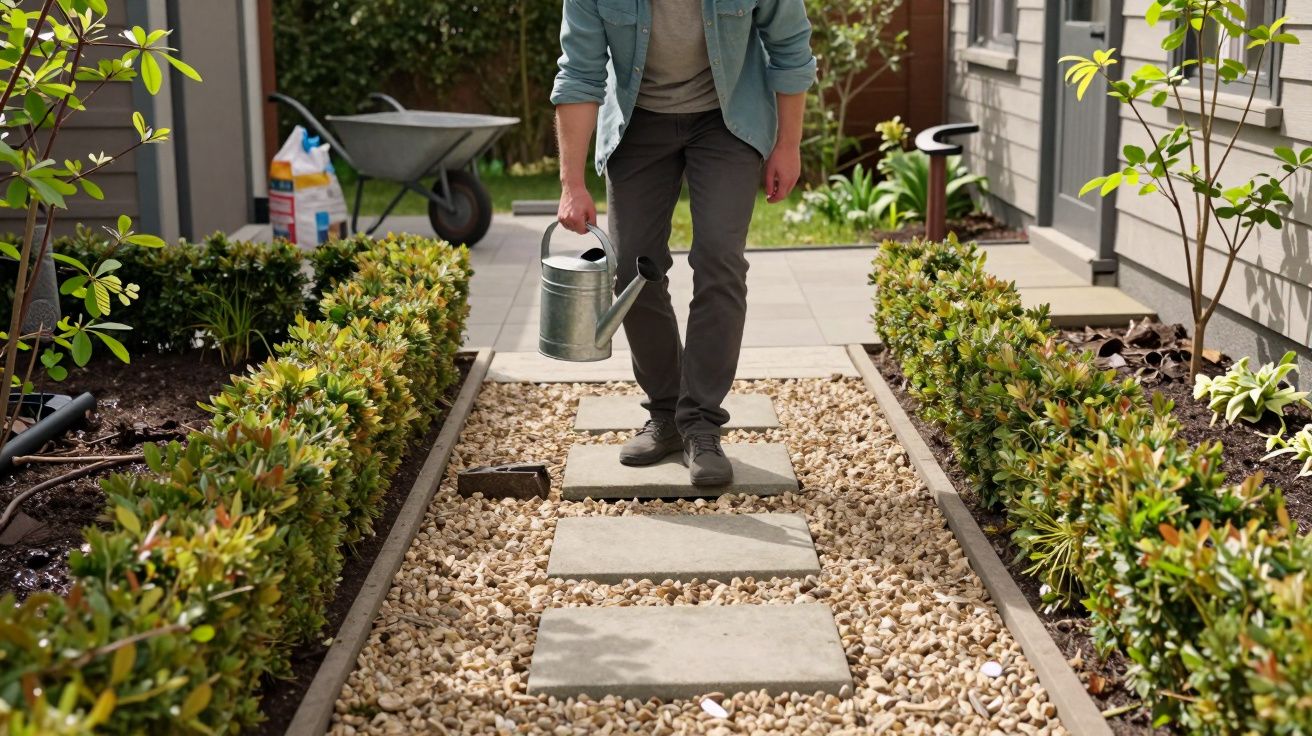
Edges are where design becomes maintenance. Crisp boundaries stop gravel migrating, keep mulch in beds, prevent lawn from creeping, and make weeding feel finite.
The trick isn’t expensive materials; it’s consistency. One edging type used well beats three used randomly.
3) A water plan you can’t see
Professionals notice where water goes because water decides longevity. They check downpipes, slope, pooling, and whether thirsty planting is fighting dry shade.
If a lawn is always soggy in one corner or a bed always bakes, the garden is telling you something. Design listens, then redirects.
| What you see | What it usually means | A simple fix |
|---|---|---|
| Border looks great in summer, bare in winter | No evergreen structure | Add 2–3 “anchor” shrubs or clipped forms |
| Patio feels exposed | No enclosure or orientation | Add a screen, small tree, or pergola slats |
| Muddy path edge, gravel in lawn | Weak boundaries | Install a continuous edge and compact base |
A complete garden has hierarchy, not more stuff
Many established gardens are generous but flat: everything is “feature level”. A fountain, an arch, a specimen, a sculpture, a firepit - all competing politely.
A designer strips it back to hierarchy:
- One hero (the thing you’d point at on a walk-through)
- Two or three supporting notes (repeated shapes, textures, or materials)
- A quiet background (the bits that do their job without calling for attention)
That’s why professional advice can feel odd at first. They might suggest fewer plant varieties, a simpler path, or repeating the same paving. It sounds like less creativity. In practice it’s what makes the creativity readable.
How to fix it without starting over: three weekend moves
You don’t need a full redesign to add what’s missing. You need a few decisive choices that create clarity.
1) Mark the main route with something you’ll repeat
Pick one: brick edging, steel strip, gravel band, mowing line. Run it consistently so the garden has a sentence it keeps repeating.
2) Give one place permission to be “the room”
Define the primary sitting area with enclosure and proportion: a rug of paving or gravel, a backdrop (hedge, fence paint, pleached tree), and one overhead element (tree canopy counts).
If you only do one thing, do this. A garden without a room is just a view.
3) Add two anchors and stop
Choose two evergreen anchors (or one small tree plus one evergreen mass) and place them where the eye needs stopping points: end of a view, corner of a patio, turn in a path. Then pause for a season before adding more.
The hard bit is restraint. But restraint is what reads as “complete”.
What this reveals about taste - and why you’re not “bad at gardens”
Most people build a garden like a scrapbook: a bit of what they love, collected over time. Garden design isn’t more correct; it’s simply more intentional. It turns collections into composition, and composition into ease.
When professionals notice what’s missing, it’s usually not an exotic plant or a pricey feature. It’s the invisible plan: a spine, a few jobs, and the bones to carry the garden through the year.
FAQ:
- Is the “spine” idea only for large gardens? No. In small gardens it can be as simple as one straight path, one repeated edge, and a focal point that stops the view.
- Do I need evergreens everywhere to add structure? No. A handful of anchors and one consistent boundary often does more than filling every gap with evergreen shrubs.
- What if I rent and can’t change hard landscaping? Focus on portable structure: large pots with evergreen forms, a freestanding screen, and lighting that defines a route.
- How do I know where the main sitting spot should be? Start with when you use it: morning sun, afternoon shade, wind direction, and the view you want to face. Then give that spot enclosure so it feels chosen, not accidental.





Comments (0)
No comments yet. Be the first to comment!
Leave a Comment