You can spend months choosing plants, edging beds and fussing over pots, then wonder why the space still feels a bit “off”. Trees often get blamed for that, as if they’re simply too big, too shady, too dominant. In reality, the way trees are spaced is one of the quietest forces shaping garden layout, and it decides how calm, bright and usable the whole place feels.
Most people plant with their eyes in the present tense. They stand in the empty lawn, imagine a canopy “somewhere around here”, and dig. Then five years pass, the light shifts, the paths feel pinched, and the garden starts behaving like it has opinions.
The spacing mistake that rarely looks like a mistake at first
The tricky part is that poor spacing doesn’t announce itself. A young tree is polite: it fits, it’s tidy, it casts a little shade that feels like a bonus. It’s only later that the garden reveals what you actually planted: a structure, not a specimen.
Trees don’t just take up space overhead. They take it at ground level too, through roots, leaf drop, dry shade, and the way people instinctively walk around trunks and low branches. A tree placed “slightly too close” to a patio becomes the reason the table ends up shoved to one side and the barbecue feels like it lives in a corridor.
Spacing isn’t an aesthetic detail. It’s the difference between a garden that flows and a garden you keep apologising for.
What spacing really controls: light, movement, and mood
A garden can have beautiful plants and still feel restless. Often that comes down to how light moves through it, and trees are the main editors of light. One well-placed canopy can make a seating area feel sheltered; three can make the whole plot feel like it’s permanently wearing sunglasses.
Spacing also controls movement. People don’t walk in straight lines in gardens the way they do in rooms. They drift towards sunny patches, avoid drip lines after rain, and choose routes that feel open. If your trees are too close together, you unintentionally build a series of narrow channels that push everyone to the edges.
And then there’s mood. A tree with breathing space reads as generous and deliberate. A cluster with no room reads as cluttered, even if the plants are “good ones”.
The simple mental shift: plant for the crown, not the trunk
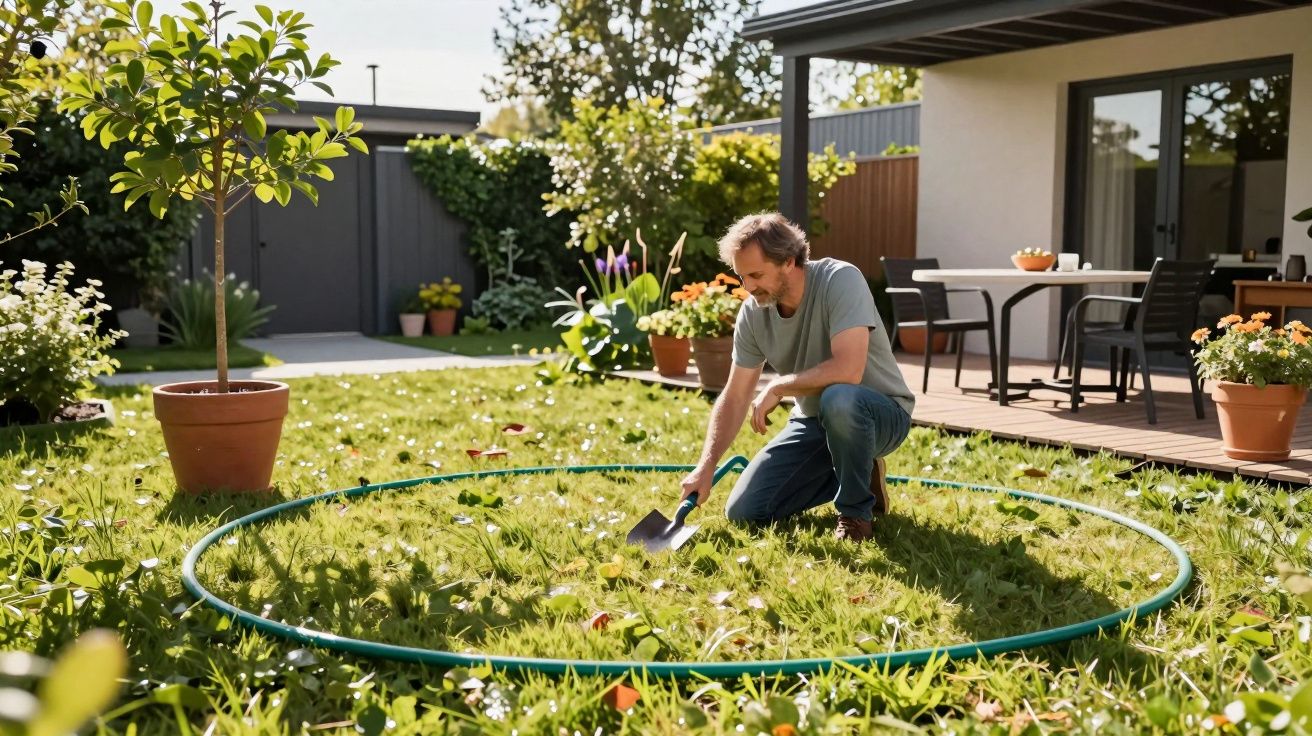
When you buy a tree, you’re shown a trunk and a neat little head of leaves. What you’re really buying is a future crown width and a future shadow pattern. A useful habit is to stand at the planting spot and picture a circle on the ground that matches the tree’s mature spread, not its current size.
If you’re not sure what that spread is, look it up before you plant, not after. Nursery labels can be vague, and “small tree” can still mean 6 metres across in time. The garden doesn’t care what the label implied.
A rough rule that keeps people out of trouble is this: if you can’t comfortably imagine two adults walking side by side between the mature canopies, you’re probably planting too tightly for a domestic garden.
A practical way to space trees without overthinking it
You don’t need a full design package to get spacing right. You need a few measurements and a willingness to leave empty space now so you can enjoy the garden later.
A quick spacing check you can do in 20 minutes
- Pick your main viewing points: kitchen window, patio chair, the place you stand to hang washing.
- Mark where you want shade (seating, play area) and where you want sun (veg bed, greenhouse, winter light near the house).
- Measure the mature crown spread of each tree you’re considering.
- On the lawn, use a rope or hose to lay out a circle for each mature crown where you think the tree should go.
- Walk the routes you actually take: door to bin, patio to shed, gate to washing line.
If the circles overlap heavily, it might look “woodland-ish” on paper, but in a typical back garden it often means permanent deep shade and a constant feeling of squeezing past things.
Common layouts - and what tree spacing does to each one
Different garden layouts tolerate trees differently. The same species that feels perfect in one plan can be oppressive in another, purely because of spacing and proportion.
- Open lawn with borders: Trees work best when they sit slightly off-centre, with enough space to keep a clear, bright middle. Tight spacing here tends to break the lawn into awkward slivers.
- Courtyard or small patio garden: One tree can be the ceiling. Two often compete and darken the whole space unless they’re very light-canopied and carefully positioned.
- Long, narrow garden: Spacing matters most here. A tree in the centre line can create a “pinch point” that makes the whole plot feel shorter and tighter. Planting to one side can preserve a clear visual run.
The goal is not “as many trees as possible”. The goal is a garden that still has a readable shape once those trees are grown.
The hidden consequences people only notice when it’s too late
When trees are too close, you don’t just lose light. You lose options.
- Underplanting becomes harder. Dry shade under crowded canopies limits what will thrive, and you end up with bare soil or struggling plants.
- Maintenance ramps up. Overlapping branches mean more pruning, more leaf litter concentrated in one place, and more damp corners that invite moss on paving.
- Everything else gets pushed around. Vegetable beds migrate to the sunniest scraps, seating moves away from drip lines, and the garden’s “best spot” becomes wherever the trees allow it.
It’s not that the trees are wrong. It’s that their spacing quietly overruled your intentions.
A spacing guide that stays realistic (not perfectionist)
There isn’t one universal distance because crown sizes vary wildly. But you can make sensible decisions using a simple principle: give each tree enough room to look like it belongs on its own, even if you’re planting more than one.
Here’s a compact guide that helps with domestic gardens:
| Tree type (typical) | Aim for this feel | Spacing approach |
|---|---|---|
| Small ornamental (e.g., amelanchier) | Light shade, detail | Leave clear air between mature crowns |
| Medium canopy (e.g., crab apple, small acer) | A “room” effect | One main tree per zone of use |
| Large canopy (e.g., oak, plane in big plots) | Landscape scale | Usually not a multi-tree cluster in small gardens |
If you’re trying to create a grove, do it knowingly: choose lighter canopies, accept shade, and design paths and seating as if you’re building through trees, not around them.
The quiet win: empty space that makes everything else work
Empty space feels like wasted space when you’re planting. Later, it feels like luxury. The gap between trees becomes the sunny bench spot, the place a border can actually bloom, the line of sight that makes the garden feel longer than it is.
That’s why spacing is such a powerful, unglamorous decision. It doesn’t show on day one. It shows every day after that, in how you move, where the light lands, and whether the garden feels like it’s helping you relax-or gently getting in your way.





Comments (0)
No comments yet. Be the first to comment!
Leave a Comment