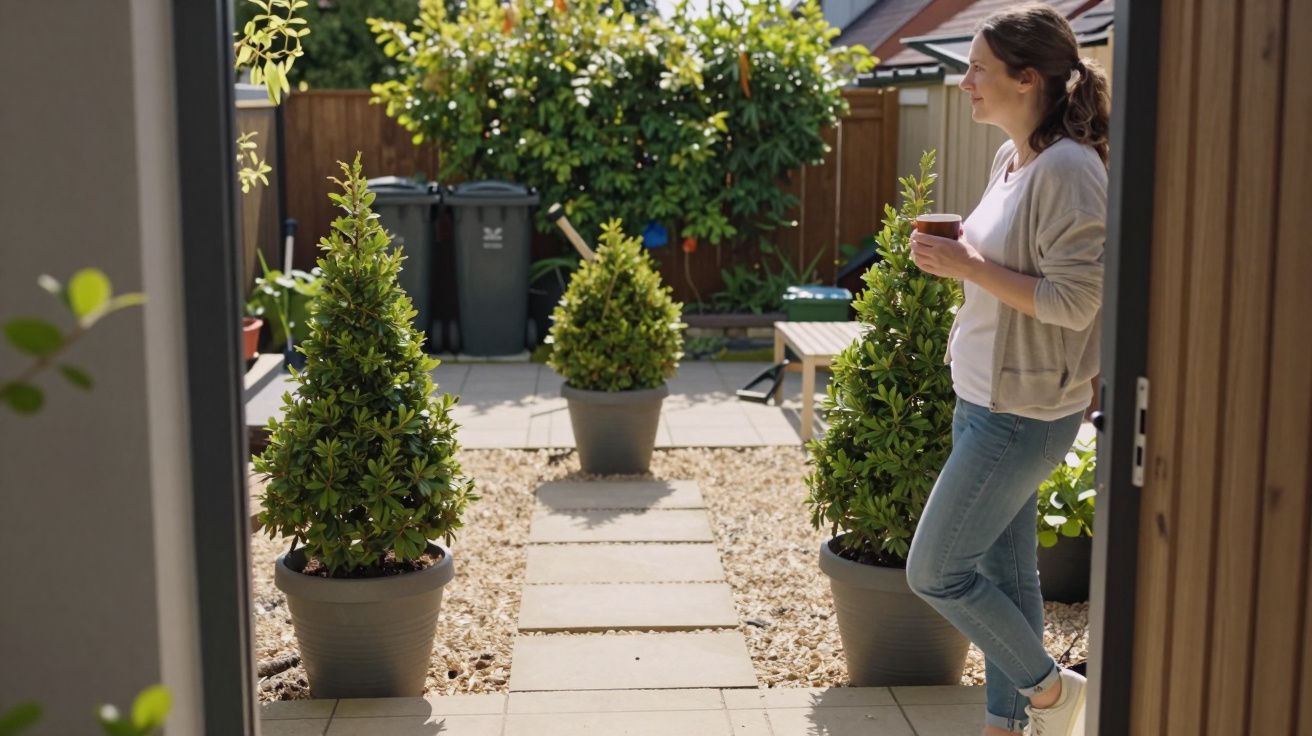
You can learn a lot about a garden before you notice the flowers. Shrubs, in particular, tend to give away the garden layout like a confession: where you want people to walk, where you want them to pause, and what you’d rather they didn’t see. Get their positioning right and the space feels calm; get it wrong and even an expensive border can feel oddly unsettled.
I realised this the year I stopped buying plants and started watching where I stood. Not where I wanted to stand in theory, but where my feet actually landed with a mug of tea, where the dog cut the corner, where guests drifted when the conversation split in two. The shrubs were either helping that flow, or quietly fighting it.
The moment you realise your shrubs are doing the talking
A lot of us plant shrubs like punctuation: one here, one there, a polite dot at each end of a bed. It looks “done”, but it doesn’t always feel lived in. The space can still read as blank, or fussy, or somehow smaller than it should.
Then you visit a garden that feels effortless and you can’t quite name why. The secret is rarely rare plants. It’s placement. Shrubs are the shapes that hold everything else up, and your eye trusts them more than it trusts your shopping list.
Think of them as stage directions. A shrub isn’t just a plant; it’s a nudge. It says: this is the edge, this is the entrance, this is a corner worth softening, this is a view worth keeping.
The three positions that change everything
You don’t need a redesign. You need a few deliberate decisions that shrubs are especially good at.
1) The “welcome” shrub (near the threshold)
The space by a gate, path bend, or front step is where gardens either feel inviting or slightly awkward. A shrub placed close to that threshold makes arrival feel intentional, like the garden is already in conversation with you.
Choose something with a clean outline and keep it clipped enough to look cared for. The aim isn’t to block the way; it’s to frame it. If you’ve ever walked into a garden and immediately felt where to go, you’ve felt this working.
2) The “anchor” shrub (where the eye needs to rest)
Every garden has a spot where your gaze lands and doesn’t know what to do. Often it’s the middle distance: the far end of a lawn, the back of a patio, the point where paths meet.
An anchor shrub goes there-not dead centre like a lollipop, but slightly off to one side, where it can balance the view. This is where rounded evergreens, airy multi-stems, or a single bold texture can stop the garden feeling like a corridor. Suddenly, the rest of the planting looks more confident, because it has something solid to lean on.
3) The “screen” shrub (to hide what you don’t want to style)
Bins. Recycling boxes. A compost heap you swear is temporary. The neighbour’s trampoline. Most gardens have one honest mess.
A screen shrub is the kindest, least stressful fix, but only if it’s positioned like a veil, not a wall. Set it slightly forward from the thing you’re hiding, and allow gaps at the sides so the area still breathes. The goal is to blur, not barricade. When you hide something too aggressively, you draw attention to it; when you soften it, the eye stops hunting.
The quiet rule: placement beats variety
If you take one idea from this, let it be this: one shrub well placed can do more than five shrubs scattered.
Scattering is what we do when we’re hoping the plants will solve the layout for us. It’s understandable. It’s also why some gardens feel like a collection of purchases rather than a place with a point of view. A shrub wants to be part of a sentence, not an isolated word.
A simple way to test it is to stand at the back door and squint. You’re not looking for colour; you’re looking for shapes. If the shapes don’t guide you-if nothing frames, anchors, or softens-your layout will always feel a bit loose, no matter how pretty the planting is up close.
A quick “walk-through” you can do in ten minutes
Do this once, and you’ll never look at shrubs the same way.
- Walk your most common route: back door to bin, back door to seating, front gate to door. Notice where you slow down, squeeze past, or cut corners.
- Stop where you tend to stand (tea spot, barbecue spot, the place you talk to neighbours). Look out. What’s the first thing your eye hits?
- Identify one “mess” view you keep meaning to sort. Decide whether you want to hide it, distract from it, or turn it into a feature.
Then match the fix to the shrub job:
- Frame an entrance with two similar shrubs (even in pots) rather than one lonely specimen.
- Anchor a view with one larger, calmer shape instead of multiple small, busy ones.
- Soften an eyesore with a layered edge-one taller shrub plus something lower in front-so it looks intentional, not like you’re hiding.
You’re not aiming for perfection. You’re aiming for a garden that feels like it knows what it’s doing.
The story your garden tells when the shrubs are right
When shrubs are positioned well, the garden layout becomes legible. Guests instinctively take the path you meant. The seating area feels held, not exposed. The borders look fuller without you adding more plants, because the structure is doing its job.
And, quietly, you stop apologising for the garden. You stop saying “ignore that bit” and “I haven’t got round to that”. The shrubs do something subtle but powerful: they reduce the number of decisions the eye has to make.
It’s a small kind of peace. You step outside and the space doesn’t argue back. It simply makes sense.

Comments (0)
No comments yet. Be the first to comment!
Leave a Comment