You can spend a fortune on shrubs and still end up with a garden that feels oddly flat. The missing piece is often garden layout: not the plants themselves, but the way they’re grouped, repeated, and given space to “read” from a distance. Once you see that, you stop shopping for individuals and start building structure.
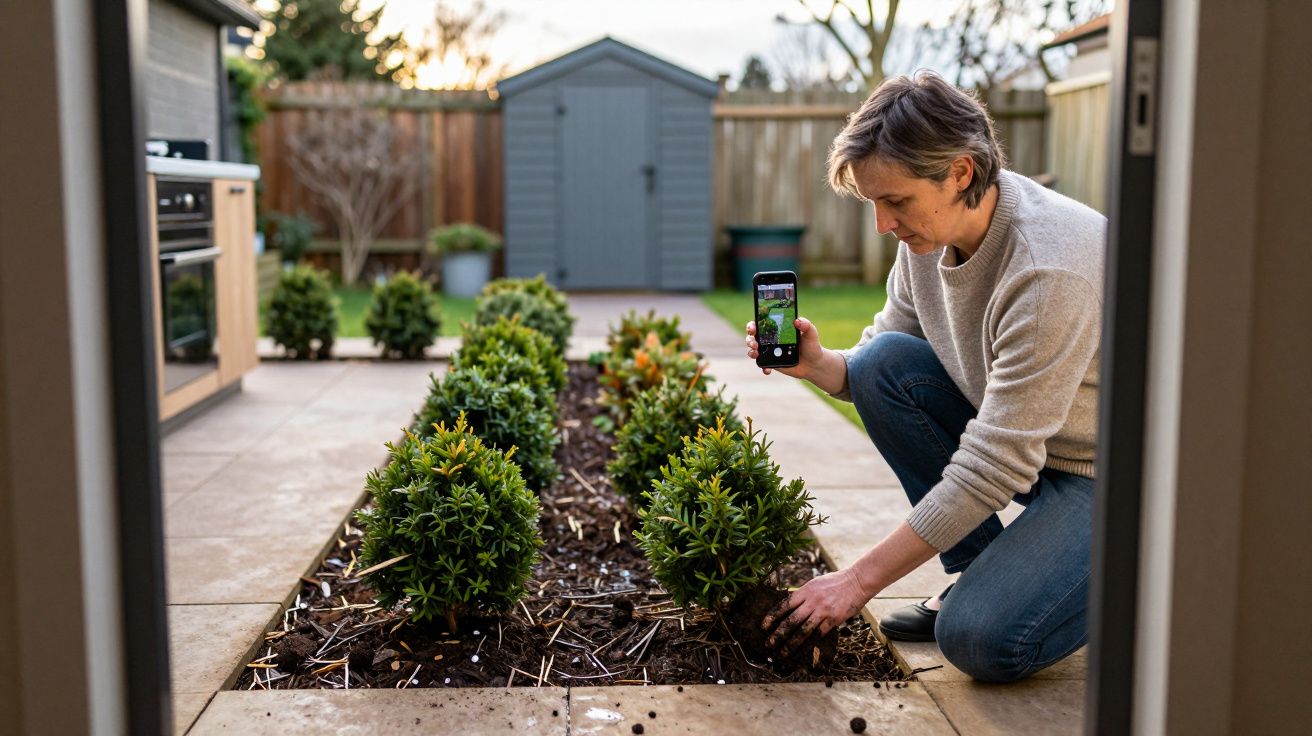
I noticed it one winter afternoon, when everything herbaceous had collapsed and the borders looked stripped. The only things holding the scene together were a few evergreen mounds, a clipped dome near the path, and a looser cluster at the back that pulled your eye towards the shed. The shrubs weren’t just filling gaps. They were doing the job of walls, doorways, and pauses.
Why grouping shrubs shows you what the garden is actually doing
A single shrub can be a nice specimen. A group of shrubs tells a clearer story: where you want people to look, where you want them to move, and where you’re happy for the eye to rest.
That’s because groups create shape at the scale we experience a garden-standing at the door, walking the path, glancing from a kitchen window. Three rounded forms read as a mass. A repeated line of the same shrub reads as an edge. A staggered cluster reads as depth. Your brain loves that predictability more than perfection, and it relaxes into the space.
If your garden feels busy, it’s often because every shrub is trying to be “the one”. Grouping is a quiet way to reduce that noise without removing interest. You’re not dumbing anything down; you’re deciding what counts as structure and what counts as detail.
The three jobs shrub groups do (even when you don’t mean them to)
Most groupings fall into a few roles. Once you recognise them, you can adjust them on purpose instead of inheriting whatever past-you planted on a whim.
- Edges: low, repeating shrubs that define where you walk, where you stop, and where planting begins.
- Rooms: taller or denser shrubs that make a boundary, screen a bin store, or create a feeling of enclosure.
- Anchors: heavier groups that “hold” a corner, terminate a view, or balance something visually strong like a patio or a small tree.
A common mistake is to ask too much of one shrub: edge, screen, focal point, seasonal moment, wildlife magnet. It can do some of those, but a garden reads better when each part has one main job and a supporting role at most.
A quick way to diagnose your layout in ten minutes
You don’t need a plan on graph paper. You need a distance view and a small bit of honesty.
Stand at three places: the back door, the main seating spot, and the point where you first enter the garden. From each, ask two questions:
- What are the three biggest shrub shapes I can see? If you can’t name them, the structure is weak or overly fragmented.
- Do those shapes repeat anywhere? Repetition is what turns “plants” into “layout”.
Then take a phone photo and squint at it. Squinting sounds silly, but it strips away detail and leaves you with masses. If the shrubs don’t form readable blocks-front/middle/back, left/right balance, or a clear curve-your garden is relying on flowers to do structural work they can’t do year-round.
How to group shrubs so the garden feels intentional
Think in odd numbers, but not as a rule of law
Three of something is usually the smallest number that reads as a group rather than a pair of accidents. Five can work in larger borders. One can work too-but then it must be clearly doing the anchor job, not pretending to be a group.
If your border is narrow, group by spacing, not by quantity. Two shrubs planted close enough to touch can read as one mass, while three scattered metres apart will read as three unrelated objects.
Repeat a shape before you chase variety
You can mix species and still repeat the shape. Two rounded evergreens in different greens can still “rhyme”. One upright, one rounded, one spiky-also fine, but then you need repetition elsewhere or it becomes a collection.
A simple pattern that rarely fails is:
- one dominant group (largest mass)
- one supporting group (echoes the dominant)
- one linking group (bridges between them in height or texture)
That’s enough to make a small garden feel designed, even before you get to perennials.
Use gaps as part of the grouping
A group isn’t just the shrubs; it’s the negative space around them. If every inch is planted, nothing reads as a form. Leaving a deliberate gap-mulch, gravel, lawn edge-can make a modest shrub group look more substantial.
This is also where maintenance gets easier. When shrubs are grouped, you can underplant once, mulch once, prune as a unit, and stop fussing around each individual like it’s a museum piece.
Examples that change the feel of a garden fast
Here are a few “swap the layout, not the plant” moves that work in ordinary UK gardens.
- The scattered trio → one cluster: If you have three similar shrubs dotted along a border, lift and replant them as a tight triangle. The border will instantly look calmer and deeper.
- The lonely evergreen → repeated punctuation: If one boxy evergreen sits alone near the path, add a second (or move an existing similar shrub) to create a rhythm. Paths look intentional when they have beats.
- The mixed hedge look → layered screen: Instead of a single line of different shrubs, make a back group (taller, denser) with a smaller repeating group in front. You get privacy and structure without the “random shrub border” vibe.
None of these require buying a new plant. They require moving the ones you already own into a composition that reads from a distance.
Small habits that keep the structure clear all year
Shrub groupings earn their keep when you maintain them as shapes, not as individuals competing for attention.
- Prune with the group in mind: keep the overall outline consistent, even if one plant is more vigorous.
- Avoid “one of everything” purchases unless you have a clear anchor spot for it.
- Review in winter: when flowers and foliage die back, the shrub structure tells the truth.
If you only ever judge the garden in June, you’ll keep fixing the wrong problems. Shrubs are what make the place feel like a garden in November.
| What you change | What it does | Result in the garden |
|---|---|---|
| Tighten spacing into clusters | Creates readable masses | Calmer, more designed feel |
| Repeat a shape or form | Builds rhythm and edges | Clearer paths and borders |
| Layer heights (front/middle/back) | Adds depth and screening | Bigger-feeling layout |
FAQ:
- Do shrub groups have to be the same species? No. They just need a shared “read” from a distance-similar height, shape, or texture-so they register as one unit.
- How close is “close enough” for a group? Close enough that, at maturity, the shrubs nearly touch or lightly interlock. If you can walk between them comfortably, they’ll usually read as separate objects.
- What if my garden is tiny-won’t groups feel bulky? In small gardens, grouping often makes things feel larger and tidier because it reduces visual clutter. Use fewer groups, keep them compact, and leave deliberate open space around them.
- When is the best time to move shrubs into new groups? Autumn to early spring is usually easiest in the UK, while the soil is workable and plants are under less stress. Avoid moving in hard frost or during drought.





Comments (0)
No comments yet. Be the first to comment!
Leave a Comment