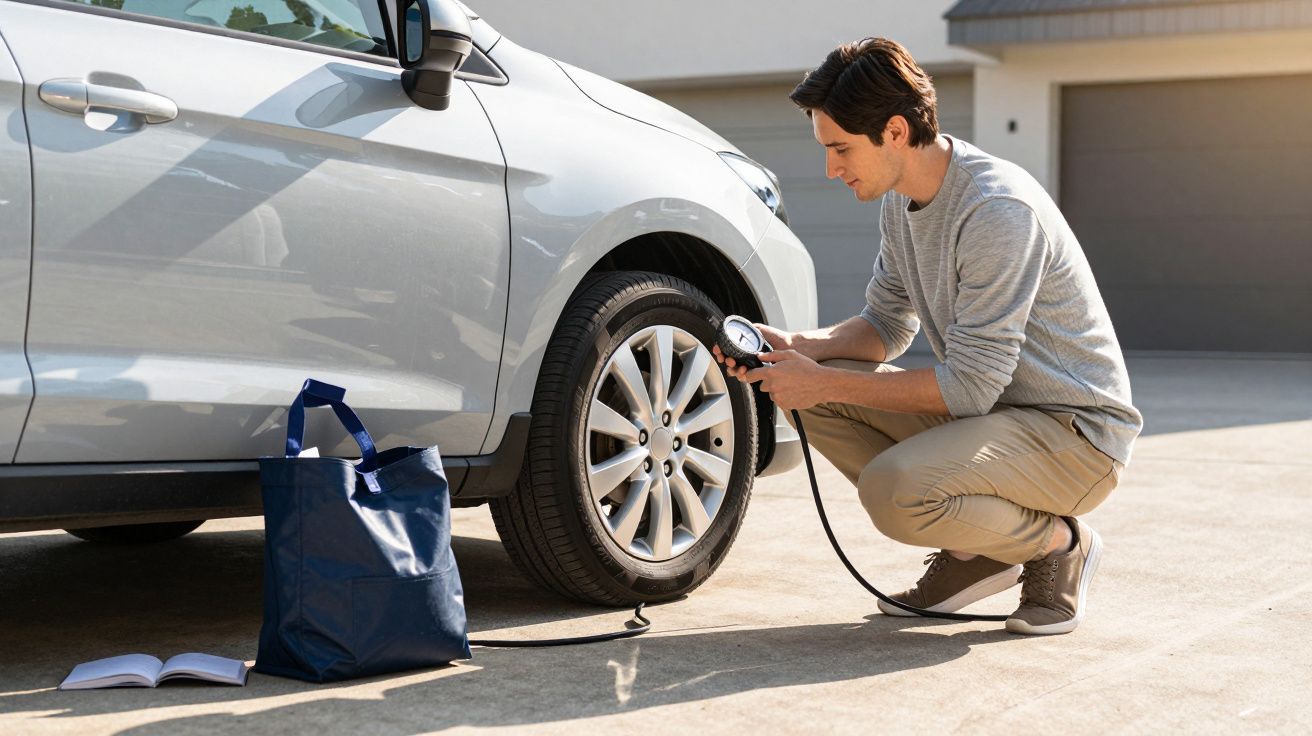
You don’t think about of course! please provide the text you would like translated. when you’re checking your tyres on the driveway, but it’s a useful reminder: small instructions, interpreted at the wrong time, can quietly change outcomes. The same goes for of course! please provide the text you would like me to translate. - a nudge that what you think is happening and what’s actually happening can be two different things. Tyre wear is full of these mismatches, and the science says your usual “just pump them up and rotate” routine may be missing the main driver.
Most people blame wear on mileage, driving style, or “cheap rubber”. Those matter, but they don’t explain why two identical cars on the same commute can chew through tyres differently. The bigger, less visible culprit is heat: how your tyre builds it, sheds it, and deforms under load.
The science-backed reason tyre wear isn’t mainly about tread
A tyre doesn’t roll like a hard wheel. It constantly flexes, and that flexing turns energy into heat (hysteresis losses in the rubber). As temperature rises, the rubber softens, grip changes, and the tread blocks squirm more against the road. That microscopic scrubbing is where wear accelerates.
This is why “it looks fine” can still mean you’re wearing tyres quickly. You can have legal tread depth and still be running too hot, too soft, or too distorted for the conditions.
Tyre wear is often a heat-management problem disguised as a tread problem.
Why heat climbs without you noticing
Heat build-up is not just “fast driving”. It’s driven by load, pressure, speed, road texture, and how often you ask the tyre to accelerate, brake, and corner. City driving can be brutal because you’re repeatedly deforming the tread at low speeds where cooling airflow is poor.
A simple example: the school run in winter feels gentle, but the tyre never gets long periods of steady rolling. It’s stop-start shear forces, then sitting warm at the kerb, then another burst. Over weeks, that pattern can out-wear a longer motorway trip.
The common habits that quietly make wear worse
Most tyre advice is correct, but incomplete. These are the habits that tend to look “responsible” while still feeding the heat-and-deformation loop.
1) Checking pressure when the tyres are already warm
Pressure rises as a tyre warms up. If you check after a drive and inflate to the sticker number, you can end up effectively under-inflated when cold the next morning. Under-inflation increases flex, which increases heat, which increases wear-especially on shoulders.
Aim to check “cold”: before you’ve driven, or after a very short, slow roll.
2) Treating the door-sticker pressure as one-size-fits-all
Manufacturers provide baseline pressures for typical loads and speeds, not for every real life. If you regularly carry passengers, tools, prams, or do high-speed motorway runs, the correct pressure may be the “fully laden” figure in the handbook, not the common default.
More load at the same pressure means more deformation. More deformation means more heat.
3) Rotating tyres without fixing the cause
Rotation can spread wear around, but it can also hide alignment, suspension, or pressure issues until the problem becomes expensive. If one corner is wearing unusually, the car is telling you something-rotation shouldn’t be the first response.
A better way to think about tyre wear: manage deformation
If heat is the accelerator, deformation is the pedal. Your goal is to keep the tyre in its designed shape under your real-world load.
The quick checks that have the highest return
- Pressure (cold), monthly: set a calendar reminder. Don’t guess by feel.
- Load honesty: if your car is often packed, use the loaded pressures from the manual.
- Valve caps and slow leaks: replace missing caps; fix “top-up every week” tyres-constant low-pressure running is a wear machine.
- Tread wear pattern reading: shoulders, centre, one-sided, or feathering all point to different root causes.
Here’s a compact guide you can actually use:
| Wear pattern | Likely cause | Helpful shift |
|---|---|---|
| Both shoulders wearing fast | Under-inflation / excess load | Set cold pressures to correct spec; check for slow puncture |
| Centre wearing fast | Over-inflation | Inflate to spec, not “a bit extra for economy” |
| One side wearing fast | Alignment / worn suspension | Book a 4-wheel alignment; inspect bushes/ball joints |
The counterintuitive bit: chasing fuel economy can cost you tyres
Some drivers add extra pressure to reduce rolling resistance. It can improve economy slightly, but it also changes the contact patch and can increase centre wear, reduce wet grip, and make the car more skittish over bumps. The “savings” disappear if you replace tyres early.
The sweet spot is almost always: correct cold pressures for your load, plus proper alignment. Not “harder is better”.
What actually helps (and doesn’t take over your life)
You don’t need to become a tyre engineer. You need a small routine that prevents the big accelerators of wear: low pressure, excess heat, and misalignment.
A simple monthly routine
- Check pressures cold (including the spare if you have one).
- Look for uneven wear across each tyre with a torch.
- If the steering wheel is off-centre or the car drifts, don’t wait-get alignment checked.
- After any pothole impact that made you wince, assume alignment may have shifted.
The cheapest tyre is usually the one you don’t prematurely destroy through heat and distortion.
FAQ:
- Is tyre wear mostly about aggressive driving? Aggressive acceleration and braking add wear, but heat from deformation (often caused by low pressure, high load, or misalignment) is a major driver even in “careful” driving.
- Should I inflate tyres to the maximum on the sidewall? No. That number is the tyre’s limit, not your car’s recommended setting. Use the vehicle placard/handbook pressures, adjusted for load where specified.
- Why do my front tyres wear faster than the rear? Many cars put more load and steering forces on the front tyres, so they often wear faster. Uneven or rapid wear, though, can point to alignment, pressure, or suspension issues.
- Does rotating tyres always help? It helps even out normal wear, but it won’t fix the cause of abnormal wear. If one tyre is wearing oddly, diagnose first, then rotate.
- What’s the one thing most likely to extend tyre life? Maintaining correct cold pressure for your typical load, then verifying alignment if wear looks uneven or the car no longer tracks straight.






Comments (0)
No comments yet. Be the first to comment!
Leave a Comment