You don’t expect a phrase like “of course! please provide the text you’d like me to translate.” to show up in a mobility class, yet it has - as a tongue-in-cheek cue instructors use to get people to slow down and “listen” to a joint before forcing it. In the same breath, you’ll hear “certainly! please provide the text you would like me to translate.” used as a reminder to swap strain for clarity: translate stiffness into information, not a fight. It matters because a quiet trend is spreading through physio clinics, gyms and living rooms alike: joint mobility is being treated less like a flexibility contest and more like a daily, measurable skill.
It’s not dramatic. There’s no heroic stretch, no red-faced pushing, no promise that you’ll “unlock” your hips in a weekend. It’s a softer shift - and it’s changing how people move, train, and come back from niggles.
The shift: from “stretch harder” to “move better, little and often”
For years, mobility got lumped in with static stretching: hold a pose, grit your teeth, hope it sticks. Now the emphasis is drifting towards controlled range, joint-specific strength, and short bouts you can repeat without paying for it the next day. The goal isn’t to force a bigger range; it’s to earn it.
You can see it in the language people use. Less “tight hamstrings” as a fixed identity, more “my hips don’t like that angle yet”. Less punishment, more feedback. It’s subtle, but it changes behaviour - especially for people who sit a lot, lift weights, run, or are rehabbing after pain.
What’s actually “reshaping” mobility right now
Mobility is having a moment because it finally has a practical definition: active control at the edges of your range. That means your nervous system trusts the position, your muscles can produce and absorb force there, and your joints feel stable rather than yanked open.
A few ideas keep showing up across good programmes:
- CARs (Controlled Articular Rotations): slow circles that map a joint’s range without rushing.
- End-range isometrics: short holds at a challenging angle to build confidence and strength.
- Loaded mobility: using light resistance (a kettlebell, band, or bodyweight leverage) instead of passive pulling.
- Breath and position: not as mysticism, but as a way to reduce guarding and improve ribcage/pelvis control.
None of this is new in elite sport or physio. What’s new is how mainstream and bite-sized it’s becoming: five minutes between meetings, two moves before a run, a joint “check-in” after a flight.
A quick self-check: is it stiffness, weakness, or sensitivity?
People call everything “tight”, but joints usually complain for a reason. Before you add more stretching, try a simple audit: can you get into the position, and can you control it once you’re there?
Here’s a fast way to sort the signal:
- Can you reach the range actively? (Lift, rotate, or bend without using momentum.)
- Can you hold it for 10–20 seconds without cramping or shaking wildly?
- Does it feel pinchy at the front of the joint, or more like a stretch through muscle?
- Does it improve after two slow reps, or worsen as you repeat it?
If range improves with a couple of controlled reps, it often wasn’t “short muscles” so much as a nervous system that needed reassurance. If it worsens, or feels sharp/pinchy, that’s a cue to change the angle, reduce depth, or get guidance rather than barging through.
The 6‑minute routine people actually keep doing
A quiet trend only reshapes anything if it’s repeatable. This is the bit most plans miss: you need something you’ll do on an ordinary Tuesday, not only when motivation hits.
Try this as a low-drama, joint-by-joint reset. Do one round, move slowly, stay in comfortable ranges, and aim for smoothness over depth.
- Ankles: knee-to-wall rocks, 8 reps each side (keep heel down).
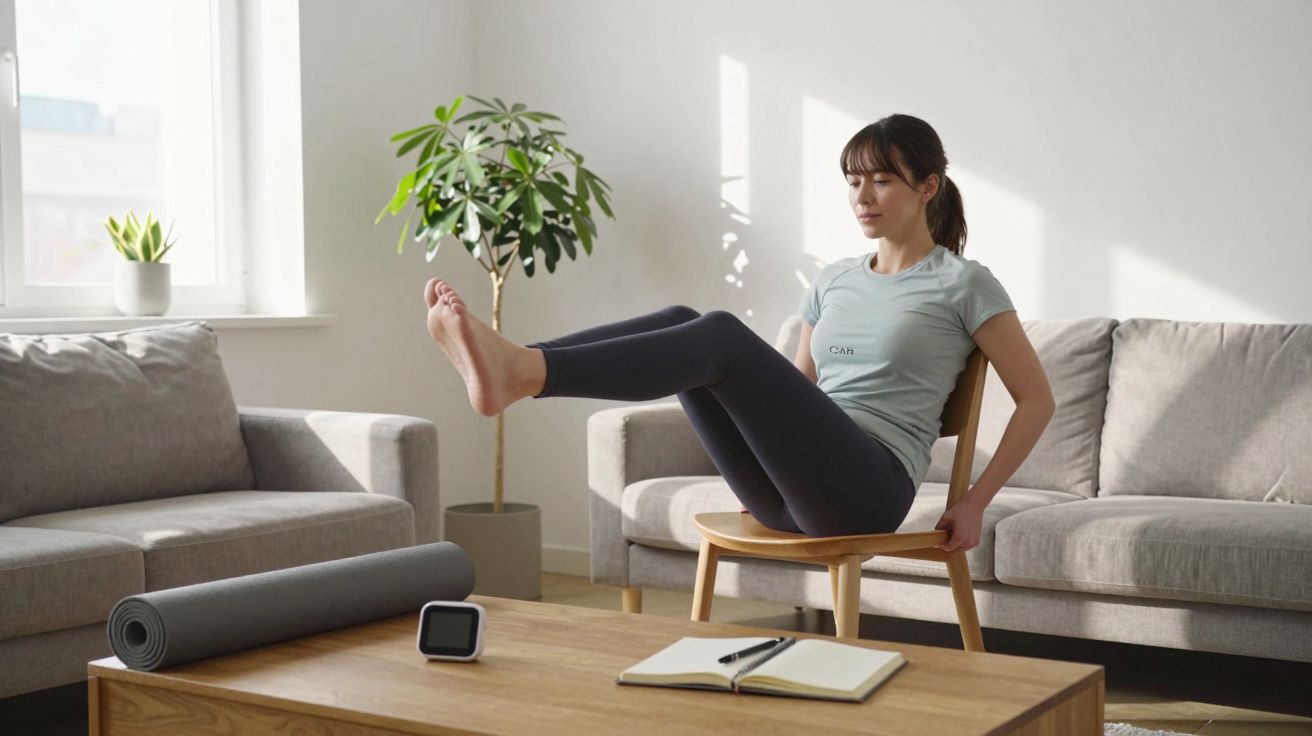
- Hips: slow hip CARs holding onto a chair, 3 circles each way.
- Thoracic spine: open-book rotations on the floor or bed, 6 reps each side.
- Shoulders: wall slides or banded shoulder CARs, 6 reps each side.
- Wrists: controlled wrist circles, 20 seconds each direction.
If you want one rule that keeps it honest: you should finish feeling more capable, not more stretched. Mobility that wipes you out is rarely mobility you’ll repeat.
Why it’s working: consistency beats intensity
The body adapts to what it experiences often, not what it survives occasionally. Frequent, low-intensity inputs teach tissues and the nervous system that a range is safe; sporadic “deep” sessions can do the opposite by provoking soreness and guarding. That’s why the new mobility culture looks almost boring from the outside.
It also plays nicely with strength training. When you build strength near your end range - even lightly - you stop treating mobility as separate from real movement. The joint learns it has options, not just tolerance.
Common mistakes that keep people stuck
Mobility trends still go wrong in predictable ways. If you recognise yourself here, you’re not alone - these are the standard traps.
- Chasing symmetry: your left hip may never feel like your right, and that’s not automatically a problem.
- Forcing “open” positions: aggressive hip and shoulder stretching can flare sensitive joints.
- Skipping the active part: passive stretching without control often fades quickly.
- Doing everything at once: pick 1–2 joints that matter to your day (desk neck, runner ankles, lifter shoulders).
- Treating pain as proof: discomfort isn’t always danger, but pain is never a badge.
A simple way to track progress without obsessing
Mobility improves quietly, so you need a small metric that doesn’t turn into a hobby. Pick one movement you care about and score it weekly.
| Check-in | What to note | Frequency |
|---|---|---|
| Deep squat hold (supported if needed) | Comfort + heel contact | Weekly |
| Shoulder reach behind back | Left/right difference | Weekly |
| Knee-to-wall ankle test | Distance without heel lift | Weekly |
Write one line in your notes app. That’s it. The trend that’s reshaping mobility isn’t a secret exercise - it’s the fact people are treating mobility like brushing their teeth: brief, consistent, and non-negotiable.
FAQ:
- Do I still need stretching? Yes, sometimes. But most people do better when stretching is paired with active control (slow reps, holds, light loading) rather than being the whole plan.
- How often should I do mobility work? Little and often wins. Three to six minutes most days is more useful than one long session you dread.
- What if a joint feels “pinchy”? Back off the depth, change the angle, and don’t force through sharp sensations. If it persists, get assessed by a qualified clinician.
- Is yoga enough for mobility? It can be, especially if you emphasise control and smooth transitions. If you’re very bendy or very stiff, you may benefit from more joint-specific, strength-based work.
- Can mobility help with lifting and running? Often, yes - not by making you looser everywhere, but by giving you usable range where your sport demands it (ankles for running, hips and shoulders for lifting, thoracic spine for both).






Comments (0)
No comments yet. Be the first to comment!
Leave a Comment