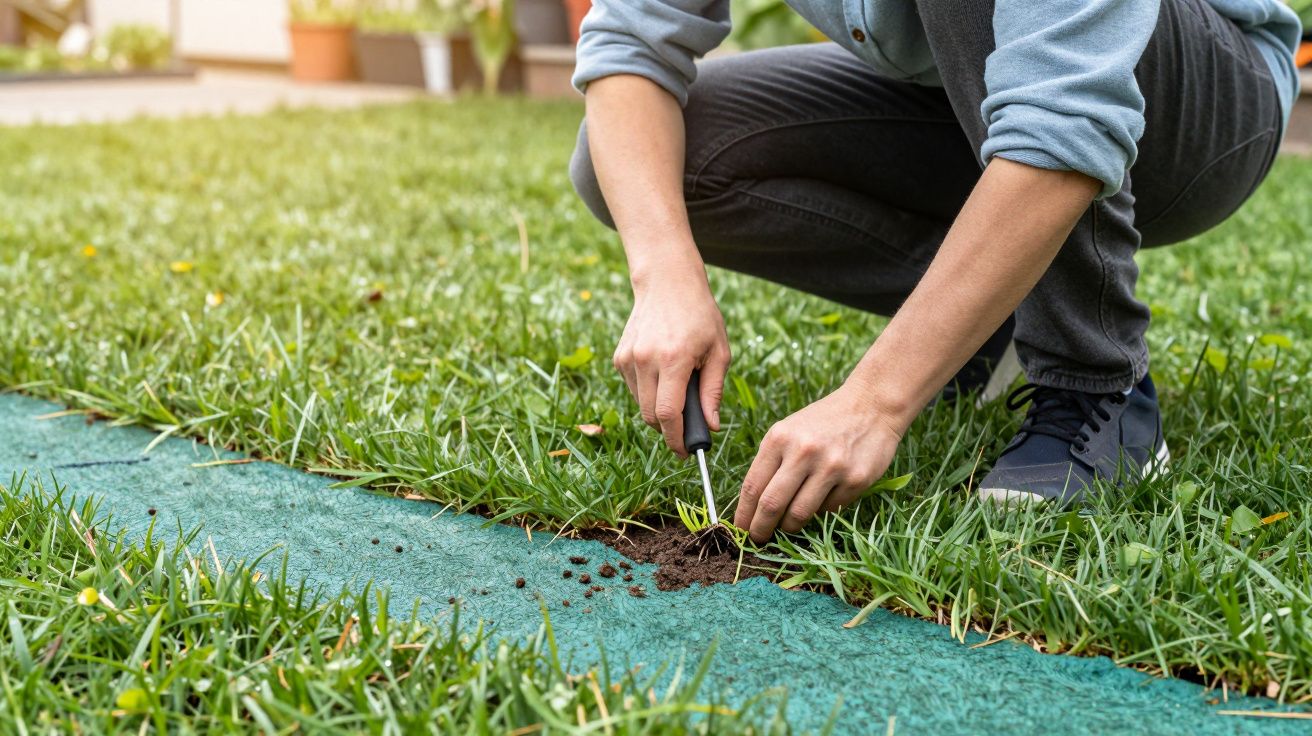
From the pavement, a lawn can look flawless: flat colour, neat stripes, not a weed in sight. In professional gardening, that “uniform” surface is treated more like a report than a picture-because tiny differences in texture, sheen, and growth rate usually point to a cause that will spread if ignored. Reading those clues early saves money, time, and the heartbreak of a turf failure right when you want the garden to look its best.
Most problems don’t announce themselves with bare soil. They arrive as subtle shifts: a faint blue-green cast, a soft patch underfoot, a stripe that won’t recover after mowing. Professionals are trained to treat those shifts as information, not imperfections.
Why “even” lawns often aren’t even
A lawn is a living mix of soil, roots, water, and grass plants competing for light and nutrients. Uniform colour can mask uneven moisture, shallow rooting, compaction, or a creeping disease moving just below the canopy. The top can look tidy while the base is stressed.
The quickest way to misread turf is to judge it only from standing height. The real story sits at shoe level and in the first 50–100 mm of soil.
Professional eyes also look for pattern. If the patch is circular, it suggests one set of causes; if it follows a line, it suggests another.
The cues professionals scan in 30 seconds
They’re not guessing. They’re running a fast checklist-shape, distribution, and what changed recently (weather, mowing, feeding, foot traffic).
1) Colour shifts that mean something
- Pale green overall: hunger, often nitrogen, or cold soils slowing uptake.
- Blue-green cast: drought stress beginning, even if the surface still feels cool.
- Yellowing in small islands: waterlogging, local compaction, or pet urine depending on edges.
Colour is read alongside growth rate. A hungry lawn often grows slowly and evenly; a water issue often creates fast/slow zones.
2) Texture and “feel” underfoot
A professional will walk it. A springy bounce can mean thatch building; a squelch can mean poor drainage; a hard “ring” under shoes points to compaction. Those are maintenance issues, not cosmetic ones.
3) Shape and placement of the problem
- Along edges, fences, or hedges: shade, root competition, and dry soil under overhangs.
- A stripe matching mower lines: blunt blade tearing leaf tips, or mower deck imbalance.
- A circle or arc: fungal activity, fairy ring, or uneven irrigation coverage.
If it repeats in the same place each year, it’s usually structural: soil profile, drainage, or shade.
What the “perfect stripes” can hide
Striping is light reflection, not health. A lawn can stripe beautifully while roots sit shallow in compacted soil, surviving on frequent surface watering. It looks great-until a dry spell, heatwave, or heavy use exposes the weakness.
Common hidden issues beneath a tidy surface include:
- Compaction: water runs off, roots stay near the top, moss and weeds gain ground.
- Thatch: spongy feel, scalping risk, and a sheltered home for disease.
- Uneven irrigation: “green enough” from above, but patchy stress that gets worse each summer.
A lawn that only looks good when it’s frequently watered is telling you it doesn’t have depth.
A practical read: diagnose before you “fix”
Before feeding, spraying, or reseeding, professionals confirm what’s actually happening. You can borrow the same approach in ten minutes.
A simple 3-step check
- Look low, not wide: crouch and inspect leaf tips, crowns, and whether grass is upright or lying flat.
- Test the soil: push a screwdriver in after watering or rain. Easy in some areas, hard in others = uneven compaction/moisture.
- Pull a small tuft: healthy roots are typically pale and firm. Short, brown, or sparse roots suggest stress (often waterlogging, compaction, or grub activity).
If you find multiple causes, prioritise the one affecting the roots. Leaf symptoms are often just the consequence.
The professional playbook: fix the cause, then the appearance
Professional gardening tends to work in the order that turf biology demands: soil first, then cultural practice, then inputs. Quick cosmetic fixes can backfire if the foundation is wrong.
- Compaction: core aeration, then top-dressing to keep channels open.
- Thatch build-up: scarify lightly in the right season, then adjust feeding and mowing height to prevent it returning fast.
- Water problems: change watering frequency (deeper, less often), fix coverage, and relieve drainage pinch points rather than just adding more seed.
- Mowing stress: sharpen blades, avoid taking off too much at once, and raise height during heat or drought.
What to do by season (UK rhythm)
| When | Priority | Why it works |
|---|---|---|
| Spring | Light feed, mowing setup, spot repairs | Supports recovery without forcing weak growth |
| Summer | Water depth, mowing height, traffic control | Reduces stress and shallow roots |
| Autumn | Aerate, top-dress, overseed if needed | Best conditions for rooting and levelling |
When to call in help
Some lawn problems are straightforward; others are expensive if misdiagnosed. Call a professional if patches spread quickly, if you suspect drainage failure, or if you’ve treated twice without a clear improvement. A good operator will explain what they see, take simple tests, and talk you out of unnecessary products.
The takeaway is not that lawns are fragile. It’s that they’re readable. Once you start seeing what professionals see-patterns, pressure points, and root health-“uniform” stops being the goal and becomes the clue.




Comments (0)
No comments yet. Be the first to comment!
Leave a Comment