
It’s easy to look at a lawn from the kitchen window and assume everything’s fine, especially if your usual lawn maintenance routine is ticking along: mow, water, repeat. But there’s a particular pattern that can show up even when the grass is green - and it’s one of the clearest signs something underneath is going wrong. Catch it early and you can save yourself a season of patching, reseeding and wondering why the “healthy” bit never stays healthy.
Most people only notice it when the sun is low and the light hits just right: pale arcs, stripes, or a repeating ripple that looks too neat to be random. At first you blame the mower. Then you see it again after rain, or after a week of growth, and it starts to feel like the lawn is trying to tell you something.
The pattern that looks like a mowing issue - but isn’t
There are a few “normal” patterns: the classic mower stripes, a bit of scalping on a turn, the odd lighter patch where the dog always goes. The one worth paying attention to is different. It repeats in a way your mowing lines don’t, and it tends to persist even if you change direction or raise the cutting height.
Look for:
- Curving, looping bands (often paler or slightly taller grass) that seem to weave through the lawn
- A ripple effect where some areas look puffy and others look flat, like a quilt that’s shifted
- Patches that feel springy underfoot, sometimes with a slightly spongy give
If you can see it from upstairs, that’s not because the grass is artistic. It’s because the surface is telegraphing what’s happening at root level.
What’s usually underneath: compaction, thatch, or shallow roots
Most “mysterious lawn patterns” come back to a simple truth: grass is only as resilient as the conditions around its roots. When those conditions are off, the lawn stops behaving like one even carpet and starts behaving like a map of its own problems.
1) Soil compaction (the silent one)
Compaction is what happens when the soil gets pressed so tight that air and water can’t move through it properly. Roots stay shallow because they can’t push down, and the grass becomes more dependent on frequent watering - which makes it look fine until it suddenly doesn’t.
Clues you’re dealing with compaction:
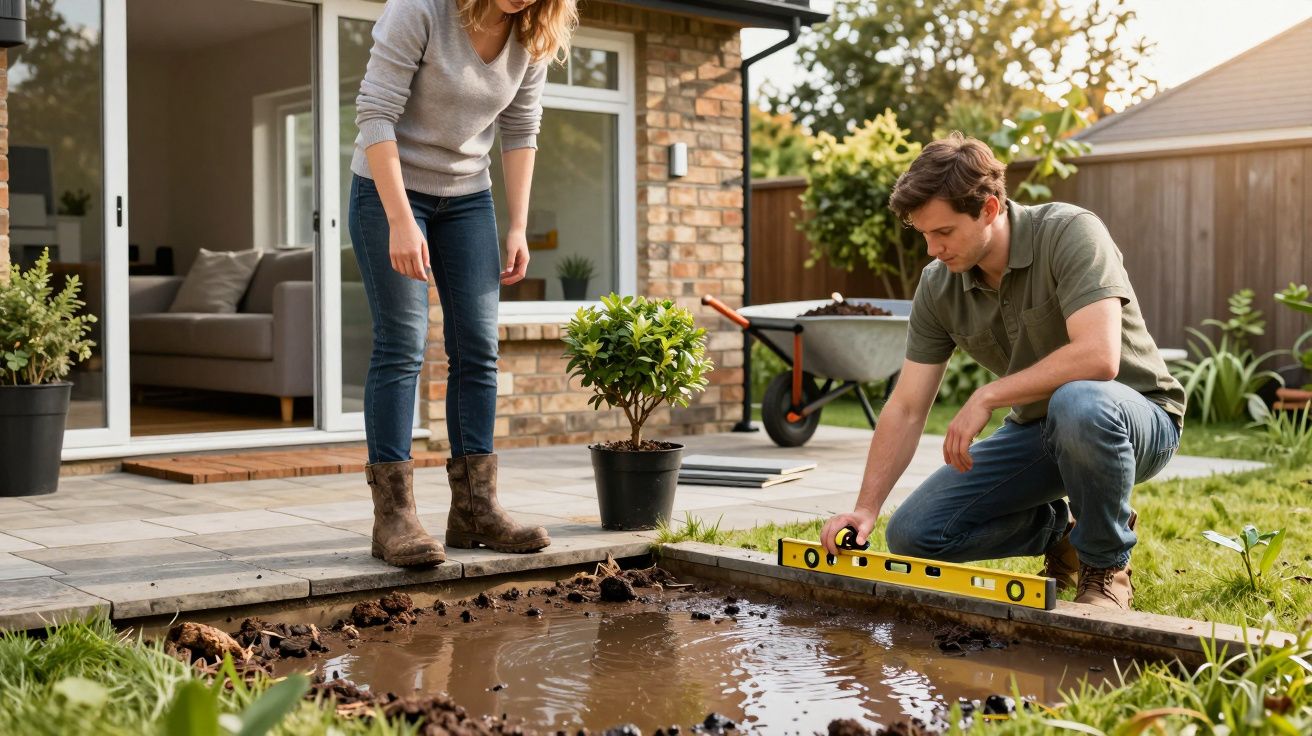
- Water puddles or runs off instead of soaking in
- The lawn dries out quickly even after rain
- A garden fork is hard to push in and comes up clean, like you’ve stabbed clay
The “pattern” appears because some areas take foot traffic, mower turns, kids’ games, or repeated walking routes more than others. The grass above those zones starts to thin, pale, or grow differently - not enough to scream “dead”, just enough to look wrong.
2) Thatch build-up (the sponge layer)
Thatch is a layer of dead stems and roots that sits between the green grass and the soil. A thin layer is normal. A thick layer acts like a mattress: it holds moisture on top, keeps water from reaching the soil evenly, and creates a cosy home for pests and disease.
Quick check: press your fingers into the lawn and part the grass. If you see a brown, fibrous layer that’s more than about 1–2cm, you’re no longer dealing with “a bit of natural material”. You’ve got a management issue.
That’s when you get that springy feel - and those odd bands where some areas stay damp and lush while others start to look stressed.
3) Shallow, lazy roots (often from “kind” watering)
Let’s be honest: most of us water when the lawn looks thirsty, and we water just enough to make the surface look better. That trains grass to keep its roots near the top. Then the first hot, dry spell hits and the lawn can’t cope without constant help.
Shallow roots can create striping and patchwork because:
- Sun-exposed sections dry first
- Slightly shaded areas hold on longer
- Any unevenness in soil depth, thatch, or compaction becomes visible fast
The simplest test that tells you which one it is
You don’t need gadgets. You need ten minutes and a willingness to disturb the lawn slightly.
- Do the screwdriver test: after watering or rainfall, push a screwdriver into the soil in a few spots.
- Easy in some places and impossible in others suggests compaction variation.
- Easy in some places and impossible in others suggests compaction variation.
- Lift a small flap: use a trowel to cut three sides of a small square and peel it back.
- A thick brown layer above soil suggests thatch.
- Short roots clustered near the top suggests shallow rooting (often alongside compaction).
- A thick brown layer above soil suggests thatch.
- Watch how water behaves: hose a “problem stripe” and a “good stripe” for the same time.
- If one pools and one absorbs, you’ve found your uneven infiltration.
The goal isn’t to diagnose perfectly on day one. The goal is to stop treating a root problem with a cosmetic fix.
What to do next (without tearing the whole thing up)
Start with aeration - but do it like you mean it
If compaction is even part of the issue, aeration is the most reliable reset. Hollow-tine aeration (removing plugs) beats spiking (just punching holes), especially in heavier soils.
- Aerate when the soil is moist, not waterlogged
- Focus on the stripes and high-traffic routes, but don’t ignore the rest
- If you can, do a second pass at a different angle
After aeration, top-dressing with a thin layer of compost or sandy loam can help keep the holes open and improve soil structure over time.
If thatch is the culprit, scarify selectively
Scarifying sounds aggressive because it is a bit. But it’s often the difference between a lawn that looks “fine” and one that actually functions.
- Scarify in spring or early autumn when the lawn can recover
- Expect it to look worse for a week or two; that’s not failure, that’s access
- Follow with overseeding if you’ve pulled out a lot
A common mistake is scarifying and then going straight back to tight mowing and frequent light watering. That’s how thatch quietly returns.
Fix watering so roots stop living on the surface
Aim for less often, more deeply. One good soak a week (adjusted for weather and soil) encourages roots to chase moisture downwards. Frequent small waterings keep the lawn dependent and shallow.
A practical rule: water long enough that moisture reaches 10–15cm down, then wait until the lawn shows early stress (a slightly dull colour, footprints lingering) before watering again.
Raise the mowing height and change direction
If you’re seeing a repeating pattern, the lawn is already under some stress. Scalping it makes the stress visible faster.
- Raise the mower by a notch for a few weeks
- Change mowing direction each cut
- Keep blades sharp (ragged tips lose water faster and invite disease)
The bit people miss: patterns are often about repetition
A lawn is a record of habits. Where you turn the mower. Where the kids run. Where you drag the paddling pool. Where you stand to chat over the fence. The pattern is rarely “mysterious” once you map it to what actually happens on that patch of ground.
If you only take one thing from this: a lawn that stays green can still be struggling. The pattern is your early warning - not your aesthetic problem.
FAQ:
- Why does the pattern stay even after I change mowing direction? Because the cause is usually below the surface (compaction, thatch, uneven water absorption), not the direction of the cut.
- Will fertiliser fix the striping? It can mask symptoms briefly, but it won’t solve poor root conditions. In some cases it worsens thatch and makes growth more uneven.
- When should I aerate in the UK? Spring or early autumn are safest. Avoid aerating during drought, heatwaves, or when the ground is saturated.
- Is spiking with garden shoes enough? It helps a little on very small areas, but hollow-tine aeration is far more effective for real compaction.
- How do I know if it’s disease instead? Disease usually spreads with less “neat” repetition and often shows lesions, thinning, or fuzzy growth in damp conditions. If the pattern mirrors traffic routes and feels hard underfoot, start with compaction/thatch checks.




Comments (0)
No comments yet. Be the first to comment!
Leave a Comment