You can drive a Skoda for years thinking you’ve beaten the cost-of-living crisis: sensible finance, sensible fuel bills, sensible servicing. Then an oddly familiar phrase pops up in your ownership journey - “of course! please provide the text you would like me to translate.” - because suddenly you’re translating warning lights, advisory notes, and garage explanations into a decision that’s either cheap now or expensive later. The hidden issue isn’t one single part; it’s how modern Skoda ownership quietly rewards people who spot a pattern early.
At first it feels like nothing. A faint vibration at idle, a slightly longer crank on cold mornings, a rattle you only hear with the radio off, or a “minor leak, monitor” on an MOT sheet. The car still starts, still pulls, still gets you there - which is precisely why people ignore it.
The problem nobody names: “small symptoms” that are actually a timeline
Modern cars don’t tend to fail with drama; they fail with a gentle drip-feed of clues. On many Skoda models (especially those sharing common VW Group hardware), the same handful of “not urgent” signs often belong to known, time-sensitive faults: cooling system leaks, timing system wear, or DSG behaviour that worsens once the fluid is overdue.
The trap is psychological as much as mechanical. Owners treat each symptom as a one-off: top up coolant, clear a fault code, live with a shudder. But the car is telling a single story in instalments, and the ending is usually a recovery truck.
Where it starts: the cooling system that looks fine until it doesn’t
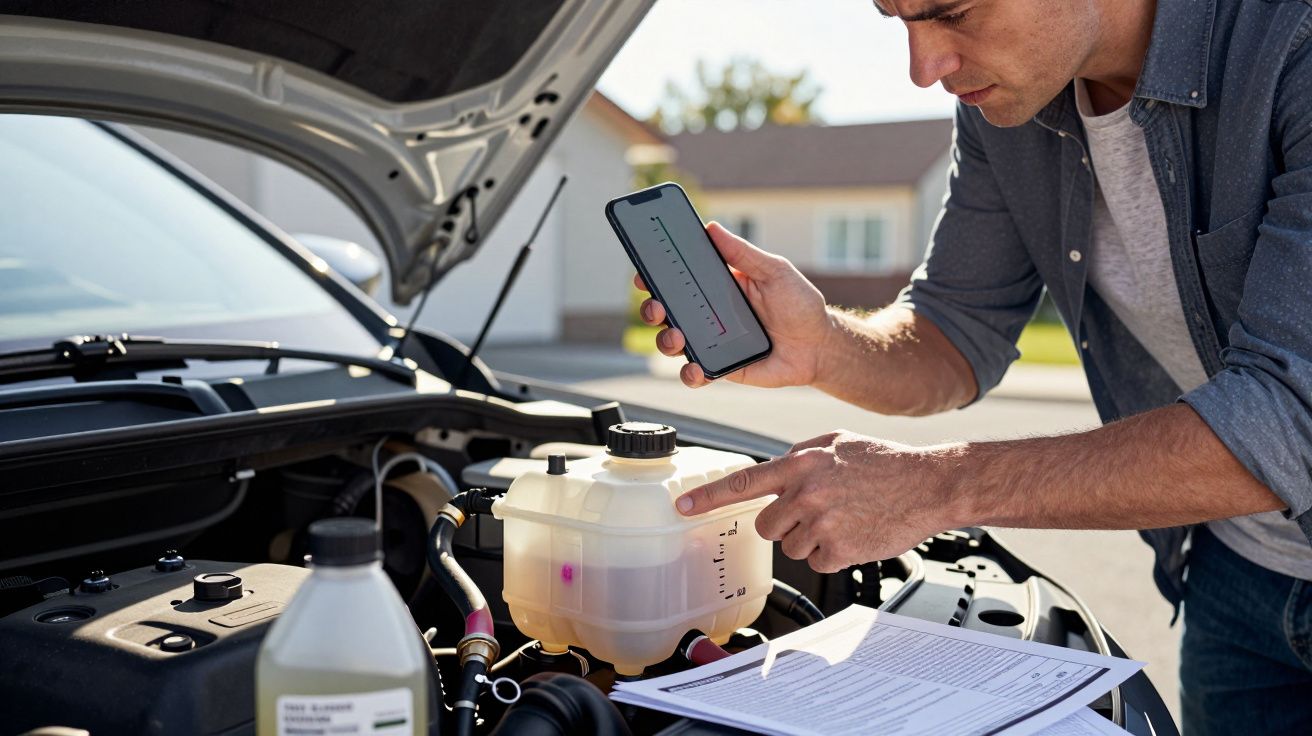
If there’s one area that regularly catches people out, it’s coolant loss that’s slow enough to rationalise. A few hundred millilitres every month can look like “evaporation” or “just winter” until the level drops at the wrong moment, the engine runs hotter than it should, and plastic housings or water-pump assemblies finally give up.
Look for the pattern rather than the puddle. Dried pink/white residue around hose joints, a sweet smell after parking, or the heater occasionally blowing lukewarm can be the early chapter.
What makes it expensive isn’t the leak - it’s the overheated drive that follows.
Quick checks you can do without tools
- Check the coolant level when the engine is cold, at the same spot on your driveway each time.
- Photograph the level against the min/max marks weekly for a month.
- If it’s dropping, don’t just top up: ask for a pressure test and a proper inspection around the pump/thermostat housing and hose connections.
- If the temperature needle ever moves from its normal position, stop and investigate - don’t “nurse it home”.
The second quiet culprit: timing wear that hides behind “it still runs fine”
Timing problems rarely announce themselves clearly. You might hear a brief rattle on start-up, notice rougher idle, or get an intermittent engine light that disappears after a restart. People wait because the car drives normally most of the time, and because garages often phrase it cautiously: “Keep an ear on it.”
On certain engines, timing chain or belt-related issues are brutally binary once they cross a threshold. The repair cost isn’t the chain or belt; it’s the collateral damage when the timing slips.
If you only take one rule from this: treat repeated start-up rattles, misfire codes, or persistent rough idle as diagnose-now issues, not “next service” issues.
DSG and the “sealed for life” misunderstanding
Some Skoda owners don’t talk about the gearbox until it starts behaving badly - because admitting it feels like admitting you bought the wrong car. In reality, many DSG issues are maintenance and usage problems wearing a mechanical face: overdue fluid changes (where applicable), heat, stop-start traffic, and software calibrations that drift.
Common early signs include:
- Hesitation pulling away, especially when hot
- Jerky 1–2 changes in town
- A shudder under light throttle
- “PRNDS” flashing or gearbox warnings that clear after cycling the ignition
None of these automatically means “new gearbox”. But all of them mean you should stop guessing and start measuring: fault codes, fluid condition (if serviceable), and a specialist road test.
A gearbox that is merely “a bit jerky” in March has a habit of becoming “undriveable” in July.
How to read the paperwork - and catch the issue while it’s still small
You don’t need to be a mechanic to spot the trajectory. You need to treat notes and advisories as data, not as background noise.
What to look for in service history and MOTs
- Repeated mentions of coolant staining, minor leaks, or “top-up required”
- Any timing-related notes, rattles, or engine management investigations without a documented fix
- Gearbox fluid/service entries (or the suspicious absence of them on high-mileage cars)
- Patterns of “could not replicate” followed by the same complaint later
If you’ve bought used, assume gaps exist. Build a baseline: one thorough inspection now can be cheaper than three vague visits later.
A simple decision framework (before you spend money in the wrong place)
When owners finally act, they often start with the cheapest visible fix. That can be correct - or it can be the most expensive way to learn nothing.
Use this triage:
- Safety/overheating risk (act immediately): coolant loss, temperature movement, burning smells, misfire under load.
- Time-sensitive mechanical risk (diagnose soon): start-up rattles, persistent rough idle, repeat fault codes.
- Comfort/drivability (book in, but don’t ignore): jerky shifts, intermittent sensors, minor vibrations.
If a garage can’t show you evidence - pressure-test results, fault-code printouts, measured play, logged temperatures - you’re paying for hope.
What this means for Skoda owners
Skoda’s value proposition still holds: lots of car for the money, sensible running costs when maintained properly, and strong parts availability. The hidden issue is that some of the most costly failures are preceded by cheap-to-fix clues that owners talk themselves out of hearing.
The fix is unglamorous: track symptoms, insist on diagnostics, and treat “minor” repeats as a single, connected story. Because the car won’t wait for your next payday, and it definitely won’t wait for your next service interval.
Cheat-sheet: early signs and the smart response
| Early sign | Likely direction | Best next step |
|---|---|---|
| Coolant slowly dropping | Leak that can escalate into overheating | Pressure test + inspect pump/thermostat/hoses |
| Start-up rattle / rough idle | Timing wear or misfire root cause | Proper diagnosis, don’t “monitor” for months |
| Jerky DSG behaviour | Maintenance/software/early wear | Specialist scan + confirm service requirements |
FAQ:
- Is this about one specific Skoda model? No. These patterns can show up across different Skoda models and engines, especially where components are shared across the wider VW Group.
- Should I stop driving if I’m losing coolant? If the level is dropping repeatedly or the temperature gauge behaves unusually, yes - stop and investigate. Overheating is what turns a manageable repair into a major bill.
- My DSG feels a bit hesitant; does that mean it’s failing? Not necessarily. It does mean you should get it scanned and assessed before the behaviour becomes consistent and costly.
- What’s the most cost-effective first step? Pay for one good diagnostic session (pressure test, fault-code readout, and a thorough inspection) rather than a sequence of small “maybe” fixes.
- Can regular servicing prevent all of this? It prevents a lot, but not everything. The real advantage comes from acting on repeat symptoms early, not just following the service schedule.






Comments (0)
No comments yet. Be the first to comment!
Leave a Comment