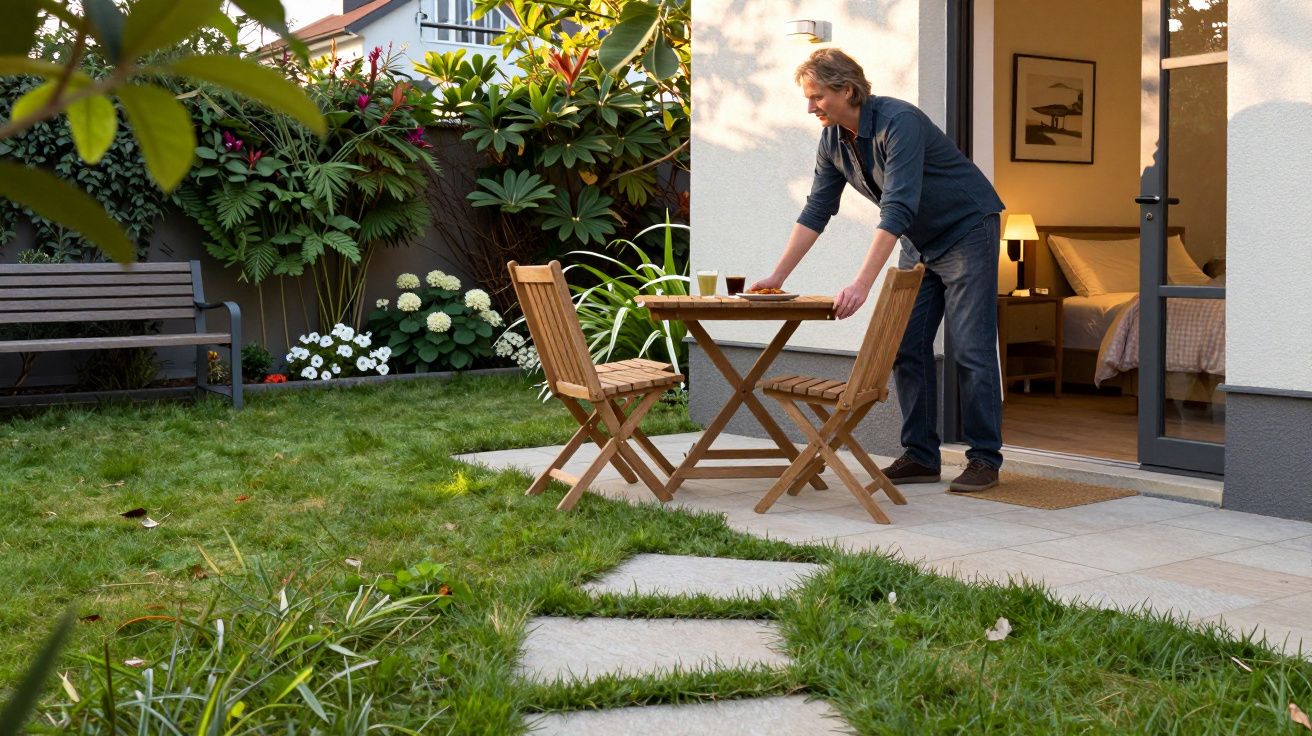
Garden elements in a residential garden rarely announce themselves, yet they steer where you sit, where you walk, and what you avoid without you noticing. A narrow path can make a lawn feel “off limits”; a low wall can turn a dead corner into the spot everyone gathers. If you’ve ever wondered why a garden looks fine but doesn’t quite get used, it’s usually the quiet features doing the directing.
I clocked this one evening at a friend’s barbecue. The food was great, the weather was kind, and still everyone clustered by the back door like the garden started and ended at the threshold. Out on the lawn there was space for a small festival, but it felt oddly far away-like you needed a reason to cross it.
Then I saw it: no obvious route, nowhere to put a drink, and seating that faced the fence rather than the people. Nothing was “wrong”. The garden simply hadn’t been given permission to be lived in.
Why gardens get ignored - and why it’s rarely about size
Most gardens don’t fail on planting, they fail on choreography. People move towards cues: a clear line to follow, a place to pause, a surface that feels stable underfoot, and a boundary that says, you can relax here. When those cues are missing, we default to the safest, nearest zone-usually the patio or the kitchen door.
There’s also an attention tax. If a route looks muddy, uneven, or too narrow to pass someone comfortably, you’ll take it once and then stop bothering. If you have to hunt for shade, your “summer seating area” quietly becomes “winter storage”.
The fix isn’t always bigger paving or a new pergola. Often it’s small, deliberate garden elements placed where decisions happen: at doors, at corners, at the edge of lawn, at the point where the garden changes from “passing through” to “staying”.
The six quiet features that decide how a space gets used
Think of these as the garden’s hidden signage. They don’t shout. They simply make one option easier than the others.
1) Desire lines: paths that match how people actually walk
A path that’s slightly off-centre, or that forces a sharp turn, will be ignored in favour of worn grass. People will always choose the most direct line to the bin, the shed, the washing line, the side gate.
What helps:
- Keep main routes at least shoulder-width for passing (especially near doors).
- Use a clear “start” point: a step, a change in material, a slight widening like a welcome mat.
- If you don’t want a hard path, use stepping stones close enough to feel confident in rain.
A good path doesn’t just connect places. It makes the whole garden feel more accessible, so the far end stops feeling like a separate postcode.
2) Edges: the low borders that turn mess into intention
An edge is a signal. A crisp line between lawn and bed tells your eye “this is maintained”, even if the planting is loose and wild. Without edges, the garden looks bigger for a week, and then starts to look untidy for the next fifty-one.
Simple edging does three jobs at once: it reduces trimming, it protects beds from foot traffic, and it tells people where not to step. In a residential garden, that alone can preserve planting near routes and seating that would otherwise get scuffed into nothing.
3) Thresholds: the first three metres outside the door
This is the most overworked part of the garden and the most under-designed. It’s where shoes land, where you juggle cups, where dogs bolt out, where you decide whether it’s worth going further.
A few small upgrades here change everything:
- A level, non-slip surface you can stand on with confidence.
- Somewhere to put something down (a wall cap, a small table, even a wide step).
- A “next move” cue: a path visible from the doorway, or planting that guides you sideways into the space.
If the threshold feels awkward, the garden becomes a view rather than a place.
4) Seating orientation: where the chairs point decides where the chat goes
People sit where they can see faces, food, and movement. If your main seating faces a fence, it becomes a waiting room. If it faces the house only, the garden becomes a backdrop rather than a destination.
A quiet trick is to give seating two anchors: one outward view (a bed, a tree, a pot cluster) and one inward view (towards the door or dining area). That way the garden feels connected rather than split into zones that compete.
“Nobody uses the bench,” my friend said, pointing at it. It wasn’t the bench. It was the fact it sat alone, with no side table and no reason to stay.
5) Microclimate makers: shade, shelter, and surfaces that change comfort
Comfort is the real currency. If it’s windy, you’ll hug the wall. If it’s scorching, you’ll cling to the only patch of shade. If the paving holds heat like a griddle, you’ll migrate indoors.
Look for small, targeted moves:
- One sheltered corner (trellis, hedge, slatted screen) to break the wind.
- Dappled shade over seating (light canopy, small tree, pergola with climber).
- A surface underfoot that doesn’t become a slip hazard or a heat trap.
The best gardens don’t just look good; they offer at least one “easy” place whatever the weather is doing.
6) Lighting: the feature that decides whether evenings exist
A garden without lighting shrinks at dusk. It’s not about airport floodlights; it’s about low-level cues that make the space feel legible and safe.
Aim lighting at what you use:
- Steps and changes in level.
- A route to bins or side gate.
- One focal point that draws you out (a small tree, a pot, a textured wall).
If you can see where you’re going and where you’re sitting, you’ll stay out longer. That’s the whole game.
A quick “use audit” you can do in ten minutes
Walk the garden like you’re arriving as a guest, then like you’re taking the bins out in the rain. Note where you hesitate, where you detour, where you speed up.
- Where do you put a drink down, naturally?
- Where do shoes get muddy or slips feel likely?
- Which spots feel exposed, and which feel calm?
- Where does the lawn get worn into a path anyway?
Be honest: if you only use one strip of the garden, that’s the garden you’ve designed-whether you meant to or not.
Small changes that have outsized impact
You don’t need to redesign everything. The most effective garden elements are often the ones that remove friction.
- Add a clear route from door to the first “destination” (seating, shed, side gate).
- Give every seating spot a surface nearby (wall cap, stump, table).
- Define lawn edges so the garden reads as intentional.
- Create one sheltered, comfortable corner and make it obvious from the house.
- Light the route and one focal point, not the entire space.
Do those, and a residential garden starts behaving like an extra room-quietly, without fanfare, and without you having to persuade anyone to use it.
| Quiet feature | What it controls | Quick improvement |
|---|---|---|
| Threshold zone | Whether people step out at all | Level surface + place to set things |
| Paths and edges | Where feet go (and where they don’t) | Widen routes; crisp lawn edging |
| Comfort (shade/shelter) | How long people stay | One sheltered seat; dappled shade |
FAQ:
- Do I need a path even in a small garden? Usually, yes. A short, clear route stops lawns getting worn and makes the space feel easier to use, especially in wet weather.
- What’s the cheapest change that makes the biggest difference? Define the threshold: a stable surface, a clear first step into the garden, and somewhere to put a drink down near seating.
- How do I make a garden feel more private without fencing it in? Use partial screens: trellis with climbers, a hedge “panel”, or a slatted screen that blocks sightlines while letting light through.
- Is lighting worth it if I don’t entertain much? Yes-because it’s also about safety and access. A lit step and a lit route to bins or the side gate gets used year-round.
- Why does my seating area feel unused even though it’s comfortable? Check orientation and context: if it faces a blank boundary, lacks a side surface, or feels exposed to wind/sun, people won’t settle there for long.



Comments (0)
No comments yet. Be the first to comment!
Leave a Comment