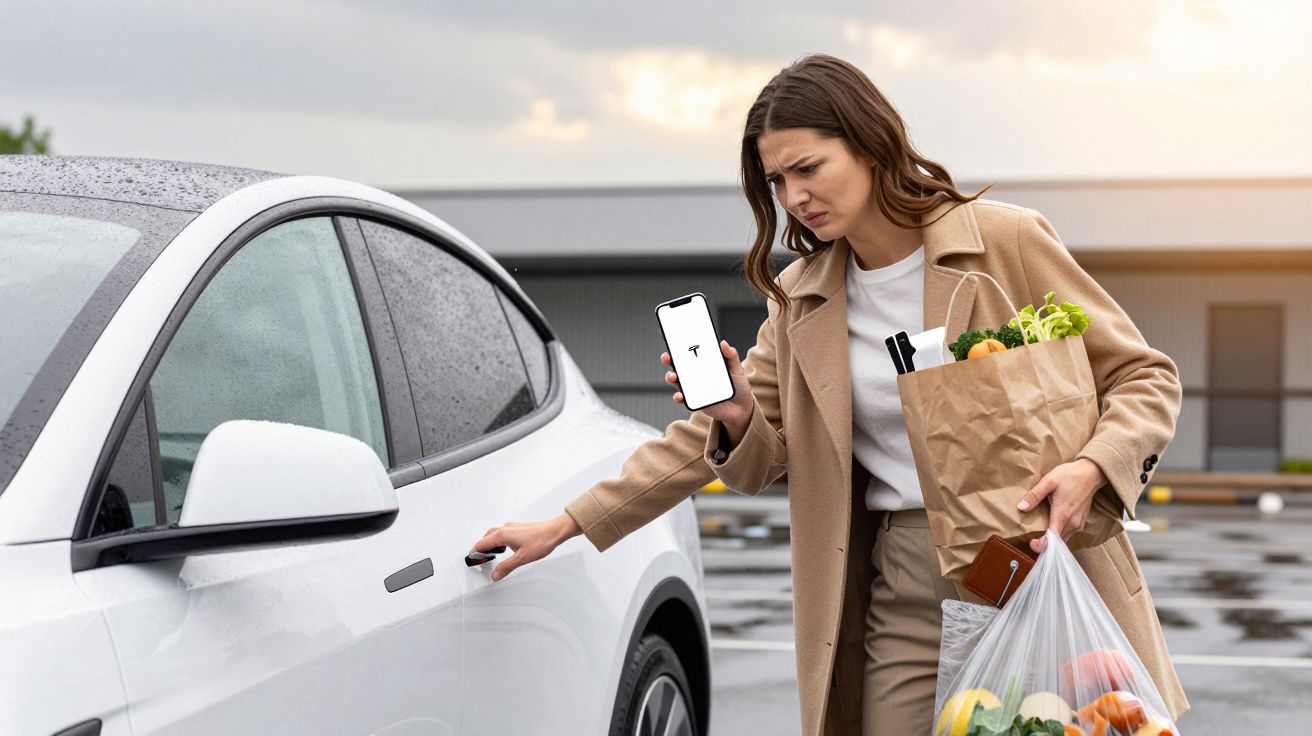
The first time you notice it, it’s usually in a car park: someone standing beside a Tesla, thumb hovering, waiting for a door handle to present itself. A friend jokes, “of course! please provide the text you would like me to translate.” and you laugh, because it’s exactly that feeling-your body expects one thing, the car offers another. You don’t buy the car for the handle, or the app, or the little animations. But those small details quietly decide whether the next five years feel effortless or slightly irritating.
And the strange part is this: the detail that matters most isn’t the one people argue about online. It’s the one you live with every day.
The tiny “friction” you only feel after month three
In the first few weeks, you’re on the honeymoon setting. You forgive oddities because everything is new: the silence at low speeds, the instant torque, the screen doing what screens do. Then routine arrives. School runs, supermarket loops, late trains, rain on a Tuesday, hands full of bags. That’s when the smallest repeated action becomes the loudest.
For many Tesla owners, that action is unlocking, starting, and leaving the car-what engineers would call “entry/exit workflows” and what normal people call “why is my car doing this again?” Phone-as-key, auto-unlock, walk-away lock, driver profile loading, mirrors moving, seat shifting, boot opening: none of it is dramatic once. Over years, it’s either smooth as a well-worn door latch, or it’s a daily micro-argument with your own vehicle.
A neighbour in Leeds put it bluntly after six months with a Model 3: he didn’t care that the 0–60 was fast. He cared that the car usually unlocked before his knuckles reached the handle-except on wet mornings, when the phone stayed stubborn in his pocket and the car stayed stubbornly asleep.
A mini-story you’ll recognise: the “two-second tax”
Picture it: you’re leaving a supermarket. It’s drizzling, the trolley wants to veer, and your hands are full. You walk up to the car like you always do. Nothing happens. You hover, you shift the bags, you wake your phone, you try again. Two seconds. Sometimes five. Once in a while, you do the awkward thing-open the Tesla app, wait for the spinning wheel, tap “Unlock”.
None of this is catastrophic. That’s the point. It’s a “two-second tax” that arrives in tiny instalments, and over time it shapes your sense of the car’s intelligence. If the workflow works 99% of the time, you call it magic. If it works 90% of the time, you start approaching the car with a slight brace in your shoulders.
Data obsessives will try to convert this into numbers, and you can, if you want: two seconds, twice a day, five days a week, 48 working weeks. That’s 16 minutes a year. But the real cost isn’t time. It’s the little leak of trust.
Why this detail matters more than people think
Tesla’s design philosophy is heavy on software and light on traditional physical cues. That’s brilliant when it’s brilliant: the car improves, features evolve, bugs get squashed, and you wake up one morning with a slightly smarter machine. But it also means your daily experience depends on a chain of invisible links-Bluetooth behaviour, phone power-saving settings, app permissions, background refresh, and the car’s own sleep/wake logic.
This is why two Tesla owners can talk about the “same” car and sound like they live on different planets. One has a phone model that behaves nicely with the app, keeps Bluetooth stable, and doesn’t kill background processes. The other has a phone that is aggressively economical with battery, or a workplace car park with poor signal, or a habit of force-closing apps. The car hasn’t changed, but the system around it has-and that’s what you actually live with.
It’s also why the smallest physical fallback becomes huge. A card key that lives in your wallet. A pin-to-drive you don’t forget. A manual door release you remember in a panic. Small, boring redundancies are what make futuristic systems feel safe.
What you can do today: make your “entry/exit” routine boring (in a good way)
Start by treating phone-as-key like you’d treat contactless payments: convenient, but not something you gamble your day on without a backup. Check that the Tesla app has the right permissions (Bluetooth, location where needed), and that your phone isn’t routinely putting it to sleep. Keep background activity on, and avoid force-closing the app unless you’re troubleshooting.
Then do one practical thing that feels almost too simple: establish a consistent pocket habit. Same pocket, same orientation, fewer weird surprises. Bluetooth is fussy; your body is a signal blocker; a bag can be a Faraday cage in disguise. If you want the “walk up and it works” magic, reduce the variables.
A quick, unglamorous checklist helps:
- Keep a key card in your wallet or bag you actually carry.
- Enable walk-away lock, then test it for a week in your normal locations.
- If you share the car, confirm driver profiles load reliably before you set off (seat/mirror surprises are not a character-building exercise).
- Learn the manual door release once, calmly, before you ever need it.
The common mistakes (and why they’re understandable)
People often blame the car for behaviour that’s really phone settings. It’s not because they’re careless; it’s because modern phones actively hide the levers. Battery optimisation menus are buried, permissions change after updates, and “helpful” power-saving modes decide your car app is non-essential.
Another easy misstep is relying on a single method of access. When everything is perfect, phone-as-key feels like the future. When you’re at 2% battery at the end of a long day, it feels like a lesson you didn’t ask for. The fix isn’t paranoia; it’s a gentle redundancy: card key accessible, a rough idea of where your charging cable is, and the ability to unlock via the app when it behaves.
Let’s be honest: nobody does this perfectly every day. You just want to get in the car and go. That’s why it’s worth making the routine idiot-proof, including for the version of you who’s cold, rushed, and carrying a toddler.
“The best car tech is the kind you stop noticing,” says a vehicle UX researcher who consults across EV brands. “If you’re thinking about the unlock process, the design has already failed-because it’s taking attention that should belong to the road, or your life.”
- Aim for boring: the fewer steps you consciously perform, the better the system is working.
- Keep a fallback: key card + app access beats “phone-only confidence”.
- Notice patterns: if it fails in one location (underground car park, driveway edge), it’s often signal/sleep behaviour, not a mysterious curse.
The long-view: small details become the story you tell about the car
After a few years, owners rarely describe their Tesla in spec-sheet terms. They talk about how it fit into their days. Whether it was easy to live with. Whether it made them feel a little calmer, or slightly managed. The battery range matters, yes-but so does the repeated feeling of being welcomed into the car without fuss.
That’s why this small detail makes a big difference over time: it’s not a feature, it’s a relationship loop. Each smooth unlock is a tiny vote of confidence. Each hiccup is a tiny withdrawal. Eventually you don’t remember the individual moments-you just carry a general sense that the car either has your back, or occasionally leaves you standing in the rain.
If you’re considering a Tesla, or you already own one, pay attention to the boring parts. The first drive impresses you once. The daily workflow impresses you thousands of times.





Comments (0)
No comments yet. Be the first to comment!
Leave a Comment