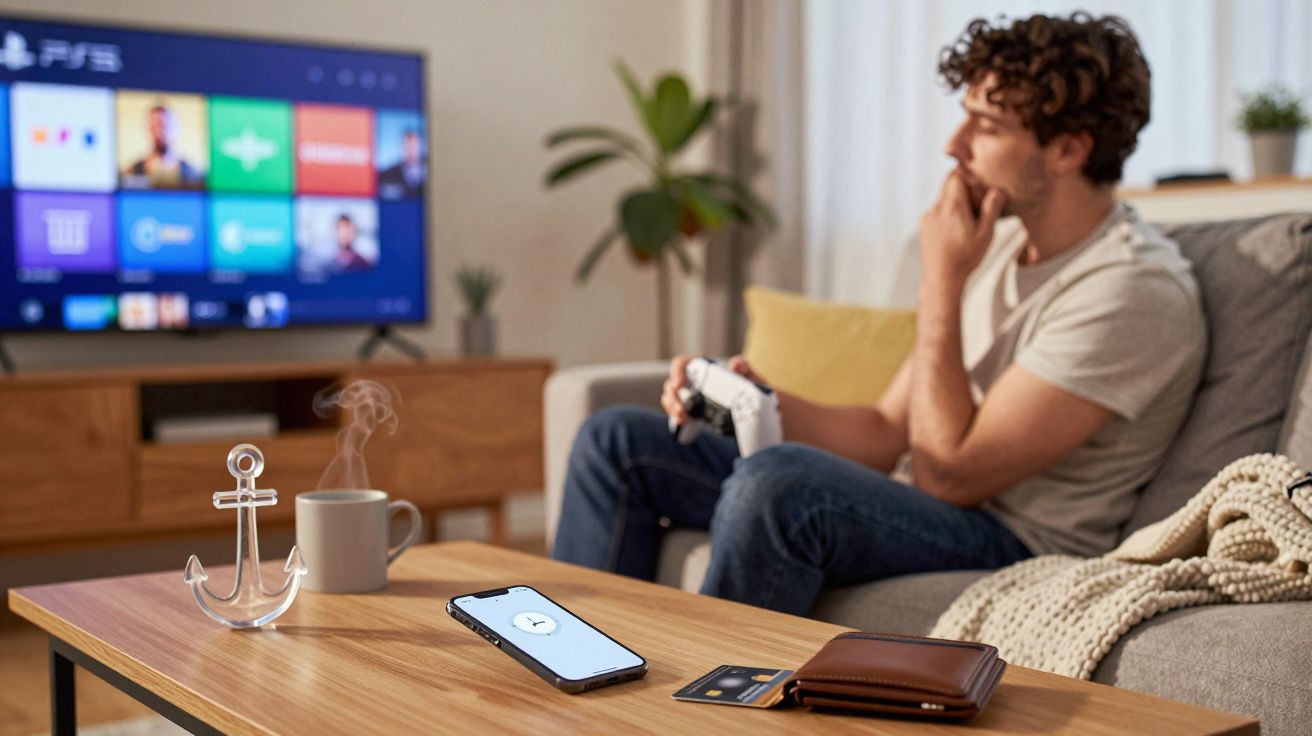
I’m on a sofa that’s seen too many late nights, controller warm in my hands, the PS5 humming under the telly like a quiet appliance. On my phone, a chat thread is stuck in that familiar loop - “of course! please provide the text you would like me to translate.” - and it’s made me notice something odd: we talk about games endlessly, but we rarely talk about what the console is doing to us while we play. That’s why researchers are asking new questions about PS5 now, and why it matters if you care about sleep, spending, stress, or simply getting the most out of your time.
There’s a shift happening from “is it powerful?” to “is it shaping behaviour?”. Not in a conspiratorial way. In the everyday way that a living-room device becomes a routine, then a habit, then a small part of identity.
No one saw that coming when it was sold as a box for better graphics.
The new research angle: the PS5 as a living-room environment
For years, consoles were treated like endpoints: you bought one, played a game, switched it off. But the PS5 era is closer to an ecosystem, where the machine is a storefront, a social hub, a media player, and a notification engine that follows you into the PlayStation app. Researchers who study media effects, human–computer interaction, and digital wellbeing are starting to frame the console as an environment, not a tool.
That changes the questions. Not “does gaming cause harm?” - too blunt, too tired - but “which design choices nudge people into longer sessions?”, “how do social features change what ‘relaxing’ looks like?”, and “what do algorithmic recommendations do when your living room becomes a feed?”
The PS5 is a useful case study because it sits in a shared space. Bedrooms have phones. Desks have laptops. The console is often in the room where families negotiate time, volume, and attention out loud. That makes it unusually visible - and unusually measurable.
What researchers are actually measuring (and why you’ll feel it)
A lot of the new work is less about the content of games and more about the shape of play. Small frictions and small conveniences add up, and PS5 is full of them: Activity Cards that promise a “next step”, fast resume-like loading that removes natural stopping points, and always-available party chat that turns a solo session into a social commitment.
In practice, studies and lab-style experiments tend to orbit a few repeatable signals:
- Session length and stopping behaviour: what makes someone say “one more” and what helps them stop.
- Spending decisions: how store layout, timed discounts, and in-game currencies interact with impulse control.
- Sleep timing: late-night play, blue light exposure, and the cognitive “spin” of competitive matches before bed.
- Stress and recovery: whether play reduces stress or keeps the body keyed up, depending on genre and social context.
- Household negotiation: how shared screens affect family rules compared with personal devices.
None of this requires a villain. It’s closer to studying supermarkets: aisle layout changes what people buy, even if everyone thinks they’re choosing freely.
A quick self-check you can do this week
You don’t need a lab to learn something useful about your own PS5 habits. Try a simple, slightly boring experiment: make one change, then watch what happens for seven days.
Pick one:
- Turn on play-time notifications (or set a phone alarm) and write down whether you stop within 10 minutes of it.
- Remove one “friction reducer”: disable autoplay on media apps, or hide the Store tile, or log out of saved payment for a week.
- Move social play earlier: agree a hard stop with friends before you start, not mid-session.
- Change the last hour: swap competitive multiplayer for something low-stakes and note sleep quality.
If you’re thinking, let’s be honest: nobody does that every day, you’re right. That’s the point. Research often begins by making the invisible visible, even briefly.
The questions nobody used to ask - and now they do
A decade ago, the headline debates were about violence, addiction, and “screen time” as a single number. Those questions still exist, but they’re being replaced by more precise ones that fit how PS5 is actually used.
Is the console’s design creating fewer natural “off ramps”?
When loading screens shrink, pauses disappear. When you can jump straight into an objective via an Activity Card, you skip the moment where you might have put the pad down. Researchers call these moments “breakpoints”. They’re small, but they’re where self-control lives.
What does “social” mean when it’s always on?
Party chat and Discord-style voice culture turn play into hanging out. That can be good - loneliness is real - but it also makes leaving feel like leaving people, not a game. The new questions aren’t moral ones; they’re practical ones: how does social obligation change session length, spending, or the ability to take a break?
How does the Store behave when it’s two clicks away?
Consoles used to be separated from shopping. Now the store is part of the same interface as your library and your friends. Researchers are paying attention to choice architecture: default settings, saved cards, countdown deals, and the way microtransactions are framed inside games.
If you’ve ever bought something because it felt temporary - “ends in 2 hours” - you already understand why this has become a research focus.
What you can do without making gaming a chore
The goal isn’t to purge fun. It’s to keep the console in its place: a leisure device, not a silent manager of your evenings.
A few low-effort habits help more than people expect:
- Use Rest Mode intentionally: decide whether it’s for updates only, not a constant “always ready” invitation.
- Create a stopping ritual: finish a mission, save, exit to Home, then power down - the same sequence every time.
- Separate play and shopping: if you browse the Store, do it at a different time than you play with friends.
- Make co-op agreements explicit: “one hour” works better than “a couple of games”, because “a couple” stretches.
Small rules beat big promises. You don’t need willpower every night if the routine does some of the work for you.
Why this matters more than it sounds
A PS5 is entertainment, yes. But it’s also one of the few technologies that sits centre-stage in the home, blending relaxation, competition, social life, and spending into a single interface. That’s why researchers are asking new questions: because the effects aren’t only in the games - they’re in the defaults, the prompts, the friction you don’t notice, and the habits you repeat.
You don’t have to be worried to be curious. The best outcome isn’t quitting. It’s understanding what’s shaping your time, so you can keep the good bits and trim the rest.
| Key point | What to notice | Why it helps |
|---|---|---|
| Breakpoints are disappearing | Faster loading, Activity Cards, instant re-queues | Makes stopping feel less “natural” |
| Social play changes the stakes | Parties, voice chat, group expectations | Leaving can feel like letting people down |
| Shopping is embedded | Store proximity, saved payment, limited-time offers | Increases impulse buys without you noticing |
FAQ:
- Is the PS5 “addictive” by design? It’s more accurate to say it can be highly engaging, and some interface choices reduce natural stopping points. People differ widely; patterns matter more than labels.
- What’s one setting that makes a real difference? Time reminders (or any external alarm) can create a breakpoint that the interface doesn’t always provide.
- Are single-player games better for wellbeing than multiplayer? Not automatically. Many people find single-player calming, but any game can become draining if it disrupts sleep or turns into an obligation.
- Should parents treat PS5 differently from phones? Often, yes. A shared-screen console is easier to supervise and negotiate around, but social features and in-game spending still need clear rules.
- How can I stop impulse spending without banning it completely? Remove saved payment for a week and force a “pause step” before purchases. A bit of friction is surprisingly protective.





Comments (0)
No comments yet. Be the first to comment!
Leave a Comment