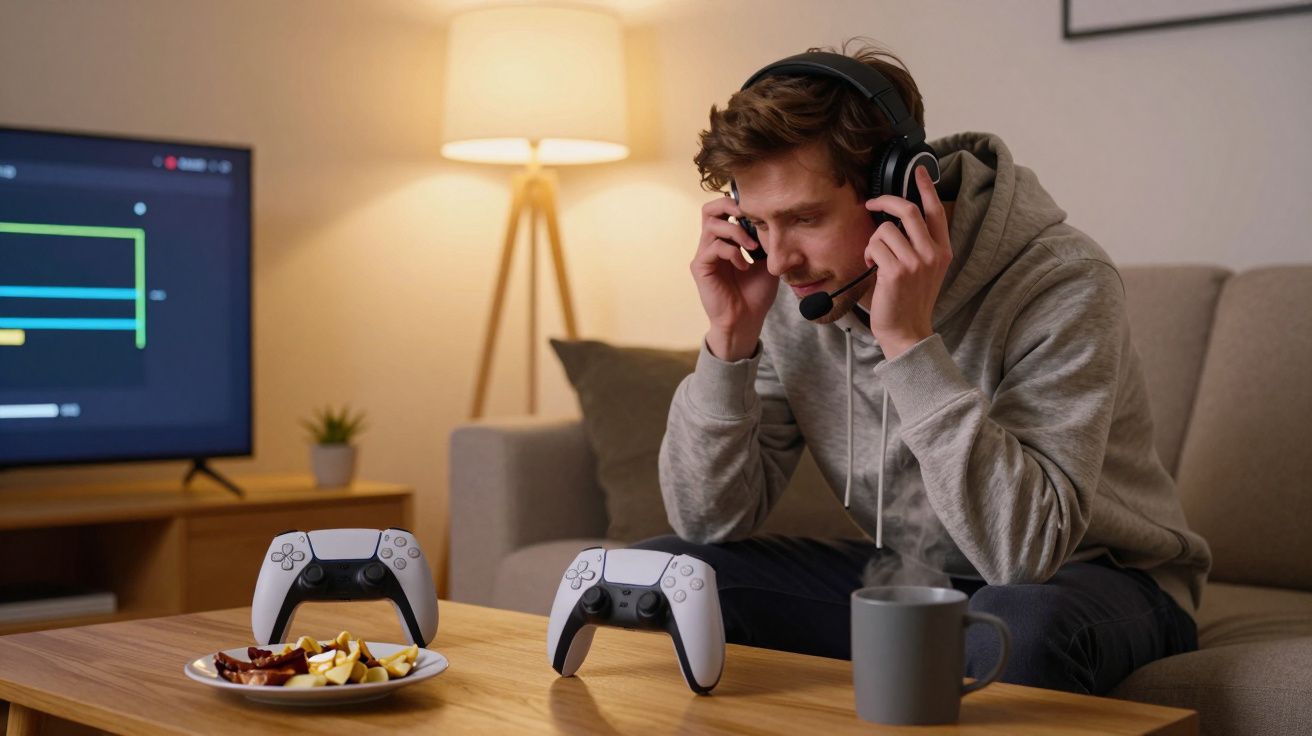
It happened in that dead hour between “one more match” and sleep, when the lounge is lit mostly by the TV and the low pulse of the PS5. Then, on a completely unrelated screen, I saw the phrase “of course! please provide the text you would like translated.” pop up - and suddenly the PlayStation 5 wasn’t the main event at all. It’s back in focus because people are using it as a test bed for a bigger shift: how we talk to machines, and what we expect them to understand.
This isn’t about a surprise hardware revision, or a secret pro model hiding in the shadows. It’s about the PS5 sitting in the middle of modern living rooms, quietly becoming the device that exposes what’s changing fastest: voice, chat, captions, sharing, moderation, and the creeping feeling that your console is now part entertainment hub, part communications terminal.
The PS5’s “new story” isn’t a new console - it’s new behaviour
Consoles used to be simple: put a disc in, play a game, maybe send a message. The PS5 still does all that brilliantly, but the way people use it has shifted. It’s a party chat machine, a Twitch-and-YouTube box, a clip factory, and a social space where strangers can be one button-press away.
That’s why it’s back in focus. Not because the box changed, but because the room around the box did - and the expectations did too. We now assume:
- speech can become text instantly (and accurately)
- text can become speech without sounding robotic
- captions should be there when we need them
- communication tools should be safe by default, not after a problem
When those assumptions collide with real life - accents, background noise, fast slang, kids on headsets - the cracks show quickly.
Where the friction actually happens: chat, captions, clips
The PS5 is most “in the spotlight” when it’s not rendering a boss fight, but mediating people. You feel it in the moments that are meant to be effortless: joining a party, understanding a callout, sharing a clip with a caption that makes sense, reporting something that crossed the line.
Even small failures get amplified. A mistranscribed instruction in a raid becomes a wipe. A caption that lags turns dialogue into mush. A message taken the wrong way becomes a report, a block, a sour night. The console ends up wearing the blame for problems that are really about language and context.
A useful way to frame it is this: graphics sell the PS5, but communication keeps it in your life three years later.
How to “read” what’s going on - like a practical person, not a tech pundit
You don’t need to follow every rumour cycle to see the trend. Watch how the PS5 is used when people aren’t thinking about it.
Start with the audio chain. A lot of “AI features” live or die based on the cheap bit: the mic. A £15 headset in a loud room will make any speech-to-text system look foolish. Then there’s the human layer: people speak differently when they’re excited, tired, joking, or trying not to wake the house.
If you want a quick reality check, look for these signals in your own sessions:
- Speed matters more than perfection. A slightly-wrong caption that arrives fast beats a perfect one that arrives late.
- Context beats dictionary accuracy. Games have names, roles, slang, and callouts that normal language tools don’t automatically understand.
- Safety features have to be usable. If reporting, muting, or blocking feels like a chore, people simply won’t do it until things get ugly.
The PS5 is where all of that becomes visible, because it’s where people are most live.
A small checklist: making your PS5 setup work with the way gaming works now
This is the unglamorous part, but it’s where most “why is this so bad?” moments come from. If your PS5 experience feels messier than it should, try the boring fixes before blaming the system.
- Place the mic a little off to the side, not directly in front of your mouth (it reduces plosives and breathing noise).
- Turn down controller speaker volume if it’s feeding back into your headset mic.
- Use the PS5’s mic level check and adjust it so normal speech peaks comfortably without clipping.
- If you rely on captions, sit close enough that you’re not reading tiny text from across the room - it sounds obvious, but it’s the difference between “helpful” and “I’m missing everything”.
- For party chat, agree on one rule: push-to-mute when someone’s eating, streaming, or has background TV noise.
None of this is exciting. All of it makes the “future features” feel like they actually work.
What to expect next: fewer gimmicks, more invisible upgrades
The most meaningful changes to the PS5 era won’t look like fireworks. They’ll be the things you notice only when they’re missing: clearer voice isolation, better real-time transcription, cleaner sharing tools, smarter moderation that doesn’t punish normal banter, and accessibility options that don’t require a settings safari.
It’s also why the PS5 keeps appearing in conversations that aren’t really about consoles. When language tools improve - translation, transcription, summarising - your living room box becomes a front-row seat. And when they fail, it’s equally obvious, because you’re not reading a demo; you’re trying to coordinate with friends in real time.
The funny part is that the PS5’s power was never the question. The question now is whether the social layer can keep up with how people actually play.
| What’s back in focus | What it affects | Why you’ll care |
|---|---|---|
| Voice, text, captions | Parties, co-op, accessibility | Less friction, fewer misunderstandings |
| Sharing tools | Clips, uploads, messages | Faster posting, fewer “what did I just send?” moments |
| Safety and moderation | Public lobbies, kids’ accounts | A calmer experience without killing the vibe |
FAQ:
- Is the PS5 “back” because of a new model? Not really. It’s back in focus because communication and accessibility features are becoming as important as performance, and the PS5 sits at the centre of that shift.
- Why do chat and captions feel inconsistent? Microphone quality, room noise, accents, and fast in-game slang can trip up transcription and voice processing. Speed and context matter as much as accuracy.
- Do I need new hardware to benefit from improvements? Often no. Many gains come from software updates and better settings, though a decent headset mic can make a big difference.
- What’s one quick fix that helps most people? Calibrating mic input level and reducing background audio bleed (TV, controller speaker, open-back headsets) tends to improve everything immediately.

Comments (0)
No comments yet. Be the first to comment!
Leave a Comment