The lawn is often treated like a simple green carpet: mow it, edge it, done. But in professional gardening, the best work starts a few minutes before the mower ever fires up, because one quiet issue can turn a tidy cut into a ragged mess.
You can usually spot it from the gate. The colour looks a touch dull, the blades sit oddly, and the surface has that “spongy-but-brittle” feel underfoot. That’s the moment a pro slows down and goes looking for what’s really going on.
The lawn problem professionals clock first: hidden thatch (and what it does to a cut)
Thatch is the layer of dead grass stems, old leaf material and roots that sits between the green blades and the soil. A thin layer is normal. The trouble starts when it builds up and behaves like a dry felt.
When that happens, mowing stops being a clean slice and becomes a tug-of-war. The mower blade grabs, tears and bruises tips, and you’re left with a greyish, frayed look a day later even if you “cut it right”.
A lawn with excess thatch often:
- Feels springy, like walking on a doormat.
- Looks uneven even when it’s been mown regularly.
- Dries out quickly in warm spells, then sulks despite watering.
- Turns into a slip hazard when damp, because the surface layer skids over hard soil.
It’s not a moral failing. It’s just biology plus habit: frequent light cuts, heavy feeding, compacted soil, and not enough removal of old material.
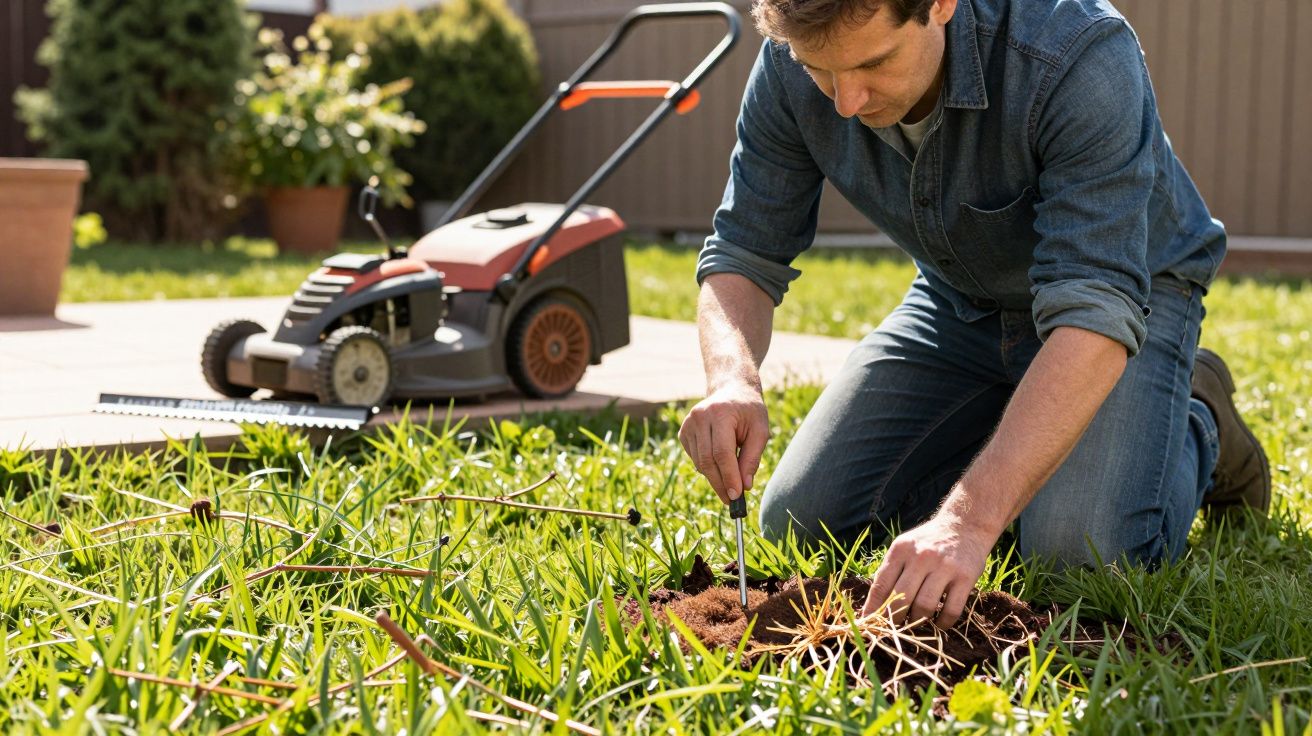
The quick pre-mow check: a two-minute test you can do with a key (or a screwdriver)
Professionals don’t guess. They poke.
Pick a few spots-near paths, under swings, by the patio where people walk-and push a key or screwdriver into the lawn. You’re not trying to dig a hole. You’re feeling for layers.
- If you hit springy resistance before you reach soil, that’s surface thatch.
- If the tool goes in, but feels “tight” and hard to push, that’s compaction underneath (often paired with thatch).
- If you pull up a little tuft and see a brown felt layer above soil, you’ve found the culprit.
A rough rule of thumb: if the thatch layer is around 1 cm or more, mowing alone won’t improve the look. It will often make it look worse.
Why this shows up before mowing, not after
Once you’ve mown, everything is shorter and the evidence gets hidden. Before mowing, the lawn tells on itself: the blades stand differently, the surface looks puffy, and colour can look slightly “dusty” rather than fresh.
There’s also a practical reason pros check first: mowing a thatchy lawn too low can scalp it. The mower sinks into the soft layer, drops the cut height unpredictably, and suddenly you’re staring at pale patches and exposed crowns.
That’s why you’ll sometimes see a gardener take a slow lap, boot-toeing the surface as if they’ve dropped something. They’re reading the lawn like a map.
The fix that works fastest: adjust the mow, then remove the felt (in the right order)
If you suspect thatch, don’t immediately go brutal with the lowest setting. Think “stabilise, then improve”.
1) Change today’s mow so you don’t shred it
- Raise the cutting height slightly for this cut.
- Make sure the blade is sharp (dull blades tear, especially through thatch).
- If it’s long, take it down in two passes a few days apart rather than one heavy chop.
2) Plan a simple thatch-removal step
Pick one option depending on how bad it is:
- Light build-up: a spring-tine rake (by hand) or a light pass with a scarifier on a gentle setting.
- Moderate build-up: a powered scarifier with a collection bag, then a tidy-up rake.
- Severe build-up: scarify in two directions in season (see below), then top-dress and overseed.
You’ll pull up an alarming amount. That’s normal. The lawn looks worse for a week or two, then it starts to breathe.
3) Do it at the right time, not just when you’re annoyed
In the UK, the safest windows are usually: - Spring: when the lawn is actively growing (often April–May). - Early autumn: when nights cool but soil is still warm (often September).
Doing it in a heatwave or during cold, wet stagnation is how people end up convinced “scarifying ruined my lawn”. It didn’t. Timing did.
The quiet duo behind most thatch problems: overfeeding and compacted soil
Thatch loves two conditions: lots of growth on top, and poor breakdown underneath.
If you’ve been feeding heavily (especially high nitrogen), the lawn produces more stems and material than soil life can recycle. If the soil is compacted, air and moisture don’t move well, and the organisms that should break things down slow to a crawl.
A simple way to balance it out over time:
- Feed less often, and avoid pushing lush growth in late summer.
- Aerate (a garden fork works; hollow-tine is better for heavy clay).
- Top-dress with a thin layer of sandy loam after aeration to improve structure.
Think of it like windows fogging up: wiping the surface (mowing) helps briefly, but the real fix is changing the conditions that keep creating the problem.
A “before you mow” checklist professionals tend to follow
- Walk the lawn and look for puffiness, dullness, uneven stand of blades.
- Do the key/screwdriver poke test in 3–5 spots.
- Check the mower blade (sharp, not nicked).
- Set the cutting height for a safe first pass.
- Only then mow-because the cut should be the finish, not the diagnosis.
“It’s not about cutting more. It’s about cutting cleaner - and that starts with what’s under the grass.”
FAQ:
- Is thatch the same as moss? No. Moss sits on the surface in damp, compacted conditions; thatch is dead grass material building up between blades and soil. You can have both, and they often feed into each other.
- Should I scarify every year? Light scarifying or raking can be annual if your lawn builds thatch quickly, but heavy scarifying is better done only when needed and in active growth periods.
- Will watering fix a thatchy lawn that goes brown fast? Usually not. Thatch can repel water at the surface and stop it reaching roots efficiently, so you end up watering more for less benefit.
- What cut height helps while I’m dealing with thatch? Slightly higher than your “perfect” summer height. It reduces scalping risk while you improve the surface and soil underneath.




Comments (0)
No comments yet. Be the first to comment!
Leave a Comment