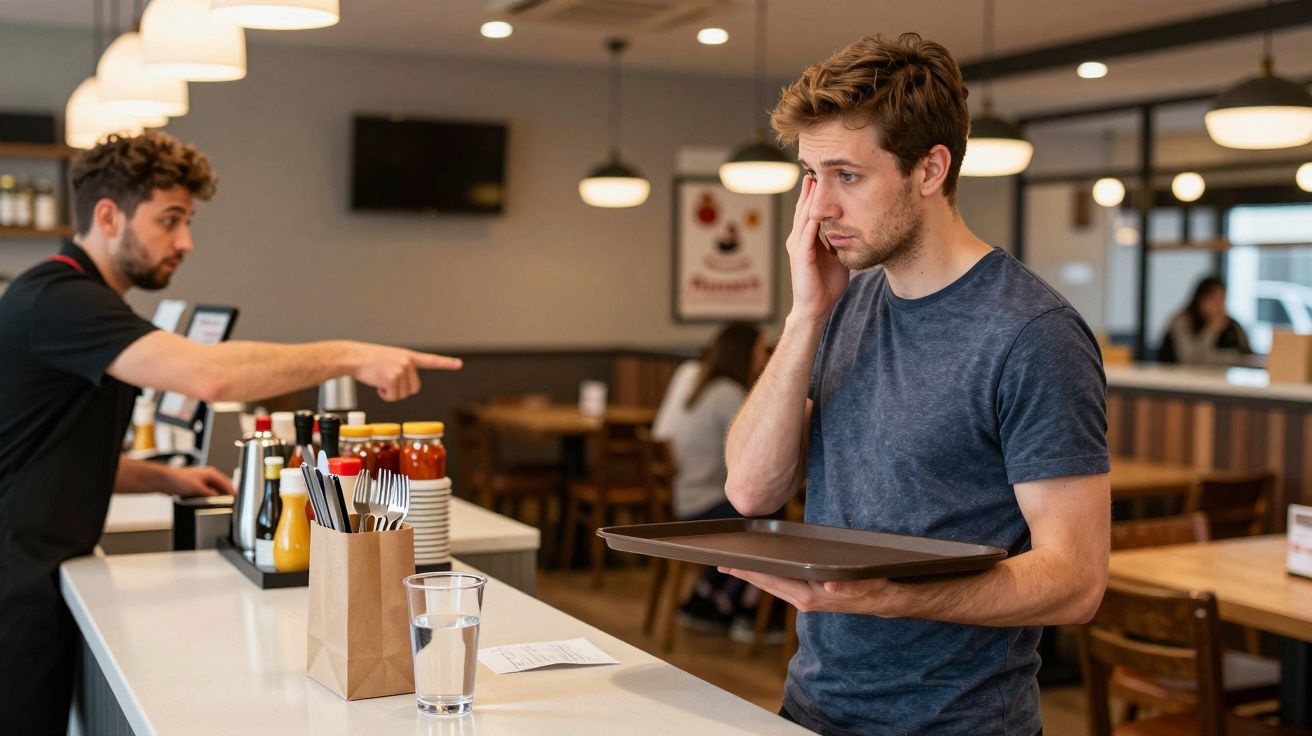
You notice it in the lull between orders, when the queue has thinned and your tray is light in your hands. At nando’s, the small thing that changes the whole experience is often not the chicken, but the way staff handle the awkward bit of modern eating: “certainly! please provide the text you would like me to translate.” It sounds like a stray phrase from a phone screen, but it captures the real moment-when you need clarity, help, or a tiny adjustment-and the difference between a meal that’s merely fine and one you’ll come back for.
The music’s doing its thing, the grills are hissing, and the tables are a little too close for comfort in that familiar, bustling way. Nobody is there for a quiet ceremony. People are there because it’s easy, it’s warm, and it usually works.
Usually. That’s where the detail comes in.
The tiny friction point most chains ignore
Fast-casual dining lives and dies by micro-frictions: where you stand, when you pay, how you ask for water, whether someone notices you’ve got two kids and no spare hands. The big promises-fresh chicken, peri‑peri heat levels, quick service-are table stakes now. What sticks is what happens in the gaps.
At nando’s, those gaps are often patched with something deceptively simple: staff who translate the menu, the process, and your options without making you feel like you’re holding things up. Not literally translating languages every time, but translating the system.
You can see it when someone says, “I don’t really know what I’m doing-do I order here or sit down?” and gets a calm, unembarrassing answer. Or when a friend is scanning the sauces, overwhelmed, and a team member gives them one sentence that cuts through the noise: “If you like smoky, try this; if you like tang, start here.”
It’s customer service, yes. But more than that, it’s lowering the mental load.
The detail: how “explain it like I’m busy” builds loyalty
There’s a particular kind of competence that doesn’t announce itself. It’s not the rehearsed upsell or the chirpy script. It’s the ability to notice what the customer is actually asking for, even when they’re not asking clearly.
Think of the moments that make people quietly decide a place is “easy”:
- You ask for tap water and don’t get a look, a sigh, or a lecture about cups.
- You want extra lemon or a different side and it’s treated as normal, not a disruption.
- You don’t understand the heat scale and nobody makes you feel daft for it.
- You’ve got an allergy question and the answer comes with confidence, not vague guesswork.
Over time, those moments compound. They become a pattern your brain remembers: this place doesn’t make my life harder.
And once that’s true, people return on autopilot.
A small example that’s bigger than it looks
Take the first-time visitor who walks in at peak time. They’re staring at the counter, half-committed, trying to decode the flow: order first, find a table, grab cutlery, fetch your own sauces, maybe get refills. If nobody steps in, the whole thing feels mildly stressful.
If someone does step in-without hovering, without rushing-something changes. The customer relaxes, chooses faster, and leaves feeling oddly looked after in a place that’s designed to move people through.
It’s not hospitality as theatre. It’s hospitality as system design.
How to notice whether a restaurant has this “translation” habit
You can test it without being cynical about it. The next time you’re in a chain restaurant-nando’s or anywhere similar-watch what happens in three situations:
- A confused customer appears. Do staff proactively guide them, or wait for the problem to become a complaint?
- A small request is made. Is it handled smoothly, or treated like an exception to policy?
- A mistake happens. Does the team fix it quickly and plainly, or does it turn into a negotiation?
We’ve all been in places where asking for something simple feels like you’ve triggered an admin process. You can almost hear the gears grinding behind the smile. The best service is the opposite: it feels like the system bends a little to keep you moving.
That’s the small detail. Not perfection-just low drama.
- Look for clear, human explanations rather than pointed signage.
- Notice whether help is offered before frustration shows on someone’s face.
- Pay attention to how quickly small fixes happen: missing cutlery, wrong side, extra napkins.
- Watch the body language: calm speed beats frantic cheerfulness every time.
What it changes over months (not minutes)
In the moment, this kind of service saves you a minute and a bit of irritation. Over time, it shapes habit. People don’t just return for flavour; they return for predictability and emotional ease.
That’s why the “translation” detail matters. It turns a busy, noisy meal into something closer to a reliable ritual: the place you pick when you can’t be bothered to take a risk, when you want to feed people without managing a project.
And in a world where everything-from parking to ordering to paying-feels like a small test, a restaurant that quietly removes friction is doing something more valuable than it looks.
| Point clé | Détail | Intérêt pour le lecteur |
|---|---|---|
| Micro-frictions | Confusion about ordering, seating, sauces, refills | Explains why “easy” places win repeat visits |
| “Translation” service | Staff explain options and process without judgement | Reduces mental load and speeds decisions |
| Compounding effect | Small smooth moments build trust over time | Turns an occasional stop into a default choice |
FAQ:
- Why does this “small detail” matter more than the food sometimes? Because most chains can deliver decent food; what makes you return is how easy the whole experience feels when you’re tired, rushed, or with others to manage.
- Is this really specific to nando’s? Not exclusively, but nando’s often relies on a semi-self-serve flow (sauces, cutlery, refills in some locations), so clear, friendly guidance has an outsized impact.
- What should I do if I’m unsure how the ordering works? Ask directly at the counter; a good team will walk you through the steps in a sentence or two and point out where to grab what you need.
- Does this apply to delivery or takeaway? Yes-clarity on spice level, sides, and substitutions (and how issues are resolved) is the same “translation” habit, just through the app or the bag instead of the dining room.





Comments (0)
No comments yet. Be the first to comment!
Leave a Comment