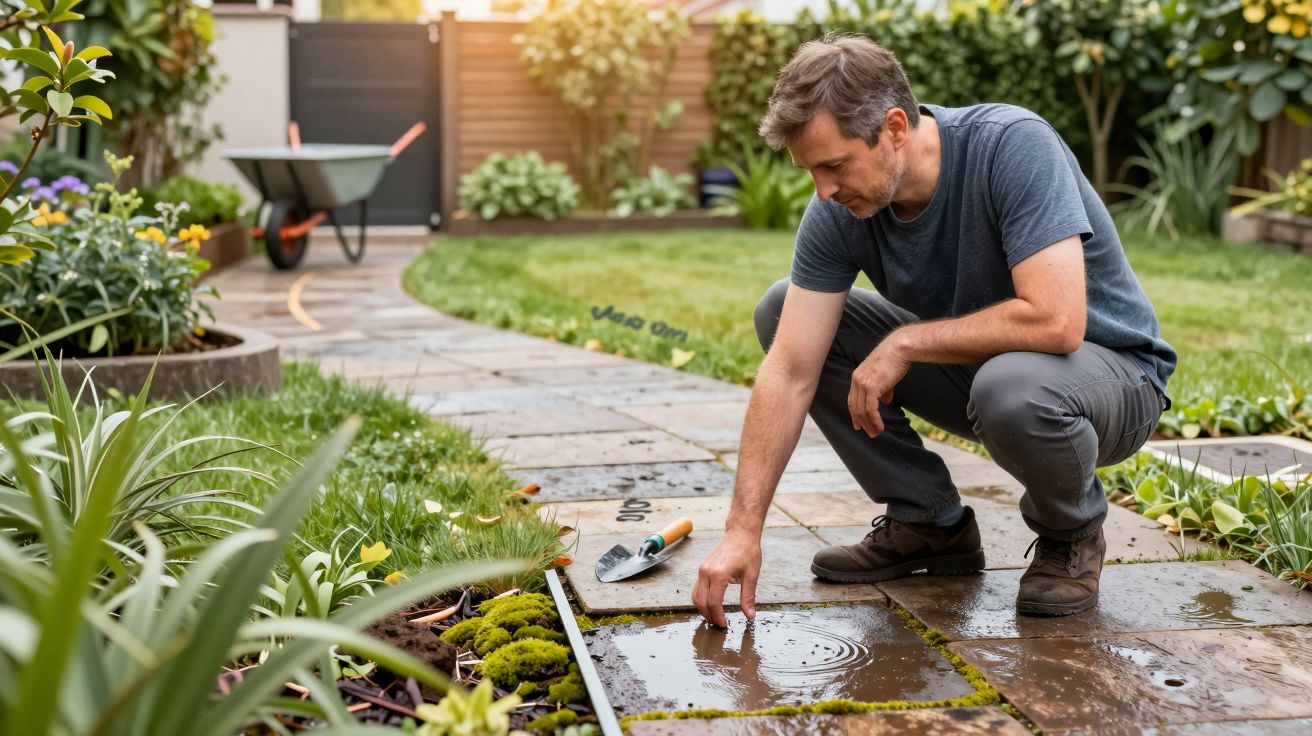
A garden path looks like a simple strip you walk on, but in professional gardening it’s treated more like a living interface between people, plants, water and maintenance. Garden paths set the tone of a space, control wear on lawns and borders, and quietly dictate how a garden is used day to day. That’s why gardeners often “read” them in a way homeowners don’t: they’re scanning for behaviour, drainage, soil compaction and future work, not just appearance.
Homeowners tend to ask, “Does it look neat and match the house?” Gardeners ask, “Where will feet actually go, and what will that do to everything around it?”
What a gardener sees first: traffic, not tiles
A path is a map of intention. If it runs where people already cut across the lawn, it will work; if it fights the natural route, it becomes a negotiation that the grass usually loses. Gardeners look for the desire line-the real line people take when carrying washing, taking out bins, walking a dog, or stepping outside with a mug of tea.
They also read speed and pause points. A straight, narrow run encourages brisk movement; a gentle curve with a widened section invites stopping, turning, chatting. That matters because stopping creates compaction and splash in the same few spots.
The usual tells of a path that’s “winning”
- A faint shortcut across adjacent turf or mulch (people voting with their feet).
- Wear concentrated at gates, steps, and back doors (the practical nodes).
- Moss or algae in shaded stretches (a slip risk and a drainage clue).
- Grit migrating to beds (edging not containing the surface layer).
- Puddling that repeats in the same shallow dip after rain.
A path that looks perfect in June but turns green and slick by October is telling you it’s shaded, damp, and probably holding water at the surface.
What homeowners often prioritise: finish lines and first impressions
Homeowners are not wrong to care about visual coherence; kerb appeal is real, and a good path can make a small garden feel deliberate rather than accidental. The difference is that appearance is often judged at standing height, in dry weather, at a calm moment.
Gardeners imagine it under pressure. They picture a wheelbarrow after heavy rain, a winter freeze-thaw cycle, a hedge that will thicken, and a border that will spill. They’re less impressed by a crisp joint line if it guarantees weeds, wobble, or constant topping up.
The practical checklist professionals run in their heads
Garden paths are rarely just “laid”; they’re built as a system. Professional gardening experience makes people sensitive to what’s underneath, where water is going, and what maintenance will be forced on you later.
The questions that change the design
- Where does the water go? A path should shed water without dumping it into the base of a fence, garage, or favourite border.
- What’s the sub-base doing? Without proper preparation, even expensive materials shift and rut.
- Who uses it, and how? Kids sprint, older relatives shuffle, gardeners drag hoses and barrows.
- What grows nearby? Roots lift edges; groundcover creeps; leaves stain porous surfaces.
- How will it be cleaned? Pressure washing, sweeping, and weeding each suit different materials.
A homeowner might fall in love with pale gravel because it brightens a shaded corner. A gardener hears, “This will migrate, mark the hallway, and need edging and raking after every downpour.”
Material choice: the surface is only half the story
Professionals tend to be less dogmatic about what’s “best” and more specific about what’s “best here”. The same paving can be brilliant in a sunny courtyard and miserable under dripping trees.
| Material | What gardeners like | What catches homeowners out |
|---|---|---|
| Gravel | Drains well; easy to repair | Spreads; weeds if neglected |
| Paving slabs/stone | Stable route; clean edges | Slippery in shade; joints need upkeep |
| Bark/woodchip | Soft, cheap, quick | Breaks down; needs regular top-ups |
The hidden trade is nearly always time. If a path saves you ten minutes each day (no muddy detours, no trampling borders), it earns its keep even if the material is modest.
Width, edges, and the “wheelbarrow test”
Gardeners think in tools and tasks. Can you pass someone coming the other way without stepping into the border? Can you turn a mower? Can you get a barrow through without clipping plants and scraping knuckles?
A common professional rule-of-thumb is simple: if you’ll garden properly, build for it. Narrow paths look quaint, but they force stepping off into soft ground, which then becomes the muddy alternative route that expands each season.
Small adjustments that change everything
- Widen the pinch points near doors, gates, compost areas.
- Add a firm strip where bins are wheeled (even if the rest is informal).
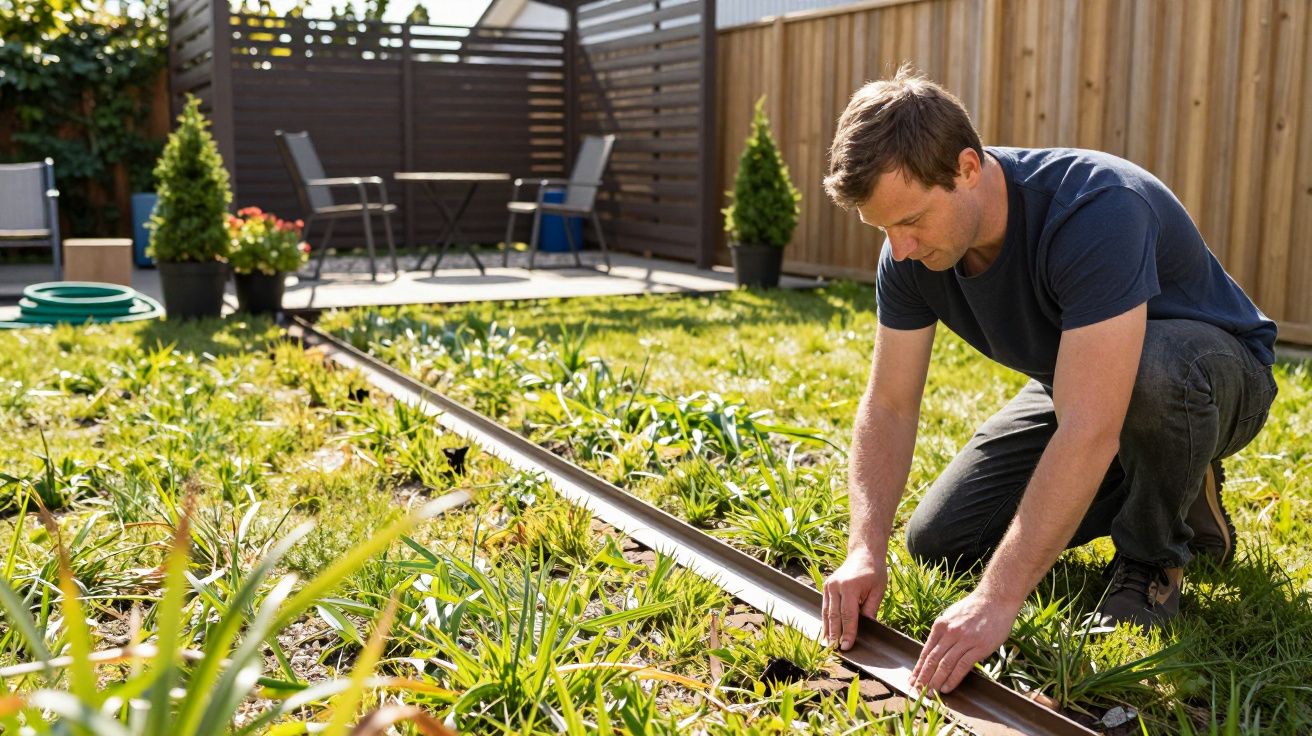
- Use edging that physically holds the surface in place, not just visually frames it.
- Break long runs with a landing or a slight change in direction to slow runoff and feet.
If you can’t walk the route comfortably while carrying something bulky, you’ll start cutting corners. And the garden will show you exactly where.
Garden paths as maintenance behaviour: preventing the “messy ring” effect
There’s a pattern gardeners recognise: a lovely path with a messy halo. Soil splashes from beds, weeds creep in from edges, and plants lean out because the border is happier than the route beside it. None of that is a moral failing; it’s physics and growth.
Professional gardening thinking treats the path as a buffer zone. A small gravel strip between lawn and paving, a mowing edge, or a planted “soft edge” that’s meant to spill can be planned rather than fought.
When to suspect the path is causing problems
- Borders dry out fast beside paving (heat and runoff effects).
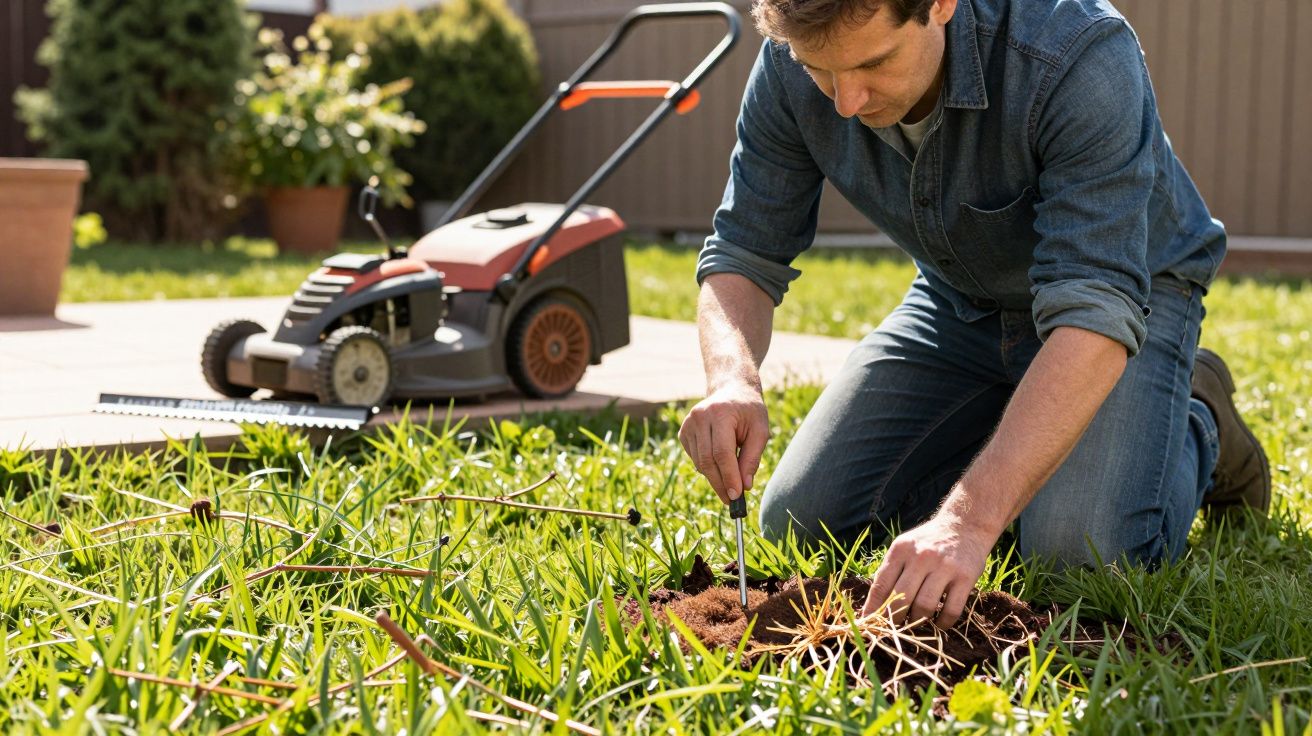
- Lawn edges crumble into the path (no solid mowing edge).
- Regular green slime in the same section (persistent shade and moisture).
- Repeated heave or wobble (sub-base or drainage failure, not “bad luck”).
A quick way to “read” your own path like a gardener
Pick a wet day, not a perfect one. Walk the route slowly and look down, then look where your feet want to go next. Notice what you avoid.
- Where are the puddles and where do they drain?
- Where do you step off to let someone pass?
- Where is it slippery, and why?
- Where do weeds return first?
- Where do you always brush against plants?
Write those locations down. They’re not random flaws; they’re the garden giving you a maintenance forecast.
The takeaway: design for use, then make it beautiful
Homeowners often start with a look and then try to live with it. Gardeners start with use and then shape the look around what will last. When you plan garden paths as working routes-dry, stable, and easy to maintain-you usually end up with something that also looks calmer and more intentional.
Beauty stays longer when it’s built on behaviour, not just a brochure photo.
FAQ:
- Can I fix a path that people keep cutting across the lawn? Yes. Either move the path to match the desire line, or make the “wrong” route inconvenient with planting, a low obstacle, or a change in level-without creating a trip hazard.
- Do I always need a sub-base? For most hard surfaces, yes if you want stability. Gravel and woodchip can be more forgiving, but they still benefit from proper ground preparation and edging.
- What’s the easiest low-maintenance surface? There isn’t one-size-fits-all. In many gardens, well-edged gravel or properly laid paving performs best; the deciding factors are shade, leaf fall, drainage, and how intensively you use the route.




Comments (0)
No comments yet. Be the first to comment!
Leave a Comment