Gardeners rarely talk about a lawn without sliding into landscape design, because a lawn isn’t just “green carpet” - it’s a working surface that affects how you move, how water drains, and how the rest of the garden reads from the house. It sits between borders, paths, trees and patios, quietly deciding whether everything feels stitched together or slightly at odds. If you’ve ever mown around a bed that never quite looks finished, you’ve felt the problem.
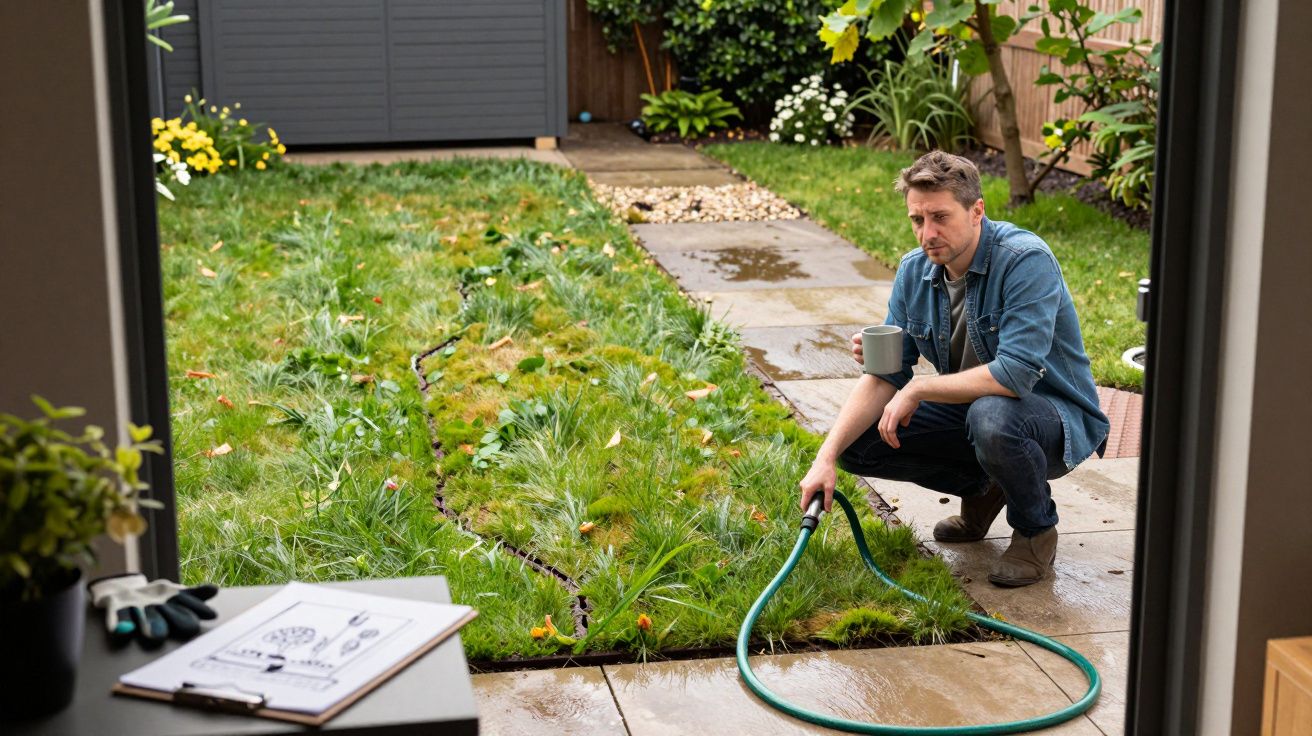
The shift usually happens in a small, ordinary moment: you stand at the back door with a mug, and the grass looks fine, but the garden doesn’t. The edges are fussy, the wet patch keeps returning, the bench feels stranded. The lawn is doing its job - but it’s doing it alone.
Why lawns are rarely “standalone” in real gardens
A lawn always touches something. It meets a path, a border, a fence line, a patio, a pond edge, the drip line of a tree, the shadow of a shed. Those junctions are where gardens either feel calm or feel like a collection of separate decisions.
In practice, the lawn becomes a kind of glue. It gives your eye a resting place, it frames planting, and it sets the mood: crisp and formal, loose and meadowy, playful and family-proof. Even in tiny spaces, the way grass connects (or fails to connect) features matters more than the grass itself.
It also carries consequences. A lawn pulls foot traffic like a magnet, shows drainage problems first, and gets battered by pets, shade, and summer drought before anything else complains. Treating it as an isolated patch means you end up fighting symptoms - moss, bare spots, scalping - instead of fixing the underlying layout.
Think in edges, not in rectangles
Most lawn disappointment isn’t about the turf; it’s about the outline. A rectangle is easy to mow, but it can look oddly pasted on unless the rest of the garden is just as geometric. Curves can soften a space, but they can also create a hundred awkward nibbles that collect weeds and waste your Saturday.
A good edge does three things at once: it looks intentional, it’s maintainable, and it supports the planting scheme you actually want. That might mean a bold, clean arc that mirrors a seating area, or a straighter run that makes the border feel deeper.
A quick, useful test is to look for “nervous lines”: edges that jitter in and out for no reason, or that change direction because the bed evolved over time. You don’t need a grand redesign to fix this. Often, you need fewer decisions, made more confidently.
- If you want easy upkeep: favour longer, simpler curves and straight runs you can strim cleanly.
- If you want lush borders: pull the lawn edge away from the fence to create depth for shrubs and perennials.
- If you want a lawn that looks bigger: keep the outline clean and avoid lots of small bays and peninsulas.
The lawn as a route, not a rug
Lawns get worn where people actually walk, not where we wish they’d walk. You can reseed forever, or you can admit the truth: that line to the shed, the compost, the washing line, the child’s swing. Once you see the lawn as circulation space, design gets easier and grass gets healthier.
Sometimes the fix is a path. Sometimes it’s stepping stones. Sometimes it’s moving the feature that’s causing the tramline in the first place. The point is to stop asking grass to behave like paving.
A helpful way to plan is to stand in each “activity” spot - back door, seating area, veg beds, bin store - and trace the likely routes in your head. If two routes cross the same muddy patch every winter, it’s not a lawn problem. It’s a layout problem.
Light, shade, and the silent influence of trees
The lawn under a tree is never the same lawn as the rest of the garden. Roots compete for moisture, shade changes through the season, leaves drop, and the soil compacts where you stand to admire the blossom. Many people blame the grass mix when the real issue is that the lawn is being asked to thrive in woodland conditions.
This is where lawns stop being the default and start being one option among several. If you’ve got deep shade and dry soil, you might do better with a planted understorey and a smaller, stronger central lawn. If you’ve got dappled shade, you can often keep grass - but you may need to thin the canopy, raise the crown, or accept a tougher, slower-growing sward.
The “connected” approach is simply to make the transition feel deliberate. A lawn that tapers into shade-tolerant groundcover, mulch, or a shady border looks designed; a lawn that struggles to the last blade looks like a problem you haven’t had time to solve.
A small checklist before you change anything
Before you lift turf or order seed, take ten minutes with the garden you already have. The goal isn’t perfection. It’s spotting where the lawn is doing a job it was never hired for.
- Where does water sit after rain? That area will dictate what the lawn can realistically be.
- Where do people walk, cut across, or play? Wear patterns are honest feedback.
- Which edges take the longest to mow and strim? Those are your redesign hotspots.
- What do you see from indoors? The lawn is often the foreground to everything else.
- What happens in shade by late afternoon? That’s the daily reality, not the midday ideal.
If you can answer those, you can make changes that last. You’ll stop patching and start composing.
The bigger shift: treating grass as one material among many
A lawn can be beautiful without being huge. It can be useful without being everywhere. And it can be part of a garden that feels cohesive, rather than a green gap between “real” features.
When gardeners stop seeing lawns as isolated features, they tend to do two things: they simplify the shape, and they give the lawn a clear relationship to everything around it. Borders become deeper where the lawn needs framing. Paths appear where feet insist. Seating stops floating and starts belonging.
It’s a quieter kind of improvement than a new patio or a big plant haul. But it’s the sort that makes you look out of the window and think: yes, that’s it. The garden finally holds together.
FAQ:
- Is a lawn still worth having in a modern garden? Yes, if it has a clear purpose: play space, visual calm, a route, or a foreground to planting. The trick is sizing and shaping it to match how you actually use the garden.
- How do I make my lawn look bigger without increasing its size? Simplify the outline, avoid lots of small indentations, and use deeper borders in fewer places rather than thin borders everywhere.
- What if my lawn is mostly shade? Consider reducing the lawn to the areas that get the best light and treating shaded zones as woodland planting, mulch, or shade-tolerant groundcover. Grass can cope with some shade, but it struggles as a default under dense canopy.
- Do curved lawn edges always look more natural? Not automatically. Curves look good when they’re bold and intentional; fussy, wiggly edges often look accidental and are harder to maintain.
- Should I fix turf problems before changing the layout? If wear, waterlogging, or shade are caused by layout, changing the layout first saves time and money. Otherwise you can end up repairing grass that’s doomed to fail again.


Comments (0)
No comments yet. Be the first to comment!
Leave a Comment