The first time I clocked it was at a neighbour’s barbecue, standing by the patio with a plastic cup and that polite summer small talk. Their lawn looked “fine” to everyone else - green-ish, recently mown, a bit scruffy around the edges like most real gardens. But anyone who’s done even a little professional gardening sees different things first.
Not weeds, exactly. Not the obvious bald patches either. It was a faint, uneven mottling - like the grass couldn’t quite decide what colour it wanted to be - and a softness underfoot that felt slightly wrong. The kind of lawn issue that’s easy to live with until it suddenly isn’t.
The moment gardeners spot it: “It’s not thirsty. It’s suffocating.”
Most owners read a struggling lawn as one simple problem: it needs watering. So they water, then water again, then stand there looking betrayed when the grass still looks tired.
Gardeners tend to ask a different question: is the lawn actually able to breathe? Because a huge number of “mysterious” lawn problems are really just compaction and thatch - the slow build-up of dead grass, moss and squashed soil that stops air and water getting where they need to go.
The grass doesn’t always die dramatically. It just starts to look… thin. Colour fades in patches. It feels spongy one week, then crispy the next, because the water sits in the wrong place: trapped near the surface, or running off instead of soaking in.
What it looks like in real life (before it looks “bad”)
If you want the early warning signs a gardener clocks on sight, they’re usually these:
- Water pooling after rain, or running off towards paths instead of soaking in
- A springy feel underfoot, like you’re walking on a damp sponge rather than soil
- Moss creeping in even though it’s not a shady woodland garden
- Grass that tears up easily when you tug it (shallow roots, not anchored)
- A lawn that never quite bounces back after being sat on, played on, or walked over in winter
Owners often don’t notice because it happens slowly, and because mowing gives a false sense of control. A tidy top doesn’t mean the base is healthy.
Why it sneaks up on owners (and why professionals don’t miss it)
A lawn is the most politely deceptive part of a garden. From the kitchen window, it can look perfectly acceptable for months. Up close, it’s telling you a different story.
Professional gardening is less about “making it look nice” and more about reading the boring signals early, when the fix is still simple. Gardeners notice patterns: the patch that always stays wet, the stripe that always goes pale first, the way the mower wheels leave ruts that don’t disappear.
And there’s a psychological bit too. Most of us treat lawns like carpets: if they look green enough, job done. Soil isn’t visible, so it’s easy to forget it’s the whole point.
The quiet causes (that aren’t your fault)
Compaction and thatch build-up aren’t moral failings. They’re just what happens when real life touches a lawn:
- Kids playing football in the same spot
- Dogs running the same route along the fence
- Frequent mowing with no removal of clippings (or mowing too short)
- Heavy rain followed by foot traffic
- Clay soil doing what clay soil does: holding water and compressing
Even “good” lawn care can contribute if it’s all surface-level. Feeding a lawn that can’t breathe is a bit like putting vitamins on a sealed jar.
The simple test gardeners do without thinking
You don’t need special kit to get a quick read on what’s happening. You just need to stop looking from above.
Do the heel test: press your heel into the grass after a normal dry day. If it feels bouncy and you can almost peel the turf back, you’re likely dealing with thatch. If it feels hard and unyielding, you’re likely dealing with compaction. Many lawns have both, which is why watering and feeding can feel like shouting into the wind.
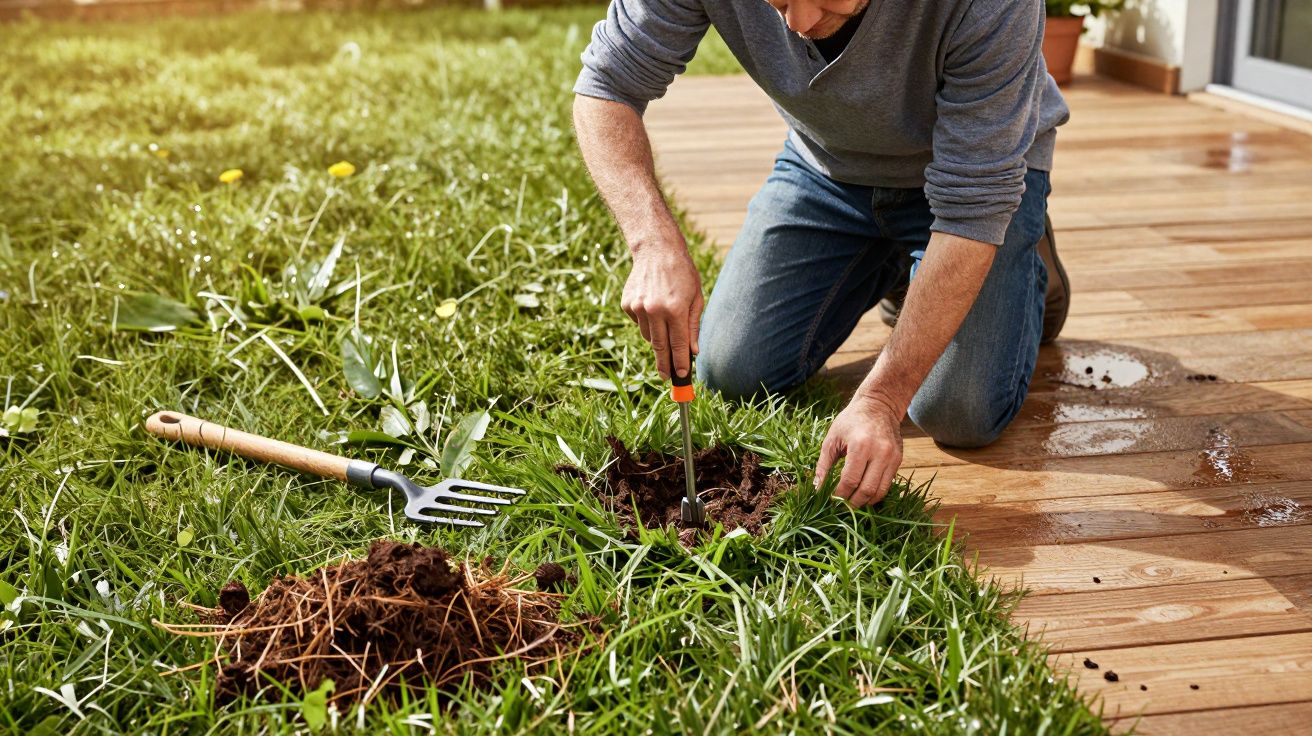
Do the screwdriver test: push a screwdriver (or a thin trowel) into the ground. In healthy soil, it should go in with reasonable resistance. If it fights you immediately, the roots are fighting too.
These are small checks, but they explain a lot. They’re also the kind of checks gardeners do automatically, while owners are still debating whether the grass “just needs a bit of rain”.
What actually helps (and what just makes you feel helpful)
The fix is rarely glamorous. It’s also rarely instant. But it’s straightforward if you match the solution to the problem.
If it’s compaction: aerate, then let the lawn recover
Aeration is the unsexy hero move: making holes so air and water can get down, and roots can grow deeper. You can do it with a fork on small lawns, or hire a hollow-tine aerator for bigger ones.
A workable rhythm looks like this:
- Aerate in autumn or spring (when the grass is growing, not stressed)
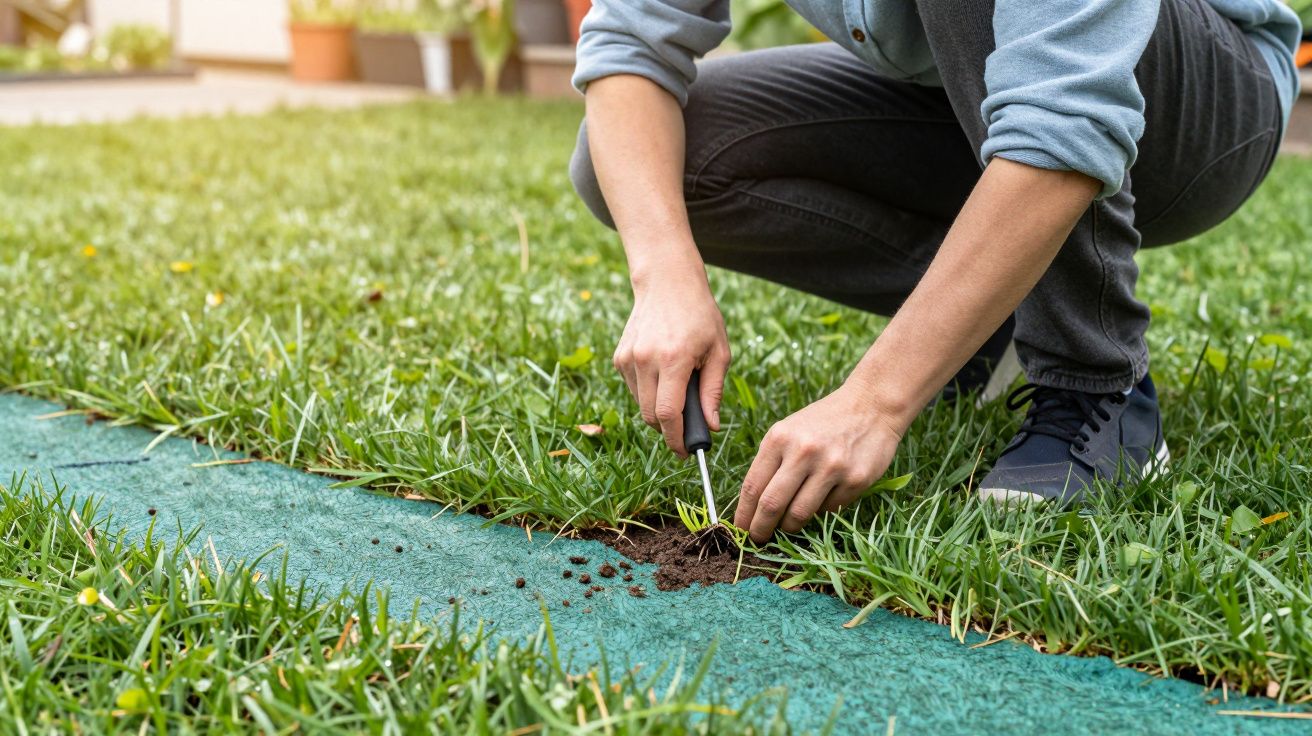
- Brush in a top-dressing (often a sandy mix) to keep those holes open
- Overseed thin areas so the lawn fills in while conditions are kind
It won’t look like a transformation on day one. It looks like you’ve mildly attacked your lawn. Then, weeks later, it starts behaving differently: it drains better, it roots deeper, it copes.
If it’s thatch and moss: scarify, but don’t panic-scarify
A little thatch is normal. A thick layer is trouble. Scarifying (raking out the build-up) can make a lawn look worse before it looks better, which is why owners often avoid it until the lawn forces the issue.
The key is restraint. People go too hard, too late, then blame the method. A gentler approach done at the right time usually wins.
- Scarify when the grass is actively growing (spring/autumn)
- Collect what comes up (it will be more than you expect)
- Overseed afterwards, because you’ve created space and light for new grass
If moss is heavy, look at shade, drainage and compaction first. Moss is rarely the main villain; it’s usually the opportunist.
The “it’ll be fine” habits that quietly make it worse
These are the small routines gardeners clock, because they’ve seen the ending before:
- Mowing too short to “keep it tidy for longer” (it weakens grass and encourages moss)
- Watering little and often (it keeps roots shallow; better to water deeply, less frequently)
- Feeding without fixing structure (lush top growth, weak root system)
- Ignoring autumn leaves (they block light and trap moisture)
None of these destroy a lawn overnight. They just nudge it towards that slow decline where the grass starts losing the competition.
When to call in help (and what to ask for)
There’s a point where DIY stops being efficient. Not because you can’t do it, but because the learning curve is expensive in time, seed, and frustration.
If you’re considering professional gardening support, don’t just ask for “a lawn makeover”. Ask for a diagnosis and a plan. Specifically:
- What’s the likely cause: compaction, thatch, drainage, shade, or disease?
- What’s the timing across the seasons (what to do now vs later)?
- What will improve it most: aeration, scarification, overseeding, top-dressing?
- What mowing height and feeding schedule suits your lawn and use?
A good gardener won’t promise perfection in a week. They’ll talk about soil, roots, and what your lawn is used for - because a family football lawn and a show-lawn are basically different species.
A new way to read your lawn
Most lawns don’t need obsession. They need attention at the right level.
If you take one thing from how gardeners see it, let it be this: the surface is the last place problems show up, and the first place we look. The early signs are subtle on purpose - a slight sponge, a slight puddle, a slight thinning - but they’re the lawn asking for air and space, not just another splash of water.
Once you start noticing those cues, you’ll spot the issue long before it becomes a weekend-consuming rescue mission. And your lawn will stop feeling like a temperamental green rug, and start behaving like a living thing with a simple request: let me breathe.



Comments (0)
No comments yet. Be the first to comment!
Leave a Comment