
You can spend years doing garden maintenance and think you’ve got it sussed-mow, water, weed, repeat. Routine maintenance keeps things ticking over, but it can also hide slow-building problems until they show themselves in a pattern you can’t unsee. The trick is noticing when “normal” stops being normal, before the damage spreads across beds, borders, and even your patio.
It often starts quietly. A few yellow leaves you blame on weather, a bare patch you call “heavy use”, a plant that sulks when you’re sure you did everything right. Then one day you step back and realise it isn’t random at all.
The pattern that should make you pause: repeats in lines, rings, or patches
Most garden issues are messy and uneven. A slug hit looks like a few ragged leaves here and there, and wind damage follows the exposed side of the garden. The pattern that matters is the one that repeats with intent: straight lines, neat arcs, or a cluster that keeps returning in the same footprint.
Common “this isn’t just one-off” shapes include:
- A stripe of greener grass that follows the same route every week
- A ring of mushrooms or a halo of dead turf
- Patchy dieback that mirrors a bed edge, a fence line, or a buried path
- Plants failing in a grid, as if someone measured it
When garden problems draw shapes, they’re usually tracing something you can’t see: water movement, soil compaction, pests working from a base, or something buried under the surface.
What that shape is often pointing to (and why it keeps happening)
A pattern is a map. It’s the garden showing you where conditions are consistently different-wetter, drier, tighter, saltier, more shaded, more disturbed-no matter how tidy your routine looks.
1) Stripes and lanes: compaction and “desire paths”
If the lawn looks tired in a faint track from the back door to the shed, it’s rarely a mowing issue. It’s feet. Compaction squeezes out air, roots stay shallow, and the grass loses resilience even when you feed it.
You can test it without tools. After rain, does that strip stay shiny-wet while the rest drains? In dry spells, does it crisp up first? Both can be compaction-water either sits on top or can’t be held in the root zone.
What helps, without overhauling your life:
- Aerate the lane with a fork (wiggle, don’t lift slabs of soil)
- Top-dress lightly with sharp sand/loam mix in autumn
- Add stepping stones if the route is non-negotiable
- Raise mower height for that section for a few weeks
2) Rings: fungi, old stumps, and buried surprises
A ring in turf-especially with mushrooms-can be classic fairy ring fungus. Sometimes it’s harmless; sometimes it creates a water-repellent band that starves grass while the ring marches outward. Other times, the “ring” is a decomposition halo from an old stump or buried roots: the soil chemistry and moisture are simply different there.
If you’ve moved into a house with an established garden, assume there’s history under your feet. Old builders’ rubble, a forgotten fire pit, a previous tree. Gardens remember.
A practical approach:
- Scarify lightly and spike the ring to improve water entry
- Wet the area slowly and deeply (a quick sprinkle won’t penetrate)
- Avoid overfeeding just the green edge; it can exaggerate the contrast
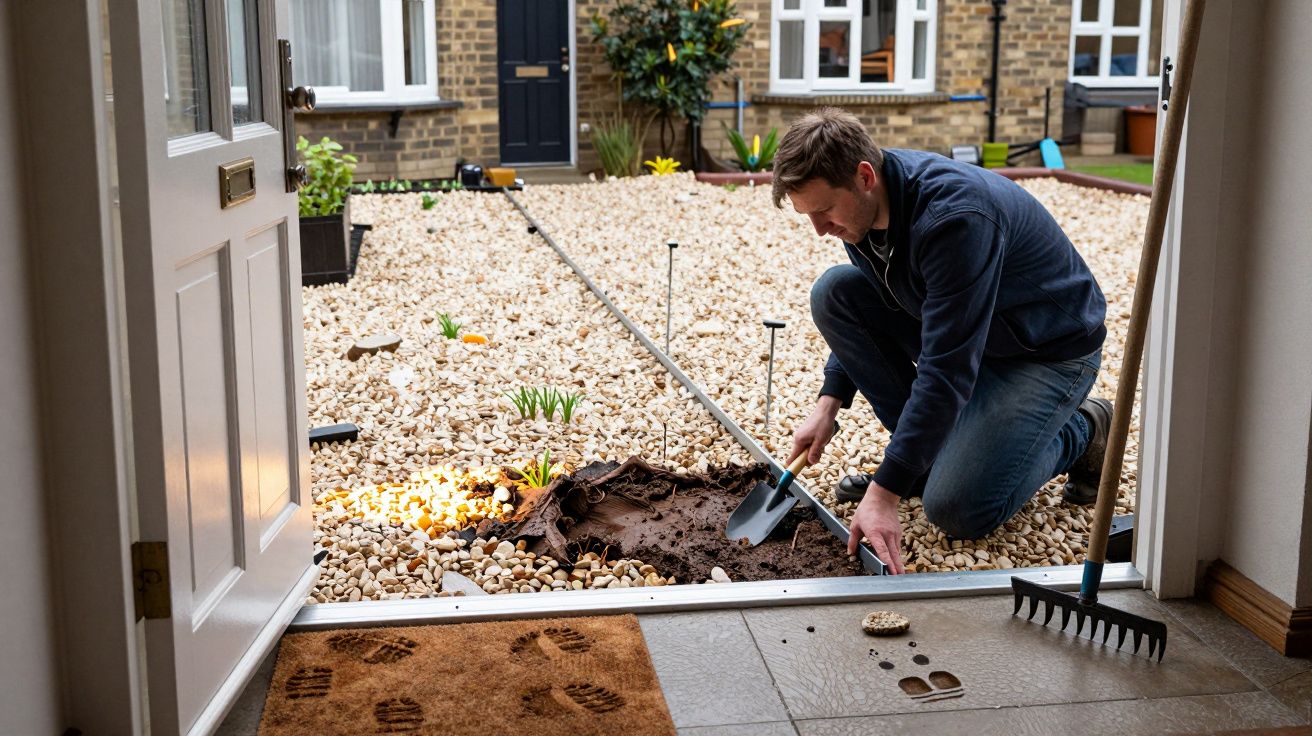
- If it’s returning each year in the same spot, dig a small inspection hole and look for roots, rubble, or a compacted layer
3) Perfect bed-edge dieback: watering habits, not plant weakness
When a border fails in a crisp line-only the front row, or only along the fence-it often reflects how the water is applied. A hose spray that never reaches the back properly. A dripline that’s kinked. A roof overhang that keeps one band dry while the rest gets rain.
We’ve all done it: you water the bit you can see. The garden quietly rewards the same patch and neglects the rest.
Quick checks that catch this fast:
- Water for five minutes, then dig a small hole 10–15cm down in three spots
- Compare moisture along the bed edge vs the centre
- Look for roots hugging the surface (a drought tell) or blackened roots (a waterlogging tell)
The “hidden pocket” of the garden: where the real culprit collects
In the same way a house has one little place grime gathers, gardens have their own. It’s usually at the boundary between two systems: lawn to path, bed to wall, gutter to ground, patio to soil. That’s where water dumps, salts concentrate, heat reflects, and compaction builds.
Look closely at these zones:
- Under the first 30cm of eaves (often drier than you think)
- Along the edge of a patio where runoff carries grit and detergent residue
- Around downpipes and soakaways (feast-or-famine moisture)
- At the base of a fence where wind funnels and rain shadow forms
If your “pattern” sits on one of these lines, it’s rarely about the plant variety. It’s about the conditions you’ve accidentally created.
How to investigate without turning it into a weekend-long project
The goal isn’t to diagnose like a laboratory. It’s to do three small checks that stop you repeating the same fix that never sticks.
- Photograph it from the same spot once a week. Patterns become obvious when you remove daily noise.
- Probe the soil with a screwdriver. If it hits resistance in the same band every time, you’ve found compaction or a hard layer.
- Do a “soak test”. A watering can in one area, then wait 20 minutes and dig a small plug. Wet on top but dusty underneath means water isn’t entering; wet and sour-smelling can mean poor drainage.
If you’re standing there thinking, “But I water, I feed, I weed-why this one shape?” that’s the moment. Routine maintenance isn’t failing; it’s simply not aimed at the real cause.
“The garden always tells you what’s wrong. It just doesn’t send you a text.” - a landscaper’s favourite line, usually said while pointing at a suspiciously straight strip of sad turf
A simple reset that prevents the pattern from coming back
Once you’ve identified the likely driver-compaction, uneven water, drainage, fungal activity-go for one small intervention and repeat it consistently. Gardens respond better to steady correction than dramatic one-off rescues.
A realistic monthly reset for most UK gardens:
- Raise mowing height slightly during stress periods (heat, drought, waterlogging)
- Deep water less often, not a daily sprinkle
- Fork-aerate one problem strip or patch (10 minutes, done)
- Top up mulch in borders to even out moisture swings
It looks almost too basic. Yet this is how you stop a pattern becoming a permanent feature.
| Pattern you see | Likely cause | First thing to try |
|---|---|---|
| Straight strip of weak grass | Compaction/foot traffic | Fork aeration + adjust mowing height |
| Ring of mushrooms or dead turf | Fairy ring/old roots | Spike + deep soak + light scarify |
| Bed-edge dieback in a crisp line | Uneven watering/rain shadow | Soak test + adjust watering coverage |
FAQ:
- How do I tell if it’s compaction or just poor grass? If a screwdriver meets resistance in the same area and the turf dries out faster (or puddles longer), it’s usually compaction rather than “bad grass”.
- Are mushrooms always a sign of a problem? Not always. They can simply mean organic matter is breaking down, but rings paired with dead or greasy-feeling turf often indicate fairy ring activity affecting water movement.
- Should I use a lawn feed to fix patchy patterns? Feed can mask symptoms and sharpen contrasts. Do one diagnosis step first (probe soil, soak test) so you’re not feeding a drainage or compaction problem.
- When is the best time to tackle these issues in the UK? Early autumn and spring are ideal for aeration, overseeding, and top-dressing because the soil is workable and plants recover faster.
- What if the pattern keeps returning no matter what I do? Consider what’s buried or built-in: rubble, old roots, a collapsed soakaway, or a hardpan layer. A small inspection hole often saves months of guesswork.





Comments (0)
No comments yet. Be the first to comment!
Leave a Comment